

Key Takeaway:
SaaS spend management covers every software subscription, contract, and renewal a company pays for, but managing that spend and actually reducing it are two different skills. The gap between them comes down to timing: whether a team acts on real pricing intelligence before a renewal lands, or scrambles to catch up after.
- Tropic's analysis of $21B+ in software spend shows that top 10 vendors command 74.2% of the average organization's software budget, a concentration that has held steady for three consecutive years.
- Renewal timing is the single highest-leverage variable in SaaS spend management: teams that start engagement 6+ months before renewal save 39% on average, compared to 14% for teams that start at 30 days.
- The "AI tax" is real: vendors are pushing renewal price increases of 20–37% on AI-enabled products, but strategic, benchmark-backed negotiation brings that average down to roughly 12%.
- Intelligence, not tracking, is what separates programs that sustain savings from programs that find savings once and then plateau.
Pull up your software spend report and sort by descending contract value. Somewhere around your top 10 vendors, the numbers may drop significantly.
Tropic's analysis of $21B+ in software spend confirms what many procurement leaders suspect but few can quantify: your top 10 vendors command 74.2% of your average software budget. That concentration has held steady for three consecutive years, through a market correction and the most aggressive AI adoption wave the industry has seen.
In pure dollars, spend on those top 10 vendors grew 46% in two years. The long tail got louder and the math got harder. And yet most SaaS spend management programs are built to track renewals and manage tail spend, not to move the needle on the handful of contracts that actually matter.
What separates organizations that manage SaaS spend from organizations that reduce it is acting on market intelligence earlier.
What Is SaaS Spend Management?
SaaS spend management covers everything that happens to a software contract between the day it's signed and the day it either renews or gets cut: who's responsible for it, what it costs, whether it's actually being used, and when the next decision point hits. Most companies already have some version of this in place: a shared folder of contracts, a renewal date sitting in someone's calendar, maybe an intake form for new purchase requests.
What separates a baseline spend management process from spend optimization is what happens with that information. Management tells you a renewal is 45 days out and what you paid last year. Optimization is the decision that follows: rightsizing the license count, consolidating two tools doing the same job, or walking into the renewal with a benchmark instead of accepting the vendor's first number. A program can run flawlessly on the management side, every contract logged, every date tracked, and still overpay on every single one if it can’t identify high savings opportunities and reduce costs.
SaaS pricing has also gotten more complex to manage. Seat tiers, usage-based billing, and now AI feature bundling mean the number on your renewal notice can shift even when your actual usage hasn't, and none of it shows up until the invoice lands. Add auto-renewal as the default and purchasing happening across a dozen departments at once, and it's clear why SaaS spend management earns a discipline of its own.
Where Does Most of Your SaaS Spend Risk Actually Live
The top 10 vendors rule
According to Tropic's analysis of $21B+ in real negotiation data, an organization's top 10 vendors command 74.2% of its average total software spend. That concentration has been remarkably stable: 73.3% in 2023, 71.7% in 2024, and 74.2% in 2025. It's also gotten more expensive in pure dollars: average spend on those top 10 vendors grew from $3.55M in 2023 to $5.21M in 2025, a 46% increase in two years, while the long tail shrank from 28.3% to 25.8% of total budget over the same period.
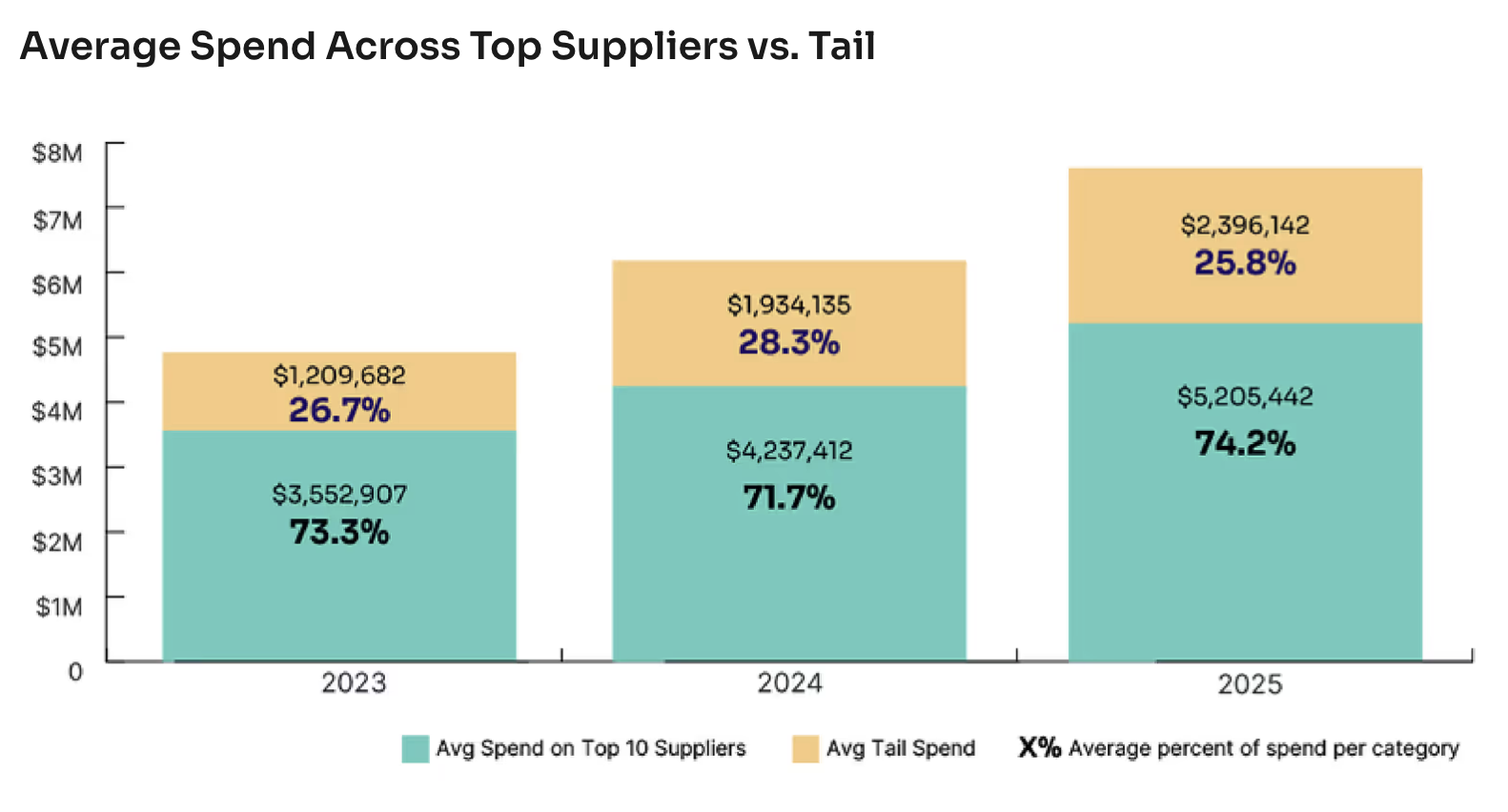
We're in what many are calling the golden age of AI tool adoption, with more vendors and more line items on the books than ever. Yet spend is concentrating, not diversifying. The likely reason for this top 10 vendors rule: the biggest incumbent vendors are capturing AI budget too. Rather than losing wallet share to AI-native challengers, established platforms (think sticky vendors like Microsoft, Salesforce, Google) are embedding AI capabilities into existing contracts and repricing accordingly.
This creates a specific blind spot for businesses. Most procurement and finance workflows treat every renewal roughly the same, with approval thresholds and review cadences built around vendor count rather than dollars. But spend doesn't distribute evenly; it concentrates. A 20% discount on a $300K renewal is worth $60K. The same 20% on a $15K tool is worth $3K. Both take roughly the same calendar time to negotiate but the outcome does not. Learn more about how this concentration shows up in practice in our SaaS budgeting analysis.
Tropic VP of Procurement Michael Shields put it into perspective: “Understand where to focus your attention. Saving 2% on a $1M spend can require lots of effort and lead to minimal results. Saving 40% on a $100K deal might be an easier lift and yield higher results.”
Tier your vendor portfolio by spend, not by headcount
Tier your vendor portfolio by spend, not by headcount. Your top 10 by dollars deserve dedicated ownership, quarterly reviews, and renewal prep that starts months in advance. The next 10-20 warrant structured but lighter-touch renewal management. The rest of your tail spend can run on AI-assisted triage.
Below is an idea of what this structure can look like. It can certainly serve as a foundation for you, but make room to adjust lead time for specific, high priority vendors that need more attention if they do fall outside the top 10 by spend.
How Much Does Renewal Timing Actually Affect Your SaaS Savings
When you start determines what you save
Tropic's renewal data shows a clear, measurable relationship between how far in advance a team engages on a renewal and the savings outcome it achieves.
The 25-point savings difference between starting 6 months out and starting at 30 days isn't primarily about negotiation skill. It's more about leverage. Starting 6 months ahead means your usage audit is already complete, alternatives have been evaluated, and the vendor knows you have time to switch or escalate if the terms aren't right. Starting at 30 days means you're operating on the vendor's timeline, not yours, because the window to run a competitive process or credibly threaten to walk has already closed. Our full guide to negotiating SaaS contracts walks through the specific levers that make that leverage real.
You need a renewal triage system, not a calendar
A renewal calendar alone isn't enough. What teams need is a system that automatically flags which renewals deserve six-month engagement and which can safely auto-renew. Tropic's Renewal Prep Agent does exactly this: it triages your full renewal calendar by urgency, surfacing where you're overpaying, underutilized, or have room to negotiate, and delivers a customized action plan per renewal, so the right contracts get the right level of attention without manual sorting.
How To Negotiate Down the AI Tax on SaaS Renewals
20-37% AI-driven pricing uplifts can be negotiated down to roughly 12%
Based on real-world renewal data from Tropic's customer base, AI-driven pricing uplifts are running 20-37% above historical baselines at renewal, well above the 3-9% annual increases typical of traditional SaaS renewals. Vendors are monetizing new AI capabilities under investor and margin pressure, often framing the repricing as a feature upgrade (versus a price increase). For finance and procurement teams, it functions as something closer to an involuntary AI tax.
AI pricing uplifts tend to be embedded directly in existing contract structures: bundled into product-tier repricing, consumption-based overages, and expanded seat definitions, rather than appearing as a clean, isolated line-item increase. That makes it harder to spot on an invoice. Teams without line-item visibility often don't realize the AI tax has landed until well after the contract is signed.
The good news is that the AI tax is negotiable. Tropic's data shows that strategic, benchmark-backed negotiation typically brings the initial vendor ask down substantially, with final uplifts landing around 12% on average, well below where the conversation started.
How to manage AI costs
Three things matter before any AI-enabled renewal conversation:
- A line-item breakdown of which features you actually use versus which are simply bundled into the AI tier
- A reliable benchmark on what comparable companies are paying for the same tier
- A negotiation anchor built on your own usage data rather than the vendor's list price
A 12% average outcome is achievable, but typically only with preparation that starts 90-plus days before the renewal date and specific contract protections and guardrails that keep AI costs contained.
Why SaaS Spend Tracking Alone Doesn’t Reduce Costs
Visibility tells you there's a problem. Intelligence tells you what to do about it, and whether the outcome you got was actually good. A spend analytics dashboard showing weak license utilization tells you something is wrong. But it doesn't tell you which of your vendors have the worst utilization, which renewals hit in the next 90 days, what comparable companies paid last quarter, or whether your usage data is strong enough to support a consolidation ask. This is where SaaS management software fits in, surfacing overlapping tools and underused licenses that tracking alone won't flag.
Tropic's market intelligence, drawn from $21B+ in live negotiations conducted by category-specialized experts and analyzed by AI in real time, is available on day one. It doesn't require months of internal data accumulation to generate a useful benchmark, because it reflects what actually closed in the market last quarter, not what vendors advertise.
How to Build a SaaS Spend Management Program That Reduces Costs
Step 1: Build your spend inventory, sorted by dollar concentration
Pull every software contract into a single normalized list: vendor, annual spend, renewal date, internal owner, and usage status. Sort by total contract value, descending. What you see above row ten is where roughly 74% of your budget lives; that's your Tier 1, and it deserves dedicated management and early renewal engagement regardless of relationship history. Most teams sort this list alphabetically or by department instead. Sort by dollars: it changes which vendors you prioritize immediately. SaaS management software can help surface that usage status automatically instead of chasing it down manually. See more on this as you increase spend visibility.
Step 2: Set renewal lead times based on what the data shows
For every Tier 1 vendor, set a 6-month renewal prep trigger, not a 30-day reminder. The savings difference between starting at 6 months (39% average) and starting at 30 days (14%) is 25 percentage points. On a $300K contract, that gap is $75K. Across your top 10 vendors, it compounds significantly. For Tier 2 vendors, use a 90-day trigger; for tail spend, a 60-day alert with AI-assisted triage to decide whether a renewal warrants active negotiation or can lightly review with confidence.
Step 3: Benchmark before every renewal conversation
Pricing benchmarks should be in hand before the first vendor conversation, not assembled in response to a quote. The vendor already knows what comparable companies paid last quarter; you should too. This matters even more for AI-enabled products, where the gap between an unprepared renewal (20–37% uplift) and a benchmark-anchored one (~12%) is now the widest it's ever been.
This is also where the process breaks down for most teams: benchmarking takes time they don't have when quotes are landing daily across dozens of active requests. Tropic's Proposal Review Agent removes that bottleneck. The moment a vendor quote arrives, it instantly benchmarks the price, rates how difficult the negotiation is likely to be, and delivers a personalized action plan, so a new proposal gets the same benchmark-first treatment as a scheduled renewal, without someone having to manually pull comparables first. The source of your benchmark matters as much as having one: data from crowdsourced self-reports reflects what buyers say they paid; data from active, expert-led negotiations reflects what actually closed.
Step 4: Make savings attributable from day one, not reconstructed at year-end
Programs that survive budget cycles are the ones that can show ROI in numbers leadership cares about: dollars saved, per contract, tied to a specific action. If procurement is rebuilding savings reports from email threads and PDF contracts at year-end, the program will always look reactive to finance, even when it isn't. Build attribution into the process itself: every negotiation outcome, benchmark action, and contract change should generate an automatic savings record. That record is what earns budget for the next cycle.
What This Looks Like in Practice
quip: from auto-renewal blind spot to $378K saved
In our work with quip, the path from reactive to proactive started with one artifact: a complete spend inventory with renewal dates and owners attached. Before that, contracts lived as PDFs in a static folder, and quip auto-renewed tools without knowing it, in one case paying full price for a shrinking license count simply because no one saw the renewal coming. From that single inventory, quip applied benchmark data at the point of negotiation, including a 29% reduction on its Stripe renewal specifically, cut purchase cycle time to under two months, and saved more than $378K over 18 months while freeing up roughly 20 hours a month previously spent chasing contract details. Every lever was at their disposal once the inventory existed.
Metronome: a process in eight weeks, not quarters
The timeline compresses even further for teams starting from less structure, not more. Metronome, a usage-based billing platform, had 15 new vendor deals land on its head of finance's desk in his first six weeks on the job, with no formal process to route them. Within eight weeks of implementing Tropic, every purchase flowed through a single system with built-in compliance checks, and the company had already saved 19% on software spend in its first two months while cutting roughly 2 hours a week of manual admin work.
Reducing Spend vs. Reporting On It
The teams that reduce SaaS spend are the ones that have the right intelligence – and act on it earlier. Tropic's data defines what "right" and "earlier" actually mean in practice. Tropic makes that intelligence available on day one, lets agents act on it (by recommending next steps for you), and keeps category-specialized experts on call for the negotiations that warrant human support.
Watch a 5-minute demo to understand what intelligence-driven SaaS spend management could look like for your business and see different procurement agents at work.
FAQ: SaaS Spend Management
What is SaaS spend management?
SaaS spend management is the ongoing work of knowing what software you're paying for, whether it's being used, and when your next renewal decision comes due. On its own, that visibility doesn't lower costs. Teams that actually reduce spend pair it with pricing intelligence and act before the renewal lands, not after.
What percentage of SaaS spend is wasted?
Tropic customers recover an additional 15-20% of SaaS spend by eliminating unused licenses and duplicate tools, on top of the 21% average reduction in vendor costs achieved through negotiation. That waste tends to hide in plain sight: seats left over after headcount changes, tools multiple teams are paying for separately, and free trials that quietly converted to paid.
When should you start negotiating a SaaS renewal?
Tropic's renewal data shows a clear savings curve: starting 6+ months before renewal yields 39% average savings; starting at 60 days yields 22%; starting at 30 days yields 14%. The gap comes down to leverage – earlier engagement means more time to audit usage, evaluate alternatives, and negotiate from a position of strength.
How does AI affect SaaS pricing in 2026?
Vendors are bundling AI features into existing product tiers and raising renewal prices 20-37% above historical baselines – what Tropic's team calls the AI tax. That tax is negotiable: Tropic's renewal data shows strategic negotiation brings average AI-driven uplifts down from the 20–37% range to approximately 12%.
What is the difference between SaaS spend management and SaaS spend optimization?
SaaS spend management is the operating discipline: governance, tracking, renewal processes, procurement workflows, and visibility. SaaS spend optimization is a subset focused specifically on reducing costs – rightsizing licenses, consolidating tools, and renegotiating contracts. Management is the system; optimization is the outcome.
How many SaaS vendors should a company actively manage?
Tropic's analysis of $21B+ in software spend shows that the top 10 vendors command 74.2% of average SaaS budgets – a concentration that has held for three consecutive years. The implication: active management should be concentrated in your top 10–20 vendor relationships, with AI-assisted triage handling the tail.
How do I prove the ROI of SaaS spend management to leadership?
ROI proof requires savings attribution – every dollar saved linked to a specific contract action. Tropic's Savings Tracker automatically captures savings from benchmarks, negotiations, and contract actions without manual entry, generating board-ready reporting. Tropic customers have delivered $425M+ in cumulative savings this way.
What tools help with SaaS spend management?
Tools in this category range from visibility-first platforms that centralize usage and discovery data, to intelligence-first solutions like Tropic that combine spend visibility with pricing benchmarks from real negotiations, renewal triage agents, and expert negotiation support. SaaS management software specifically focused on usage and overlap detection is worth layering in if license waste and shadow IT are your primary concern. The right choice depends on whether your primary problem is tracking spend or reducing it.

Related blogs





Drive savings and efficiency at any stage
Discover why hundreds of companies choose Tropic to gain visibility and control of their spend.