

AI-driven software price increases of 20-37% are forcing CFOs to consolidate software stacks as budgets cannot match vendor AI premiums lacking measurable ROI. Consolidation addresses widespread redundancies, uneven tool utilization, and difficult-to-quantify AI value. CFOs should require business owners to provide utilization rates, productivity gains, and competitive alternatives before approving uplifts above 10%. Effective consolidation requires starting renewal evaluations three to nine months early - not 30 days before opt-out - to create negotiation leverage without deadline pressure.
For the past decade, every function - from HR to sales to IT - adopted software at blistering pace. What started as point solutions became the business itself.
SaaS spending grew explosively as businesses digitized workflows and went cloud-native. Enterprise software spend accounts for a growing share of total IT budgets - measured in the hundreds of billions annually.
That boom made us faster, more agile, better connected. But it also introduced complexity, sprawl, and redundancy that most finance teams learned to absorb as the cost of doing business.
AI's arrival adds another layer to all of this - and honestly, CFOs cannot let its entry be another form of cost of doing business. The math doesn't math.
AI Is The Force Multiplier For Portfolio Pressure
AI is a force multiplier embedded in nearly every tool we buy right now, and it's reshaping the economics of those tools faster than most organizations can plan for.
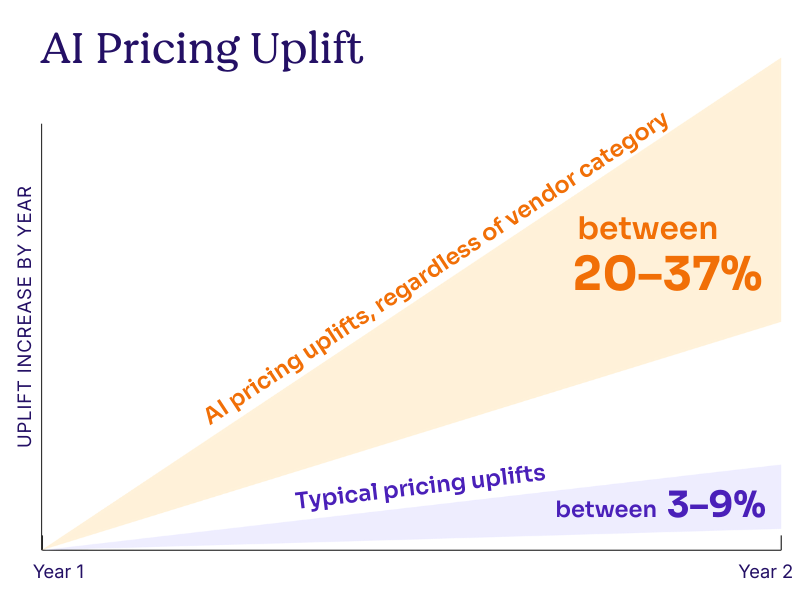
Two things can be true: software renewal negotiations are difficult given how fiscal calendars and metrics vary across vendors, yet these negotiations tend to follow somewhat predictable patterns at a high level. You benchmark pricing, time your engagement strategically, negotiate concessions. The uplifts were small enough - 3% here, 5% there - that finance teams could absorb them without broader portfolio conversations.
Today, vendors are justifying double-digit price increases - 15%, 20%, even 30% - by pointing to AI functionality that often isn't translating into clear ROI yet.
Analysis of AI-driven software renewals across Tropic customers shows AI pricing uplifts consistently landing between 20-37%, with vendors leveraging four distinct tactics: forced SKU migrations, unbundling-then-rebundling, credit-based obfuscation, and conditional discounts that make AI adoption feel mandatory rather than optional.
This AI Tax clashes with the reality of our budgets. CFOs are not sitting there saying, "It's budget season - everyone just add 25% to your software stack."
When price increases move beyond what finance teams can casually absorb, they branch beyond line-item discussions and become software portfolio management questions. Consolidation becomes unavoidable.
- Does this tool still earn its place at this price?
- Where is overlap or redundancy across the stack?
- Which tools are strategic versus "nice to have"?
Eventually, CFOs will reach a breaking point (if they haven't already) and say something along the lines of, "All of you can't be asking for this uplift. One of you has to go."
People tend to forget that budgets don't expand every time a vendor introduces an AI premium - no matter how compelling the pitch sounds.
Three Harsh Truths Driving Software Stack Consolidation
I've spoken with CFOs across industries who are looking at their software stacks and recognizing the same pattern. Three realities keep surfacing:
- Redundancies are everywhere: Departments adopt tools independently, often without centralized coordination. When pricing was more stable/predictable than it is now, this decentralization was somewhat manageable. With AI premiums layered on top, it's untenable. Two teams paying separately for overlapping capabilities made sense at $50/user/month. At $75/user/month with forced AI bundles, it's waste.
- Usage is uneven (and now visible): Some tools drive measurable value. Others are nice, but not essential. When costs rise 20-30%, those differences matter more than finance and procurement teams ever had to acknowledge. Utilization data is now the basis for software renewal strategy decisions.
- AI value remains hard to measure: Even when AI adoption is high, tying those features to concrete business outcomes is difficult across most categories. Teams experiment, iterate, and get value - but when asked to quantify productivity gains or cost savings, the answers get fuzzy.
Part of the measurement challenge stems from how AI is being priced. Majority of vendors have leaned on consumption-based pricing built on credits, agents, or outcomes. When finance teams can't clearly explain what a credit represents, how consumption gets metered, or why usage varies across similar behaviors, they're effectively budgeting without a unit of measure. That opacity makes it nearly impossible to forecast costs or measure AI ROI with any precision.
That fuzziness is a problem because vendors demand premium pricing for AI capabilities that finance can't validate. Taken together, these realities turn AI pricing pressure into a catalyst for software consolidation. It’s unavoidable at this point.
Instead of renewing every tool at whatever price vendors demand, finance and procurement teams must ask harder questions:
- Does this overlap with something we already pay for?
- Are we paying for AI capabilities that never get adopted?
- Could we consolidate without hurting productivity?
What Software Stack Consolidation Actually Looks Like
A consolidated stack isn't about having fewer tools, but it's about having better clarity on what each tool delivers and what it costs to deliver it.
Vendor consolidation is all about making informed decisions based on total cost of ownership, measurable value, and realistic budget constraints.
Here's what this discipline looks like in practice:
Elevate Strategic Value Over Feature Buzz
AI can be genuinely transformative in specific use cases:
- Tools that reduce process cycle times by 40%+
- AI systems integrated into core workflows that employees use daily
- Analytics engines that surface insights no other system can provide
These are tools worth defending - even when price increases are significant. The ROI is clear, the adoption is proven, the business impact is measurable.
But other categories are murkier. Tools with overlapping capabilities, AI features with low adoption rates, or platforms that require extensive change management to realize value become easier targets for rationalization when budgets tighten.
The question becomes: "Does this AI deliver value we can measure and defend?"
Bring CFO Discipline Into Renewals Earlier
Instead of treating renewals as operational tasks handled 30-something days before opt-out, the most effective finance teams are building renewal cycles into strategic planning three-to-six-to nine months ahead.
This shift helps answer critical questions before pricing conversations start:
- What's the expected value of this tool over the next year?
- How does it tie to measurable business outcomes?
- Can usage be optimized before committing to higher spend?
- Are there competitive alternatives worth evaluating?
This is how you discipline a budget when pricing pressure meets economic uncertainty.
When we review our software stack at Tropic, we don't wait for renewal notices to arrive. We track every significant contract, monitor utilization quarterly, and flag tools for evaluation well before they're up for renewal. That advance visibility creates negotiation leverage and decision-making space that disappears when you're reacting to a 30-day opt-out deadline.
Create Competitive Tension Where Alternatives Exist
AI pricing pressure often unlocks great competitive evaluation.
- Are there AI-native challengers delivering better ROI at lower cost?
- Can we consolidate overlapping tools across departments?
- Is there a central platform that replaces multiple point solutions?
In many cases, the answer is yes - and the competitive dynamic itself becomes the strongest negotiation leverage with incumbent vendors.
I've seen this play out: A vendor proposes a 25% AI uplift. Finance evaluates alternatives and discovers an AI-native competitor offering comparable functionality at 40% below the renewed price. Suddenly, the incumbent finds flexibility they claimed didn't exist.
What CFOs Should Do Right Now
Too many tools. Too many vendors. Inconsistent measurement of value. Pricing models that outpace planning processes. Don’t blame AI. It’s really a maturity gap in managing your software portfolio before AI and got accelerated by it.
AI raises both expectations and costs faster than organizations have traditionally adapted their governance. Like I mentioned earlier, when you could absorb 5% annual increases across your stack, governance could be a little looser (it shouldn’t be, but that was the cost of doing business). When increases jump to 20-30%, governance becomes non-negotiable.
CFOs need to keep pushing for clarity about what AI delivers, how it gets adopted, and how value gets measured - before approving premium pricing.
As someone responsible for aligning spend with business outcomes, here's how I approach the mandate:
1. Treat AI pricing as a portfolio stress test (not a budget footnote)
Every significant price increase is an invitation to reassess whether a tool earns its place at the new price point. Don't approve uplifts just because "we've always used this vendor." Use renewal pressure to force value conversations that should have happened anyway.
2. Demand ROI narratives supported by usage data
Before approving any AI-driven price increase above 10%, require the business owner to provide:
- Current utilization rates (not just seats purchased, but active usage)
- Specific productivity gains or cost savings from AI features
- Adoption timeline showing how usage has grown since AI features launched
- Competitive alternatives evaluated with comparable pricing
If stakeholders can't provide this data, the answer is "not yet" - not "yes."
The challenge is that traditional metrics often miss where AI value actually lands. In many cases, productivity gains get captured by individual employees rather than redeployed as business capacity. An account executive using AI tools might hit quota in 75% of the time it took before - but that extra 25% often goes to improved work-life balance, not additional pipeline generation. Without instrumentation to track this, CFOs are asked to absorb material cost increases without clear organizational returns.
3. Build cross-functional accountability for software spend
Finance shouldn't drive consolidation alone. This requires alignment between procurement, IT, and business unit leaders on shared definitions of value and usage expectations.
At Tropic, we run quarterly - sometimes monthly - spend reviews where finance, procurement, and department heads evaluate our stack together. We look at utilization data, upcoming renewals, and emerging needs. This creates shared ownership of spend decisions rather than making finance the bottleneck or bad actor.
4. Recognize that consolidation is a discipline, not a one-time cost cut
Simplifying a software stack improves negotiation leverage, reduces redundancy, and makes it easier to measure value. But it's not a project you complete and move on from - it's an ongoing practice.
Every new tool request should trigger questions about consolidation opportunities. Every renewal should include evaluation of alternatives. Every quarter should include utilization reviews that surface waste. Recognize a theme here? You have to be intentional.
Scrutiny Leads to Clarity
As much as AI has changed software pricing, it has done something equally profound: it has forced clarity.
The AI Tax shows up as higher uplifts at renewal and the unpredictable consumption that underlines its credit-based pricing models. But its real impact runs deeper. It forces finance teams to answer uncomfortable questions about value, prioritization, and strategic investment that got deferred during the SaaS expansion era.
That scrutiny is uncomfortable. But it's also healthy.
Finance and procurement teams will need to treat AI pricing pressure as a forcing function for better portfolio discipline. Until we get serious about clarity, the math won't math - and the math doesn't have to be perfect, by the way. It just has to get you better clarity than you had yesterday. That’s a step in the right direction.

Related blogs




%20(1).png)
.png)
Drive savings and efficiency at any stage
Discover why hundreds of companies choose Tropic to gain visibility and control of their spend.