

CFOs use Tropic's capabilities to simultaneously cut costs and approve AI investments faster: tiered prioritization ranking renewals by savings opportunity using $18 billion spend intelligence across 30,000+ suppliers, automated compliance checks flagging contract risks against customized standards, pulse surveys distinguishing low adoption from low product value comparing internal scores against network averages, request highlights providing two-minute flash briefings enabling between-meeting approvals, AI invoice match catching 15-20% billing errors by comparing invoices against contract terms, and data reports providing board-ready visibility into spending allocation, savings achievement, and risk management across the entire software portfolio.
Your tech stack has exploded. Everyone is buying AI tools like they're going out of style. And your board is pouring gasoline - handing you two completely contradictory mandates at the same time: cut costs and invest more in AI.
We call this the SaaSpocalypse. And it's the environment all of us are operating in today.
To weather these waves, I obviously drink our own champagne here at Tropic. Yes, the platform serves as a way to save money on software purchases and AI tooling. We do that and we’re the best at it. But I consider that table stakes.
What I get from using Tropic every day in my workflow as a CFO is something harder to articulate and equally as valuable: a repeatable, scalable process that lets me say yes to the right AI investments and cut costs and bloat everywhere else. That's what I want to walk you through:
- Tiered Prioritization: How I Know Which Renewals Not to Focus On
- Compliance Checks: How I Keep Our Risk Exposure in Check
- Pulse Surveys: How I Know Which Tools Are Low ROI (And What To Do About It)
- Request Highlights: How I Can Approve a New AI Tool Between Meetings
- Invoice Match: How I Catch Errors Faster Than You Can Compare Them Manually
- Data Reports: How I Tell the Board What They Actually Want to Hear
1. Tiered Prioritization: How I Know Which Renewals Not to Focus On
When I open Tropic, the first thing I look at is what's expiring.
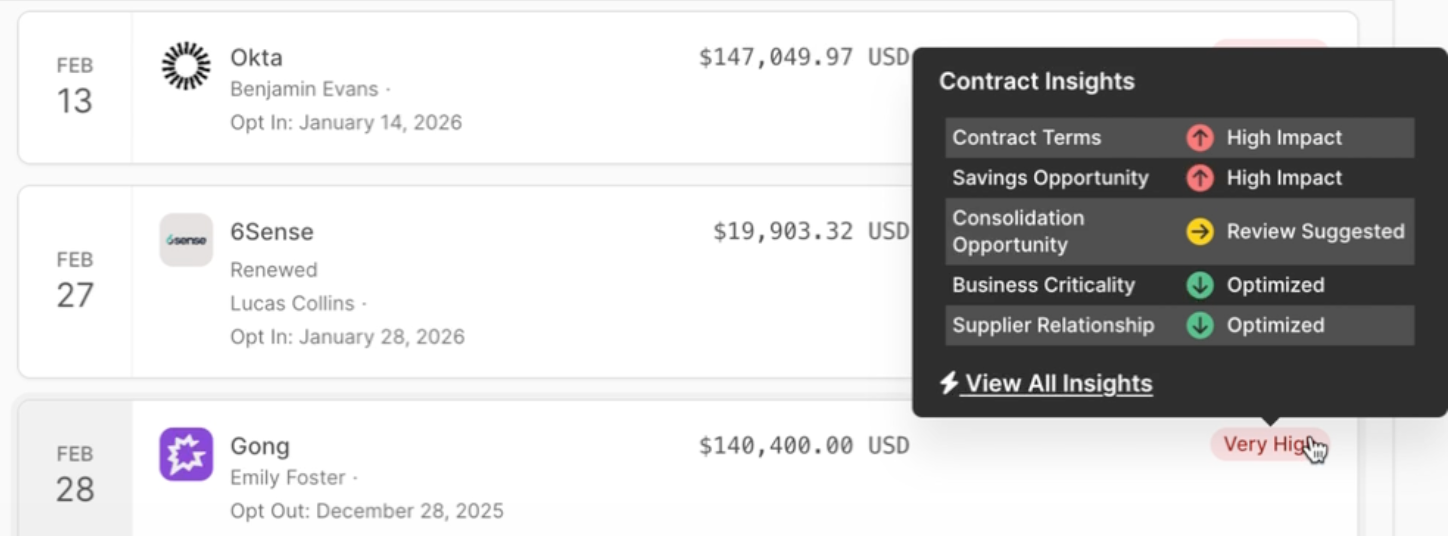
The home page dashboard shows me contracts coming up for review, and they're ranked by priority - high, medium, low. That prioritization alone is worth something, because knowing where not to focus is just as valuable as knowing where to focus. If something is flagged low, I'm not spending mental energy there today.
For the high-priority renewals, I can immediately pull up rich insights across categories like contract term, savings opportunity, consolidation opportunity, and more.
I click into a supplier and within seconds I'm looking at negotiation recommendations, market pricing insights, and a price benchmark section by the SKU that shows me exactly why there's a savings opportunity - not just that one exists. I can drill into a detailed comparison against what others in Tropic's network are actually paying for the same tool.
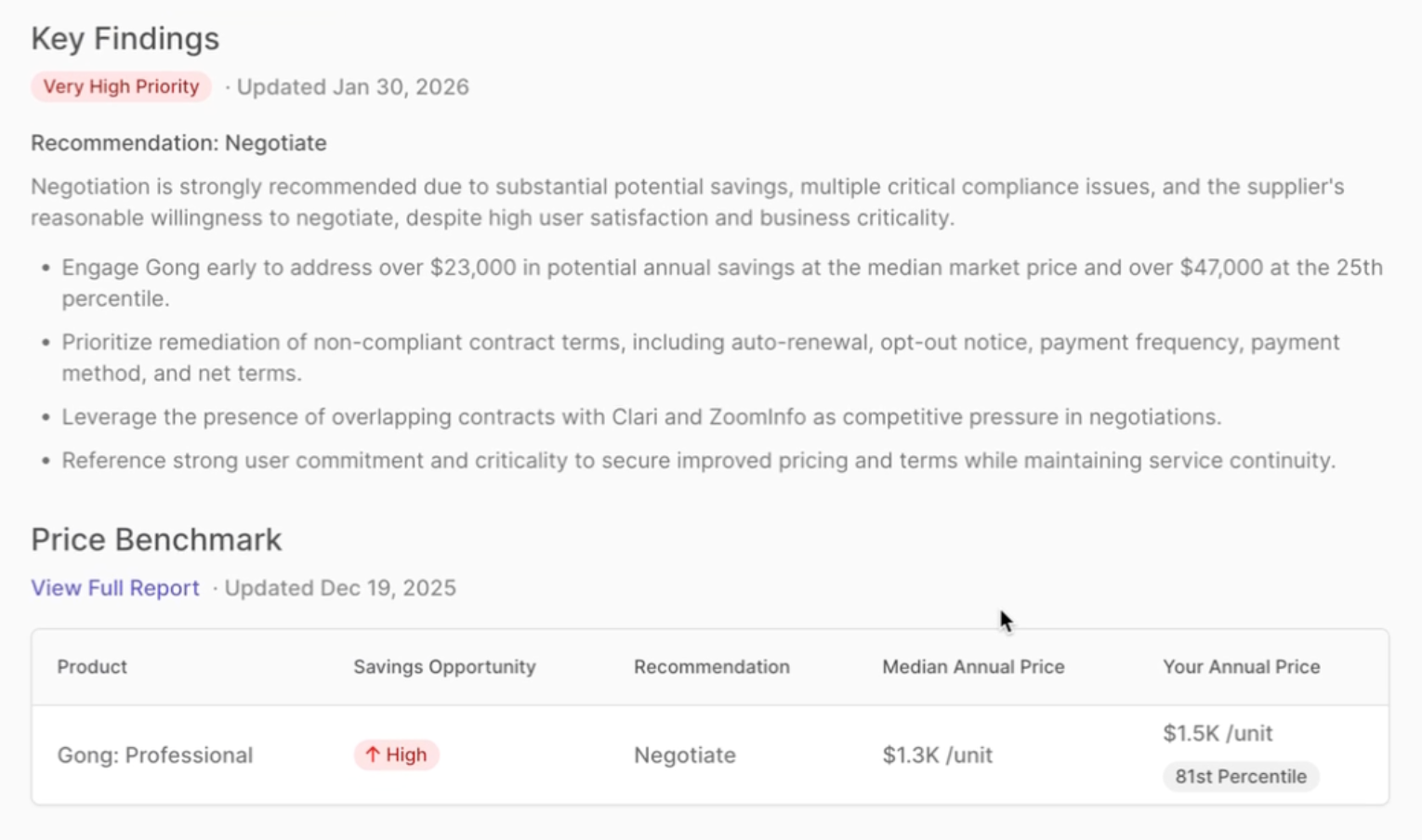
That network matters. Tropic is powered by over $18B in software spend intelligence, across 30,000+ suppliers. When the platform tells me I'm overpaying, it's not an estimate. It's grounded in real negotiation data from real contracts and actual experts negotiating with suppliers who know how they actually behave when it’s time to sign.
The practical output of this every morning: I know exactly which renewal conversations deserve my time this week and which ones don't. For a CFO managing a full calendar of renewals, that triage is the job.
2. Compliance Checks: How I Keep Our Risk Exposure in Check
Here's something I want to be direct about, because I've seen it happen to smart people.
Last quarter, one of our portfolio companies was moving fast to sign a new AI tool. Everyone's doing that right now. And they nearly signed an agreement with a provision that would have exposed them significantly on the data side. Smart people, moving fast, simply missed it in the legal language.
That story isn't unusual. When you're reviewing dozens - or hundreds - of agreements in a year, things fall through the cracks. And with the current AI buying frenzy, the volume of agreements is accelerating while the attention available per agreement is shrinking. That's a risk exposure problem that compounds quietly until it doesn't.
The compliance check feature in Tropic automates this. It has taken our own company's defined compliance standards and runs every supplier agreement through those checks automatically, flagging anything that's out of line. We’ve customized the standards to match our specific requirements - data privacy, security provisions, liability terms, (whatever matters most to your organization).
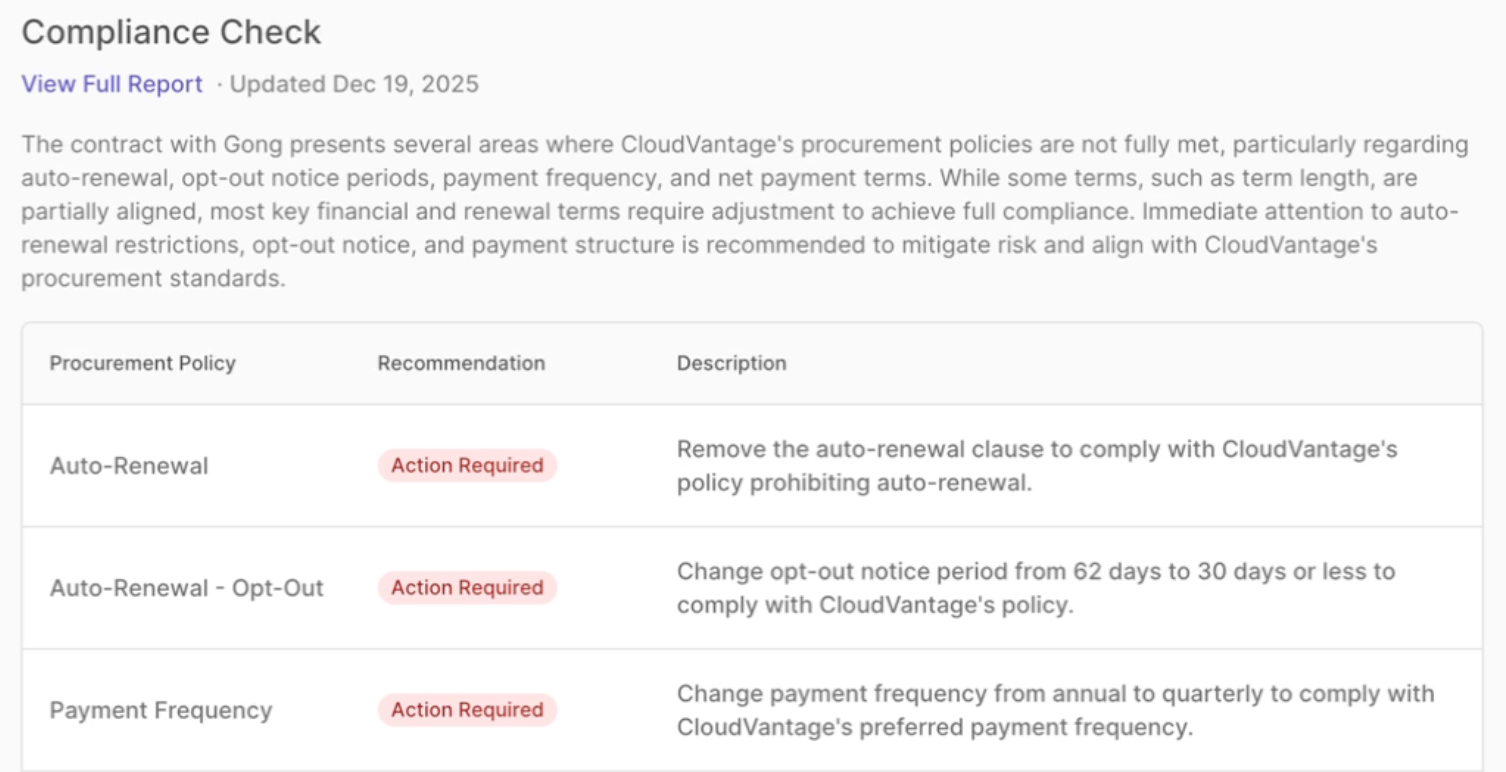
Think about what that's worth in real terms. If this saves you an hour or two per agreement, and you're managing dozens of renewals annually, you're reclaiming hundreds of hours for your team. More importantly, you're closing a risk exposure that could cost you millions - not because anyone was careless, but because volume and speed are the enemy of careful review.
I'm not saying your legal team is asleep. I'm saying no human process scales the way AI-powered compliance review does. And in the chaotic environment we’re dealing with this year, CFOs need something that can scale.
3. Pulse Surveys: How I Know Which Tools Are Low ROI (And What To Do About It)
There are renewals happening at your company right now that are on autopilot.
Nobody looked at the utilization data. Nobody asked the team if they're still using the tool. Nobody wanted to be the person who raised their hand and said "actually, I'm not sure this is working" - probably because that person championed the tool in the first place. So the renewal processes quietly, the invoice gets paid, and the cycle continues.
I call these zombie renewals. They're not dramatic failures. They're the slow drain that compounds over years into meaningful budget waste, and they're almost impossible to catch without the right data.
The Pulse Survey in Tropic is specifically designed to interrupt this pattern. I use it to quickly capture feedback from my team on upcoming renewals across multiple dimensions and compare our scores against the Tropic network average. And the part that actually changes the conversation is that it tells me whether a low score is:
- An adoption problem (your team isn't using the tool correctly)
- Or a product problem (the tool genuinely isn't delivering value)
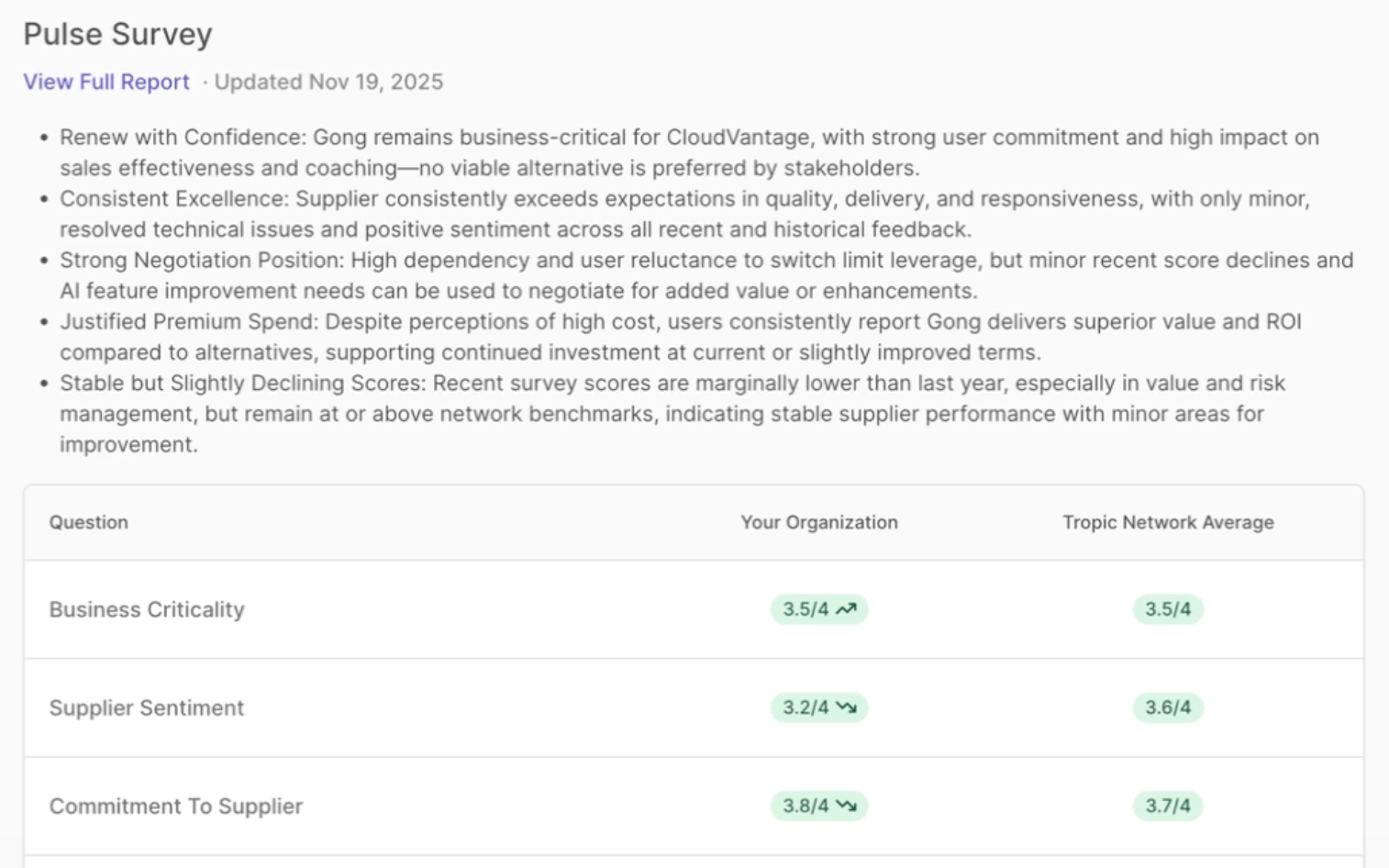
Those are completely different situations with completely different solutions. If it's adoption, we should invest in better training and change management. If it's the product, we should evaluate alternatives. Pulse Surveys tells me which one problem I’m dealing with instead of me having to guess.
Let’s also say both our company and the network are scoring low on the same tool (which has happened numerous times). Alternative suppliers are surfaced right to me on the platform. The old way of doing that analysis - pulling competitor research, evaluating alternatives, talking to your team - would take hours or days.
The 360-degree view this creates completely changes what I'm reviewing at renewal time. It's not just "did we save money on this contract." It's "are we avoiding risk, are people actually using this, should we consolidate it?" That's a fundamentally different and more actionable conversation.
4. Request Highlights: How I Can Approve a New AI Tool Between Meetings
This scenario happens multiple times a month for me right now, and I suspect it does for you too.
Someone needs approval on a new tool purchase. I'm in back-to-back meetings. I don't have time to read through every Slack thread, find the original request, dig up the pricing discussion, and verify the compliance status. But I also can't afford to just rubber-stamp something without context - not in this environment, where every AI tool decision compounds.
This is where I tap into Request Highlights.
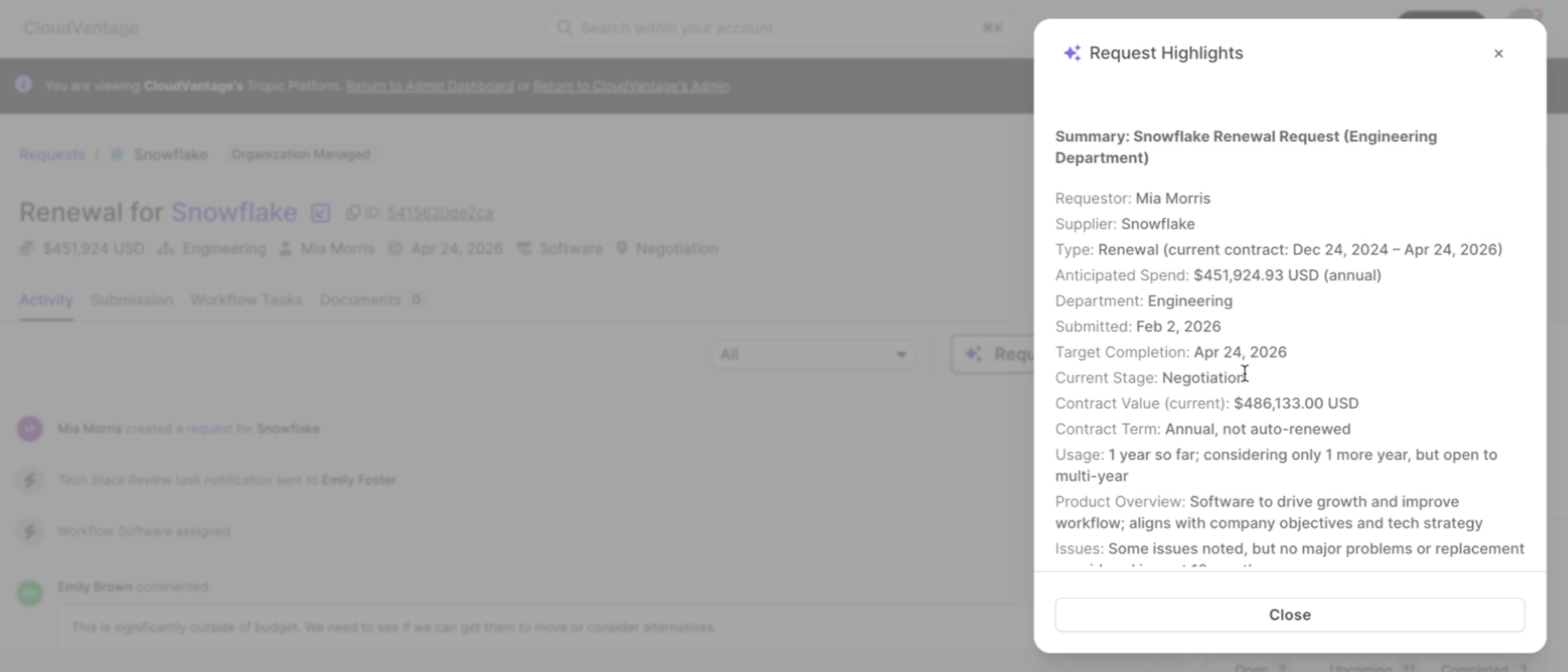
When I click into a purchase request, instead of reading through the full history, I hit Request Highlights. I’m given a flash briefing of sorts in one view under two minutes - the business justification, the negotiation process, the pricing comparison, and the compliance status.
Last week I approved a new AI tool between meetings using exactly this. I had the full context I needed virtually, instantly. No need to ping the requester, dig through emails threads, or hoping I didn’t miss something important.
The reason this matters isn't just for efficiency sake, although it is genuinely a significant time saver. That speed without context is how you get burned. A finance leader who approves everything quickly isn't doing their job. Neither is one who becomes the bottleneck because they can't process information fast enough. Request Highlights solves both problems at the same time, and I rely on it constantly.
5. Invoice Match: How I Catch Errors Faster Than You Can Compare Them Manually
I think any CFO can attest: invoice discrepancies are a nuisance.
I've personally caught invoices that were 15 to 20% higher than our agreed upon contract terms. And I want to be clear - this typically isn't something malicious. It's clerical errors. Billing systems that didn't get updated when a discount was negotiated. Line items that got carried over from a previous contract term. Honest mistakes that are completely understandable given how complex vendor billing can be.
The thing is, if those invoices slip through, you're paying for them.
The old process for catching this was manual: find the contract, find the terms, find the invoice, compare them line by line, and hope you caught the discrepancy before the payment processed. On a lean finance team managing hundreds of vendor relationships, that process doesn't scale. Things slip through every time.
With our contact metadata captured in Tropic automatically, the platform knows what each supplier should be billing you based on your agreed terms, and it flags discrepancies the moment an invoice comes in through AI Invoice Match. And when I click into a flagged invoice, I can see the scan of the invoice itself alongside exactly what the contract says with the specific areas of difference highlighted.
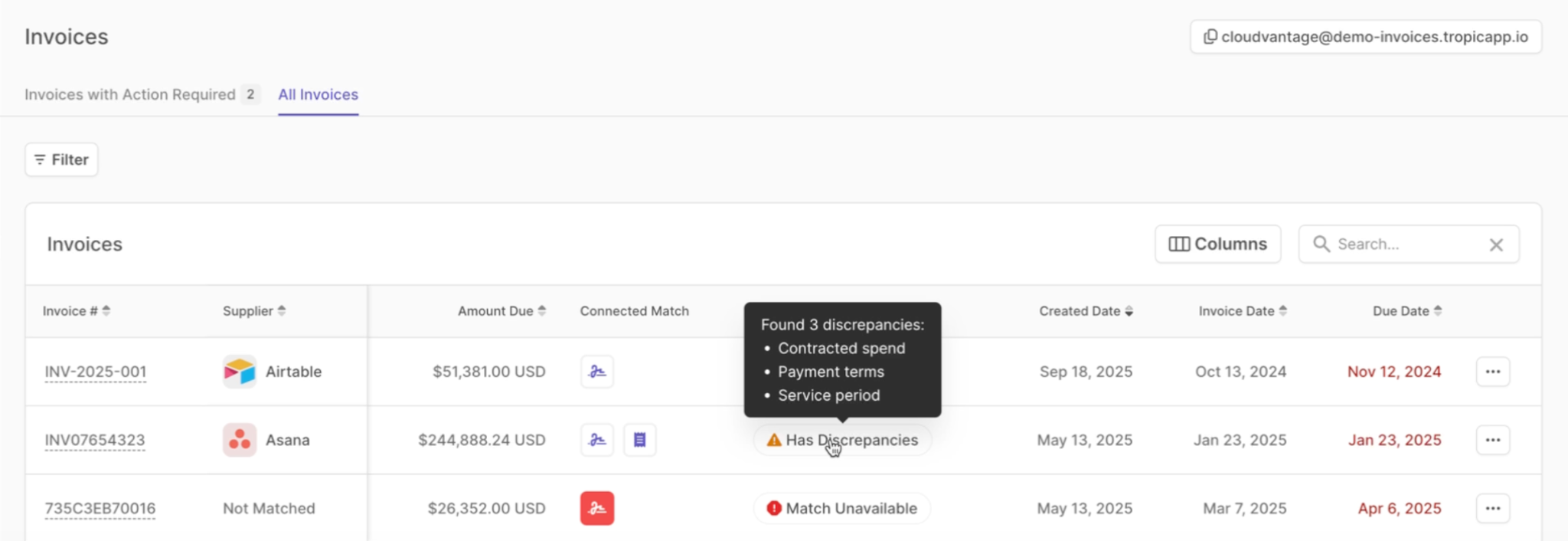
This is how I think about the impact: every dollar recovered from an invoice error is real money. And in the current environment, where you're being asked to simultaneously cut costs and fund new AI investments, that money can get reallocated to the initiatives that matter.
6. Data Reports: How I Tell the Board What They Actually Want to Hear
So everything I've described so far - the renewal prioritization, the compliance checks, the zombie renewal data, the invoice variance - it all feeds into the conversation I have to have regularly with our board and investors.
That conversation is harder than it used to be. Boards in 2026 aren't just asking "what did we spend?" They're asking "what did we save, where did we reallocate, what risks are we managing, and are we investing in the right AI capabilities?" Those are strategic questions that require easy data that allows you to be strategic.
The reporting view in Tropic gives me an organized and accessible timeline of everything: what's renewed, what's in progress, and what hasn't been touched yet.
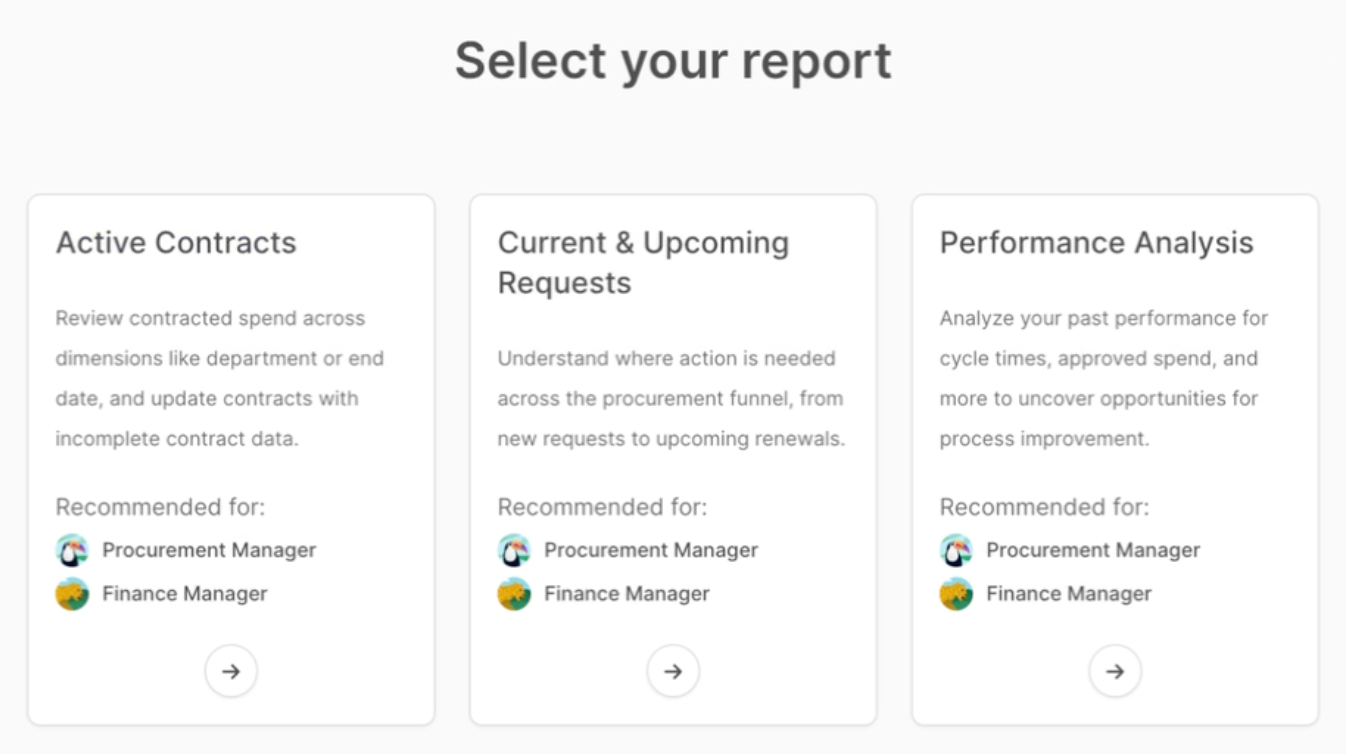
I see renewal bubbles coming. For example, if there's a heavy concentration of renewals landing in July, I know now to resource for that, not three weeks before when it's a crisis. That's capacity planning for my finance and procurement team based on actual data, not intuition.
More importantly, it gives me the ability to walk into a board meeting and say: here's what we're spending, here's what we've saved, here's where we've reallocated budget to fund AI capabilities, and here's how we're managing risk across our whole portfolio.
That's the conversation finance leaders NEED to be having.
You Have THE Opportunity to Actually Influence How Your Company is Spending Money
The lost visibility, continuity, and opportunity to actually influence how the company is spending money is a nightmare for people in my position. When your board is asking you to simultaneously cut costs and invest in AI, you can't wing it. You can't cobble this together with spreadsheets and good intentions.
You need precision, and you need market intelligence that’s built from years of real negotiations, real contracts, and real outcomes across thousands of companies.
If any of this resonates, try starting with a free savings assessment. See where there’s opportunity in your portfolio before you make another renewal decision without full context.

Related blogs



%20(1).png)
.png)
Drive savings and efficiency at any stage
Discover why hundreds of companies choose Tropic to gain visibility and control of their spend.