
In 2026, software vendors are opening renewal conversations with AI-tied price increases as high as 37%. Buyers who come prepared are talking that number down to roughly 12%. That gap, between what vendors ask for and what they actually get, is the clearest single signal of where leverage sits in software procurement this year.
Procurement intelligence is the practice of applying real market pricing, usage, and negotiation data (not vendor list prices or self-reported surveys) to software buying decisions. For a full breakdown of what the category includes and how it differs from procurement software, see What Is Procurement Intelligence?
This report is built on negotiated transaction data and outcomes, not sentiment (list prices or self-reported survey data). The underlying dataset spans $23B+ in tracked spend, 100,000+ negotiations, and 30,000+ SKUs across 14,000+ suppliers, collected by Tropic's commercial executives through live buyer-side negotiations.
Software Procurement Benchmarks: What Teams Actually Pay in 2026
Before you can tell whether your software spend is reasonable, you need procurement benchmarks that reflect what companies actually pay after negotiation, not what a vendor first quotes.
AI-native spend per employee varies sharply by company size
As of Q2 2026, median AI-native annual contract value (ACV) per full-time employee looks like this:
Smaller companies concentrate AI usage in a handful of high-usage roles, which pushes the per-person number up; enterprises spread usage across a much larger workforce and typically negotiate better per-seat pricing at scale. Full breakout in AI Spending and Pricing Trends H1 2026.
Price variability is real, and it's concentrated in specific vendors
Looking at the middle 50% of price variation (25th to 75th percentile) in what different buyers pay for the same product, some vendors show enormous spread. DocuSign's range runs roughly 134 percentage points, from about -68% to +66%, while others show almost none: Figma and Articulate both sit at 0%. That's the difference between a vendor worth spending real negotiation time on and one where the price is effectively fixed. See a preview of the pricing spreads for some vendors below. Full chart in the Intelligence Hub.
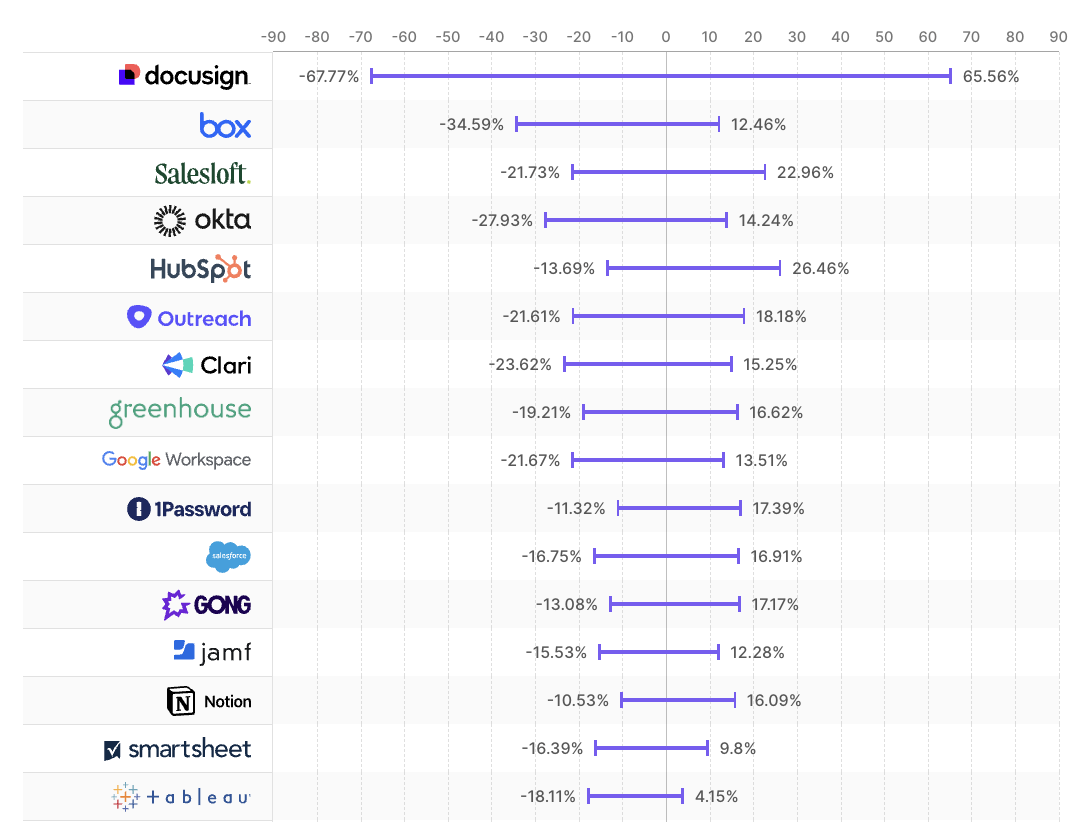
The pattern that shows up across Tropic's negotiation data again and again: two companies of similar size can pay meaningfully different prices for the same tool, and the difference usually comes down to whether either side had real benchmark data going into the conversation. For a deeper look at why negotiated data tells a more accurate story than list-price indices, see Price Data vs. Spend Intelligence.
The AI Tax Is Now a Line Item: What Renewals Show
Software renewals in 2026 increasingly show up with a distinct AI charge attached: a new line item, a packaged premium tier, or a straight price increase tied to "AI capabilities." It's one of the sharpest procurement trends 2026 has produced so far, and the kind of pattern only real procurement intelligence (not list prices) can surface.
The story so far is consistent: vendors are testing how much of an AI premium the market will absorb, and the ask rarely survives negotiation intact. Vendors are also getting more specific about where they hold firm: discount bands on the consumption/usage portion of a contract have narrowed to roughly 0–7%, even as base license fees stay negotiable. Teams that push back, armed with data on what comparable buyers are actually settling at, are the ones landing well below the initial number. For more on what's driving these charges and how to evaluate them, see What Is the AI Tax in Software Pricing? and How to Manage AI Costs.
Timing Is Leverage: Negotiation Outcomes by Renewal Lead Time
Tropic tracks negotiation outcomes by renewal lead time in a couple of different ways (by month-out cohort, and by relative comparison to later-starting teams), and the pattern holds however it's sliced:
Savings rate by engagement window
Savings erode steadily the closer you get to the renewal date. Looked at another way, the effect compounds fast: teams that engage 90+ days ahead of renewal save roughly 3x more than teams that wait until 30 days out, and roughly 5x more than teams that wait until two weeks out.
Renewal cycle length is shifting slightly, and unevenly by category
Contracts with a 12-month-or-shorter term dropped from 59.2% to 55.3% of new agreements year over year, with most of that shift moving into 13–24-month terms. That lengthening is almost entirely a traditional-SaaS story:
Vendors without a clear AI story are pushing for longer lock-in; AI-native vendors are keeping terms short, likely to preserve room to reprice as the category evolves.
The practical takeaway: if your team is still building the "who's up for renewal" list a month before contracts expire, you're negotiating from a measurably weaker position, not just a theoretically weaker one. Put the calendar first. Every additional week of lead time is optionality – the ability to walk away, compare alternatives, or simply wait out a vendor's quarter-end pressure to close. This is what real procurement intelligence adds that a static spreadsheet can't: procurement benchmarks for lead time itself, not just price, that tell you when to start acting. Full breakdown in How to Stop Losing Money: 10 Uncomfortable Truths About Software Renewal Management.
Shadow Spend and Vendor Concentration: Where Budgets Leak
Two forces define where software budgets actually go in 2026: concentration at the top, and leakage at the edges. Unlike survey-based procurement statistics, the numbers below come from actual negotiated and tracked spend.
- Vendor concentration: a company's top 10 vendors still account for roughly 74% of total tracked software spend, and that figure hasn't moved in three years. That means a small number of negotiations, done well or done poorly, determine most of the year's outcome. Full analysis in SaaS Budgeting Starts With Your Top 10.
- Shadow spend identified: Tropic has identified $3B+ in shadow spend across customer portfolios: spend that existed before organizations had the visibility to see it.
- Fastest-growing spend categories: across SMB, Mid-Market, and Enterprise segments alike, Anthropic ranked as the #1 fastest-growing vendor in Q2 2026, the first time a single vendor has topped all three size segments simultaneously. Just behind it: a mix of other AI-native tools and the security, compliance, and financial-planning vendors (Wiz, HackerOne, Anaplan, Sovos, and similar) growing because AI adoption is generating more code, more cloud surface area, and more spend that often lands outside the budget that was originally planned for it. Full vendor-by-vendor rankings in AI Spending and Pricing Trends H1 2026.
These data points point in the same direction: procurement teams should spend disproportionate energy on the handful of vendors that make up most of the budget, while also assuming the real spend number (and the real list of vendors) is bigger than what's sitting in the approved vendor list. The shadow IT statistics above are a visibility problem as much as a budgeting one. For more on closing that visibility gap, see The Spend Visibility Guide, Top Suppliers Driving The Highest Shadow Spend, and Software Vendor Management & Spend Variance Guide.
Five Software Procurement Trends to Watch Through 2027
Here are the procurement trends 2026's data points suggest will keep shaping software buying through next year:
- AI spend normalization: The 20–37% AI-tax ask is already compressing toward a 12% settled average for buyers negotiating with the right benchmark data and negotiation guidance. What to do: don't accept the first AI-pricing number a vendor offers: ask what comparable buyers are actually settling at.
- Usage- and credit-based pricing spreads: More AI vendors are moving from flat per-seat pricing to consumption and credit-based models, with narrow 0–7% discount bands on the usage portion even as the base license stays negotiable. What to do: model total cost at realistic usage volumes, not list price per credit, and negotiate credit rollover and overage protection into every contract.
- Consolidation pressure: With roughly 74% of spend already sitting with a small group of vendors, buyers have leverage to push for bundling or multi-product discounts with those suppliers rather than adding new tools. What to do: audit your top 10 vendors first before evaluating any new purchase.
- Agentic procurement workflows: More of the renewal-triage and quote-benchmarking work that used to sit with a human is shifting to automated agents that flag risk and recommend action the moment a quote or contract lands. What to do: identify which parts of your renewal process are manual today and could be triaged automatically.
- Buyers demanding price transparency: As negotiated-data benchmarks become more available, "what did the last comparable buyer actually pay" is becoming a standard question in every negotiation. What to do: don't walk into a renewal without a benchmark: ask for one before you ask for a quote.
How Tropic Turns This Data Into Procurement Intelligence
This report isn't a survey: it's a sample of the same dataset that runs inside Tropic every day. The intelligence behind these findings comes from live, expert-led negotiations, not supplier-provided data, marketplace relationships, or crowdsourced invoices. Tropic works exclusively for buyers: no supplier kickbacks, no marketplace conflicts, no bias in what gets recommended.
Inside Tropic, that same $23B+ dataset powers:
- Price benchmarks across 14,000+ suppliers and 30,000+ SKUs, so you know what comparable buyers are paying before you negotiate.
- Renewal prep, triaged by urgency so your team focuses on the contracts where there's real room to negotiate, not every renewal on the calendar.
- Negotiation support, drawing on playbooks built from real outcomes across the categories you're buying in.
Tropic customers see an average of 21% savings, totaling $425M+ delivered across 50,000+ renewals managed to date. Explore Tropic's Intelligence Hub and live Expert Insights feed into vendor pricing and packaging changes to see how this data applies to your own stack.
Methodology
Dataset: This report draws on two connected layers of Tropic's proprietary data: negotiated transaction outcomes (the AI-tax ask/settle figures, price variability, and lead-time savings) and Tropic's broader tracked spend and usage data across its customer base (vendor concentration, fastest-growing vendors, contract term shifts, and AI-native spend per employee). Combined, the underlying dataset spans $23B+ in tracked spend, 100,000+ negotiations, 110,000+ contracts, and 30,000+ SKUs across 14,000+ suppliers. Individual stats above are drawn from specific live Tropic data cuts (the Intelligence Hub's Q1–Q2 2026 tracked figures and the H1 2026 AI Pricing Trends analysis), with each stat linked to its specific source.
What counts as a negotiation outcome: For the stats sourced from negotiated transactions specifically (the AI-tax ask/settle figures, price variability, and lead-time savings), a negotiation outcome reflects the final negotiated contract value compared to the vendor's initial quoted or list price, calculated on closed, signed agreements, not open or in-progress deals.
Ready to see what this data means for your own stack? Request a demo.
FAQs: Software Procurement Data
What Is Procurement Intelligence?
Procurement intelligence is the practice of applying market pricing, usage, and negotiation data to software buying decisions, rather than relying on vendor-quoted prices or gut instinct. It goes beyond spend reporting (what happened) to recommend what to do next: what to pay, which vendors to prioritize, and which renewals deserve attention. Read the full breakdown in What Is Procurement Intelligence?
How Much Do Companies Spend on Software in 2026?
On AI-native tools specifically, median annual spend per employee runs $312 for SMB, $122 for Mid-Market, and $50 for Enterprise as of Q2 2026. Smaller companies concentrate AI usage in a handful of high-usage roles, which pushes the per-person number up; enterprises spread usage across a much larger workforce and typically negotiate better per-seat pricing at scale. See the Benchmarks section above for the full breakdown, including price variability across top SKUs.
What Is the AI Tax in Software Pricing?
The "AI tax" refers to price increases vendors attach to AI features or usage at renewal: commonly opening in the range of a 20–37% uplift ask over the prior contract, well above the standard 3–9% annual increase on non-AI software. Negotiation routinely reduces that ask; buyers negotiating with Tropic's benchmark data and tactics are settling closer to a 12% average uplift. More detail at What Is the AI Tax in Software Pricing?
How Early Should You Start a Software Renewal?
As early as possible: ideally six months out. Tropic's data shows companies that engage six months ahead of renewal save up to 39% on average, compared to 22% at 60 days and just 14% at 30 days. Waiting until the last few weeks doesn't just reduce savings modestly: it can cut them by more than half.
Where Does This Data Come From?
This report is built on negotiated transaction data and live tracked spend data (not surveys and not vendor list prices) across $23B+ in tracked spend and 100,000+ negotiations conducted by Tropic's commercial executives. See the full Methodology section above.

Related blogs



Drive savings and efficiency at any stage
Discover why hundreds of companies choose Tropic to gain visibility and control of their spend.