

Key Takeaways
Procurement category management software helps teams organize software spend into defined categories – such as security, collaboration, or analytics – so they can benchmark pricing, control renewals, and eliminate duplicate tools across vendors. Applied to software procurement, it turns reactive, scattered SaaS buying into a structured program with measurable savings.
- Ad hoc software purchasing, without a category structure, leads to duplicate tools, missed renewals, overspending, and a complete inability to report savings at the category level.
- A practical 5-step framework helps procurement and finance teams apply category management principles to their existing software portfolio, starting with a category taxonomy and ownership assignments.
- Procurement category management software should deliver category-level benchmarking, renewal triage, supplier overlap detection, and savings attribution, not just contract storage.
- Tropic customers save an average of 21% and have identified over $3B in shadow spend (much of it concentrated in software categories with no ownership structure or procurement oversight).
Picture this: your renewal calendar has 12 software categories. No single owner for most of them. Marketing auto-renewed a project management tool in Q1. IT let two security monitoring contracts roll over in Q2. Finance just discovered that three departments independently purchased data visualization tools from different vendors, with different pricing, serving functionally identical use cases. Now it’s Q3, and the CFO wants a category-level view of what you’re spending on analytics. You don’t have one.
This is a structural problem.
Many organizations buy software the way they buy office supplies: reactively, department by department, with no strategy for the category as a whole. The result is fragmented ownership, uncontrolled renewals, and a procurement program that can’t defend itself when leadership asks where the savings are coming from.
Procurement category management changes this. It’s the operating model that turns scattered SaaS buying into a structured, measurable program with benchmarks, renewal control, and clear savings attribution. And while category management was originally developed for direct spend and manufacturing, it has become essential for software and indirect tech spend. A well-designed procurement process is the foundation this framework builds on.
This guide walks through what procurement category management looks like when applied specifically to software, why it matters, and how to build a framework your team can actually use.
What Is Procurement Category Management – and Why Does It Apply to Software Spend?
Procurement category management is the practice of grouping similar purchases into defined categories and managing each category strategically, rather than treating every vendor or contract as a one-off transaction. At its core, it means organizing spend so you can benchmark pricing, manage supplier relationships, control renewals, and measure outcomes at the category level rather than vendor by vendor.
The concept emerged from direct spend and manufacturing procurement, where category managers would oversee raw materials, logistics, or facilities with dedicated strategies for each. Major enterprise platforms like SAP and Ivalua built entire frameworks around this approach. But over the past decade, indirect spend – and specifically software and AI spend – has become one of the largest and most unmanaged categories in the enterprise budget. The same strategic rigor that transformed physical supply chains is now essential for SaaS.
For software, categories aren’t defined by commodity groups; they’re defined by business function. Your software (and newer AI-native tools) stack might break into:
- Security
- Collaboration
- Analytics
- DevOps
- HR Tech
- Finance & Accounting
- Sales & Marketing Tech
Each category has its own renewal cadence, pricing dynamics, vendor landscape, and consolidation risk.
Software is harder to categorize than physical goods for several reasons: pricing models shift constantly (AI is the clearest example – see the AI tax), tools overlap across functions, new categories emerge rapidly, and ownership is fragmented across departments that bought tools independently.
Why Software Spend Breaks Without a Category Structure
Here are the specific ways software spend breaks down when you lack a strong category management structure:
Fragmented ownership across departments
Marketing buys Salesforce. IT buys security tools. Finance buys FP&A software. No one has a category-level view. It means no one is accountable for what the company spends on Collaboration as a whole, or whether three departments are each paying separately for the same Analytics capability.
Duplicate spend within categories
This is the result of fragmented ownership. IT owns one project management tool. Engineering owns another. Finance owns a third. Same category, three separate budget lines, none of them aware of the others. This is one of the most common and most expensive failures in software procurement – and it’s almost always invisible without category-level spend visibility.
Across Tropic’s customer base, we’ve identified over $3B in shadow spend – much of it concentrated in categories where there was no ownership structure and no procurement oversight.
Renewal chaos at scale
Managing a large renewal calendar, often spanning hundreds of contracts annually, without category triage is operationally impossible, especially for lean teams. Without a category structure, everything feels equally urgent. Category management creates the prioritization layer that separates renewals worth serious negotiation attention from those you can move forward.
Blind benchmarking
Without category-level intelligence, you’re negotiating without knowing whether your Analytics spend is at market rate or 40% above it. Benchmarking tool by tool, without a category frame, misses consolidation leverage and makes it impossible to build a category-wide negotiation strategy.
AI price volatility compounds the problem
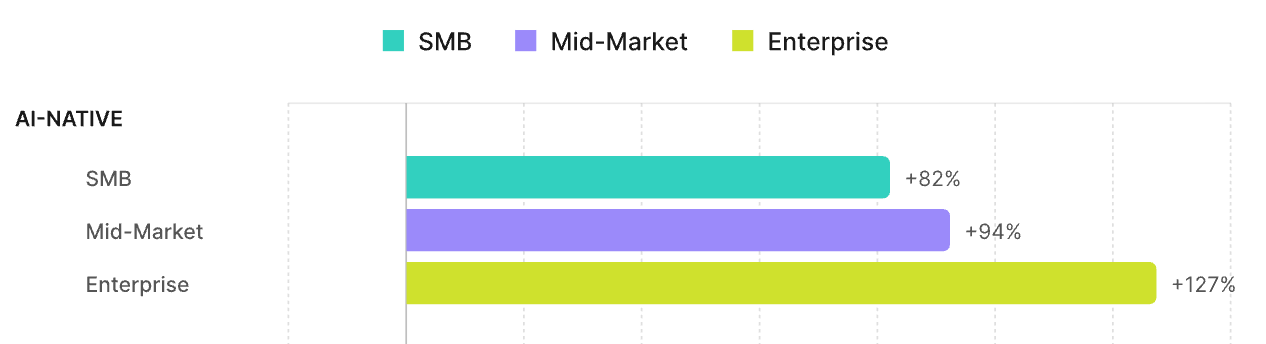
AI tools have introduced consumption-based and seat-based pricing models that behave differently from traditional SaaS contracts. The scale of this shift is real: according to Tropic’s Intelligence Hub, mid-market and enterprise software spend climbed roughly 20% year-over-year in Q1 2026, while AI-native spend grew between 82% and 127% across every company segment. Without governance over consumption, benchmarks, and renewal strategy for these AI tools, organizations are often the last to know when pricing shifts. For a deeper look at this problem, see our guide on managing AI costs. This makes AI one of the fastest-growing sources of budget variance for unmanaged software portfolios.
5-Step Framework for Software Procurement Category Management
The following framework is designed for procurement and finance teams managing software spend – not general procurement or direct spend. Each step builds on the previous, and the entire model can be applied to an existing vendor portfolio without rebuilding your procurement process from scratch.
Step 1: Define Your Software Category Taxonomy
Start by defining the top-level categories that reflect how your business uses technology, not how vendors market themselves. A mid-market company typically needs 8 to 15 top-level categories. Common examples include:
- Security (identity, endpoint, SIEM)
- Collaboration (video conferencing, messaging, project management)
- Analytics (BI, data warehousing, reporting)
- DevOps (CI/CD, monitoring, cloud infrastructure)
- HR Tech
- Finance & Accounting
- Sales & Marketing Tech
- AI Tools
Subcategories can live beneath each top-level bucket. The goal is a taxonomy that a procurement leader, a CFO, and a department head can all recognize and navigate. This taxonomy directly informs your SaaS budgeting process – categories without clear ownership are categories that routinely blow their budget. Revisit the taxonomy as your stack evolves, especially as AI tools create entirely new subcategories.
Step 2: Map Spend to Categories and Assign Ownership
Every dollar of software spend needs to live in a category, and every category needs a named owner responsible for renewals and vendor relationships. Fragmented ownership is the root cause of most renewal misses and duplicate spend.
Mapping spend to categories starts with a clean spend analysis to understand what you’re paying, to whom, and when contracts renew. Once mapped, assign category owners based on functional alignment: IT for Security and DevOps, Finance for accounting software, and so on. Procurement should hold the cross-category view.
Step 3: Benchmark Spend Within Each Category
Without category-level benchmarks, you don’t know if you’re overpaying relative to market.
This is where external intelligence matters most – knowing what peers pay for the same tools in the same category at similar company size. Spend visibility at the category level shows not just what you’re spending, but whether that spending is at, above, or below market. That benchmark is what creates negotiating leverage.
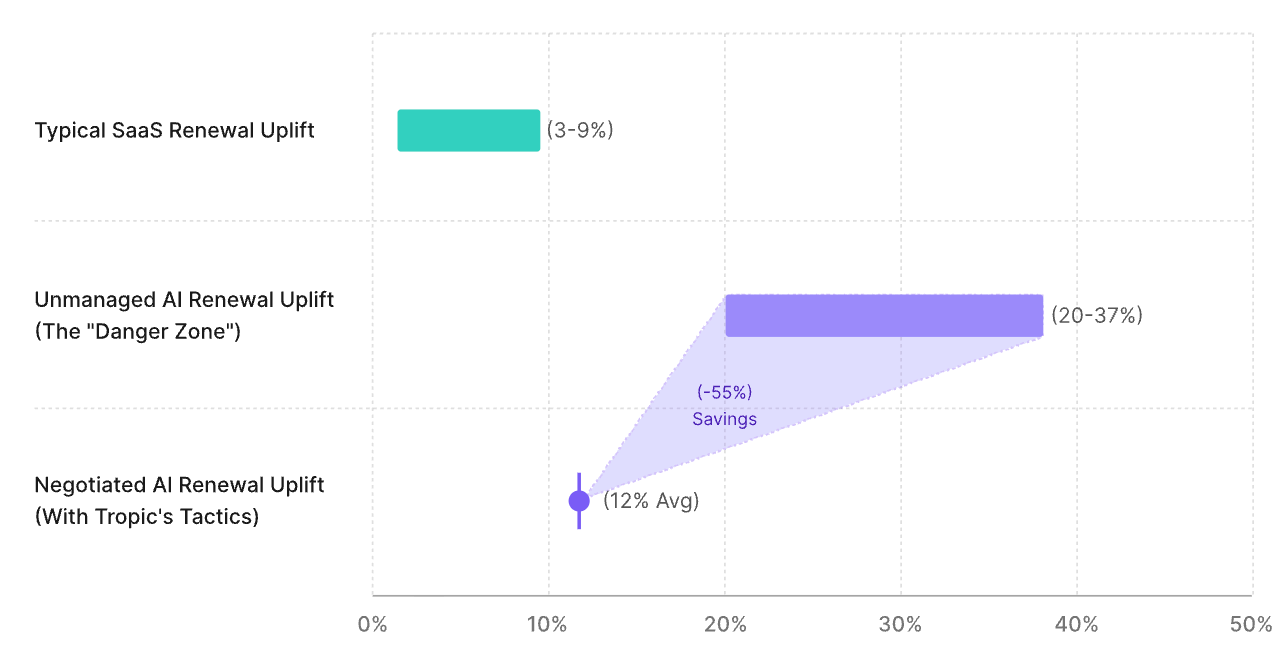
Tropic’s Intelligence Hub data shows that buyers who come to AI renewals with pricing benchmarks and a more strategic negotiation approach have cut vendor-proposed uplifts of 20–37% by more than half. Tropic’s benchmarking covers 30,000+ SKUs across 14,000+ suppliers, including long-tail and indirect spend categories, not just top-tier SaaS contracts.
How Adyen Uses Tropic to Negotiate Software with Confidence
The impact is tangible. When Adyen's category manager used Tropic to benchmark their software portfolio, they gained visibility into $7M in spend across their stack – and used that intelligence to save 18% on a $1.2M contract. That's not a negotiating trick; it's what happens when you walk into a renewal knowing exactly what comparable companies are paying. Now Adyen's CFO can answer his original question every single time: "How do we know we're getting a good deal?" See the full case study.
Step 4: Build a Category-Level Renewal Strategy
Not all renewals deserve equal attention. Category management enables triage:
- High-spend or high-overlap categories get full procurement review
- Low-risk categories with favorable pricing and high utilization can pass through more easily with confidence
Score each category by renewal urgency using three signals:
- Whether the category is overpaying relative to market
- Whether there are underutilized licenses within it
- Whether there’s room to negotiate based on competitor pricing or contract flexibility
This triage model lets lean teams focus where it counts. For more on managing software tail spend within a category framework, see our guide.
Step 5: Track Category Performance and Prove ROI
Category management that can’t show results won’t survive budget cycles. The measurement layer is what converts procurement from a cost center to a value driver.
Track savings by category, compliance rates by category, duplicate tool reduction, and renewal cost avoidance. These are the same levers covered in our guide to software cost optimization, but category management gives you the structure to apply them at scale. Board-ready reporting should show the category-level view, not a vendor-by-vendor list (unless it’s truly notable), so finance leadership can see where the program is delivering.
What Should Procurement Category Management Software Do?
Not all platforms support a software-specific category management approach. Many contract management and procurement tools lack the pricing intelligence, renewal triage, and supplier overlap detection that software category management requires. Here are the capabilities that matter:
How Tropic Supports Procurement Category Management for Software Spend
See how Tropic’s cost savings solution works for procurement teams here.
Here is how the category management framework above maps to what Tropic actually does at each stage of the process.
- Benchmarking: Tropic’s Spend Intelligence covers $21B+ in data, 30,000+ SKUs across 14,000+ suppliers – including long-tail software categories. When a category manager wants to know whether their Analytics spend is at market rate, that benchmark exists and is derived from real human-led negotiations, not crowdsourced estimates.
- Renewal triage: Tropic’s Purchase Prep Assistant automatically prioritizes the renewal calendar by urgency – surfacing where the organization is overpaying, where licenses are underutilized, and where there’s room to negotiate. Category owners receive actionable triage, not a raw list of upcoming dates.
- Proposal review: The Proposal Review Agent benchmarks new purchase proposals the moment a vendor quote arrives – instantly delivering a benchmark price, a negotiation difficulty rating, and a personalized action plan. New requests land in the right category context from the start.
- Supplier overlap detection: Overlapping suppliers alerts identify duplicate tools at the SKU and parent-company level within a category, surfacing the consolidation opportunities that manual audits routinely miss.
- ROI tracking: Tropic’s Savings Tracker automatically attributes every dollar saved to specific categories – with no manual entry. Board-ready reporting on spend trends, compliance rates, and vendor performance is available without building it in a spreadsheet.
- Portability: Tropic’s MCP integration brings category intelligence into Claude, ChatGPT, NetSuite, Coupa, and more, so procurement teams get category-level insights in the tools they already use, without switching context.
The proof points that anchor this approach from Tropic:
- 21% average customer savings
- $425M+ in savings delivered for customers
- $3B in shadow spend identified – much of it in categories with no governance structure
- 450,000+ hours saved by customers
Signs Your Organization Needs a Software Category Management Approach
If any of the following describes your current state, your software spend program lacks the category structure it needs:
- You manage 50+ software vendors but have no taxonomy – they all live in a spreadsheet or contract management tool with no category structure
- The same type of tool (project management, video conferencing) has been purchased by three different departments independently
- You’re heading into renewal season with no priority framework – everything feels equally urgent
- You’ve discovered duplicate contracts only after they auto-renewed
- Finance asks how much you’re spending on Security tools (or AI) and you can’t answer at the category level
- Your AI software spend grew significantly last year – Tropic’s Intelligence Hub data shows AI-native spend grew 82–127% YoY across every company segment in 2025–2026, but you have no category-level governance for it
Turn Scattered Software Purchases Into a Strategic Category Program
Software procurement without category management is reactive by default. Every auto-renewal is a missed opportunity. Every duplicate tool is a cost that compounds. Every category without an owner is a blind spot that will eventually show up in a budget review.
Procurement category management software doesn’t require rebuilding your entire procurement process using a new tool. It starts with organizing what you already have – mapping spend to categories, assigning ownership, benchmarking within each category, and building a renewal triage model that lets your team focus where it counts.
The teams that control software spend have clear category structure and the best intelligence. That combination – structure plus real-time data – is what turns a reactive SaaS buying program into a measurable, defensible, value-generating function.
Ready to build a category management program for your software spend? See how Tropic’s procurement intelligence and agentic tools work at the category level: Get a demo.
FAQ: Procurement Category Management Software
What is procurement category management in software procurement?
Procurement category management for software is the practice of organizing software spend into defined categories – such as Security, Analytics, or Collaboration – so teams can benchmark pricing, manage renewals strategically, identify duplicate tools, and measure savings at the category level rather than vendor by vendor.
How is software category management different from general procurement category management?
Software category management focuses on indirect tech spend: SaaS subscriptions, AI tools, cloud services, and software licenses. Unlike direct spend categories, software categories have annual or monthly renewal cycles, high overlap risk (multiple vendors in the same category), and consumption-based pricing that requires continuous monitoring.
What are common software procurement categories?
Common categories include: Security (identity, endpoint, SIEM), Collaboration (video, messaging, project management), Analytics (BI, data warehousing), DevOps (CI/CD, monitoring), HR Tech, Finance & Accounting, Sales & Marketing Tech, and AI tools. Categories should reflect how your business uses technology, not how vendors self-classify.
How does category management reduce software spend?
Category management enables volume negotiation leverage (consolidating multiple vendors in a category), benchmarking against market rates, proactive renewal triage, and identification of duplicate or unused tools within a category. Tropic customers save an average of 21% – a meaningful portion comes from category-level consolidation and renewal optimization.
What is the best procurement category management software for SaaS spend?
Tropic is purpose-built for software and indirect tech spend, with $21B+ in spend intelligence across 30,000+ SKUs and 14,000+ suppliers. Its Renewal Prep Agent and Proposal Review Agent operate at the category level, triaging renewals and benchmarking new requests automatically. See why teams choose Tropic with a demo.
Can category management work without dedicated procurement headcount?
Yes. Procurement category management software automates the most time-intensive parts: categorizing spend, tracking renewals by category, flagging duplicate tools, and surfacing benchmarks. Finance leaders and lean ops teams use Tropic to apply category management principles without a full procurement function.
How do I build a software category taxonomy?
Start with your existing vendor list and group tools by function (not vendor). Aim for 8–15 top-level categories at the mid-market stage. Assign an owner to each category responsible for renewals and vendor relationships. Review the taxonomy as your stack evolves, especially as AI tools create new categories.
How does AI improve software category management?
AI surfaces patterns humans miss at scale: duplicate suppliers within a category, pricing shifts before renewal, usage drop-off indicating consolidation opportunity, and invoice discrepancies against contracted rates. Tropic’s AI agents triage renewal calendars and review proposals by category automatically – reducing hours of manual work per renewal cycle.

Related blogs


.jpg)

Drive savings and efficiency at any stage
Discover why hundreds of companies choose Tropic to gain visibility and control of their spend.