
Key Takeaway
- Productiv shuts down August 6, 2026 (notified customers August 2).
- Finance and procurement teams need to export contracts, renewal dates, and usage history now, plus check the next 6 months of renewals for auto-renewal clauses, opt-out deadlines, and AI usage overages before visibility disappears.
Productiv customers are being forced into a decision no finance, procurement or IT team wants to make: what happens when a platform you rely on disappears in the middle of planning season?
On August 2, Productiv notified customers that it would sunset its SaaS management platform on August 6. That leaves customers just four days to preserve their data and determine what comes next.
Productiv has not publicly shared why it is shutting down, and speculation will not help the teams affected. The more important question is what customers should do now to protect upcoming renewals, preserve visibility into their software portfolio and build an accurate 2027 software plan.
What Productiv customers should do now
1. Export your data
Before evaluating another platform, export as much information as possible from Productiv, including:
- Your application and supplier inventory
- Contracts, order forms and amendments
- Contract end dates and opt-out deadlines
- Annual and monthly spend
- License counts and historical usage
- Application owners and purchasing departments
- Upcoming renewal workflows
- Historical savings and renewal decisions
- Security, compliance and vendor records
Do not assume another platform can automatically recreate all of this later. Application discovery may rebuild part of your inventory, but it may not reproduce the historical context behind a contract, renewal or budgeting decision.
Store the exported data somewhere accessible to finance, procurement and IT. Even an imperfect central repository is better than having critical information spread across individual downloads and inboxes.
2. Protect your upcoming renewals
Next, identify every contract renewing or requiring notice over the next six months.
Pay particular attention to contracts with approaching opt-out dates, automatic renewal clauses, significant price increases or unused licenses. You should also flag categories where multiple products provide similar capabilities and AI agreements that could create overages or leave committed spend unused.
Assign an owner to every material renewal and make sure the necessary contracts, usage data and supplier communications are available outside Productiv.
Your immediate goal is not to complete a perfect platform migration. It is to avoid missed deadlines and preserve enough time to make informed renewal decisions.
3. Reconsider what you actually need
A shutdown creates urgency, but it also creates an opportunity to reconsider what your company needs from its technology.
Productiv supported several jobs, including application inventory, usage analysis, license management, renewals and spend visibility. Those jobs do not necessarily need to be solved by a single platform.
Before selecting a replacement, ask:
- Do we need automated discovery of shadow applications?
- Do we need deep usage data to reclaim unused licenses?
- Do we need provisioning, offboarding or access governance?
- Do we have a reliable source of truth for contracts and renewals?
- Can we identify redundant spend across our technology stack?
- Do we know whether we are paying a competitive price?
- Do we have the intelligence and expertise to negotiate effectively?
- Can we forecast consumption-based AI costs?
If your primary requirements are application discovery, provisioning and access governance, you will likely need a dedicated SaaS management or identity platform.
If your larger challenge is deciding what to buy, what to renew, what to consolidate and what to pay, you need market intelligence.
Some organizations may need both.
→ Get a look at what market intelligence can offer you by watching a 5-minute demo here.
Use this transition to strengthen your 2027 budget
The timing of Productiv’s shutdown is especially difficult because many finance and procurement teams are beginning their 2027 planning.
Losing portfolio data now can make it harder to answer some of the most important budgeting questions:
- What technology spend is already committed for 2027?
- Which renewals are likely to increase?
- Where are we paying for unused or redundant capabilities?
- Which contracts should be renegotiated, consolidated or eliminated?
- Are our negotiated rates competitive with the market?
- How much AI consumption should we budget for?
- Where should procurement focus first to have the greatest impact?
Rebuilding a list of contracts is only the beginning. A strong technology plan connects each contract to its renewal timing, usage, business value, potential risk and market pricing.
This is also an opportunity to stop treating every software renewal as an isolated transaction. Looking across the full portfolio makes it possible to identify patterns, prioritize the highest-value opportunities and negotiate from a stronger position.
Visibility identifies the problem – intelligence helps you act
Productiv was best known for helping companies understand which applications they owned and how employees used them. That information is valuable when right-sizing licenses or making a case for consolidation.
But usage data alone cannot tell you whether your pricing is competitive, what similar companies negotiated for the same SKU, where a supplier is likely to be flexible or how to structure the negotiation.
Productiv did offer pricing benchmarks for certain applications. According to its documentation, those benchmarks depended on uploaded contract data and sufficient industry data, and focused on reported license costs.
Tropic’s intelligence is built differently. It comes from live software and AI negotiations conducted by specialized commercial experts. AI analyzes the calls, emails, proposals and contracts generated during those negotiations, turning them into current, SKU-level price benchmarks, supplier insights and proven negotiation strategies.
Tropic’s intelligence covers more than 14,000 suppliers and 30,000 SKUs, backed by more than $23 billion in spend data and insights from over 100,000 transactions. It is available from day one, before a company uploads its own contracts.
That means teams do not simply learn that a renewal deserves attention. They can see what a competitive outcome looks like and how to pursue it.
How Tropic can help Productiv customers move forward
Tropic is not a direct replacement for every Productiv capability. Companies that relied heavily on Productiv for technical application discovery, access governance or automated offboarding may still need a dedicated IT management platform.
Tropic can help replace and strengthen the procurement capabilities affected by the shutdown.
Rebuild your source of truth and prioritize what matters
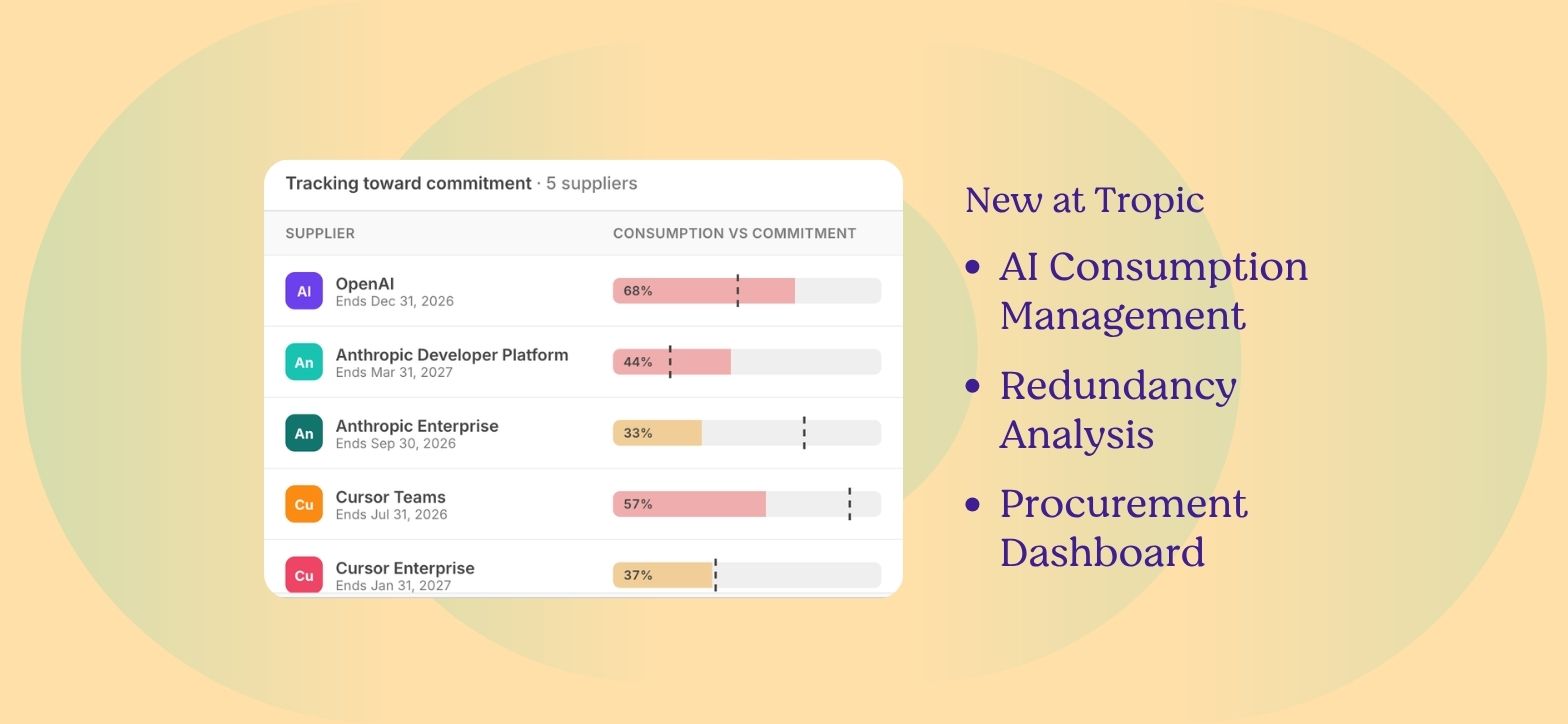
Centralize software and AI contracts, renewal dates, commitments and owners. Tropic Signals then surfaces savings, consolidation and risk opportunities across the portfolio, organized by contract end date, so teams can focus on the decisions where timing and financial impact matter most.
Identify redundancy at the SKU and capability level
Two suppliers do not need to be identical to create waste. Tropic analyzes overlap at the capability and SKU level, helping teams see exactly which contracted products may be redundant, how much they cost and when there is an opportunity to consolidate.
Know what to pay and how to negotiate
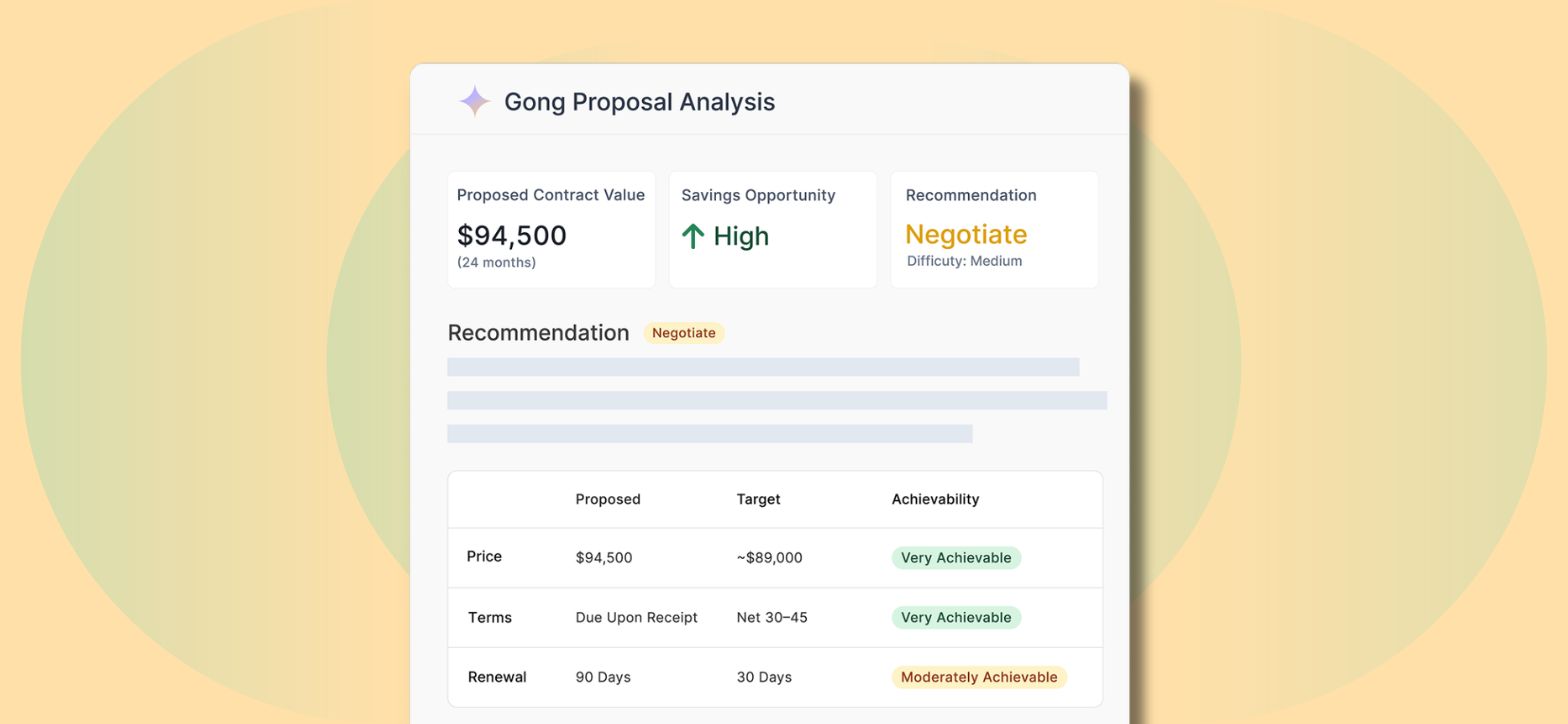
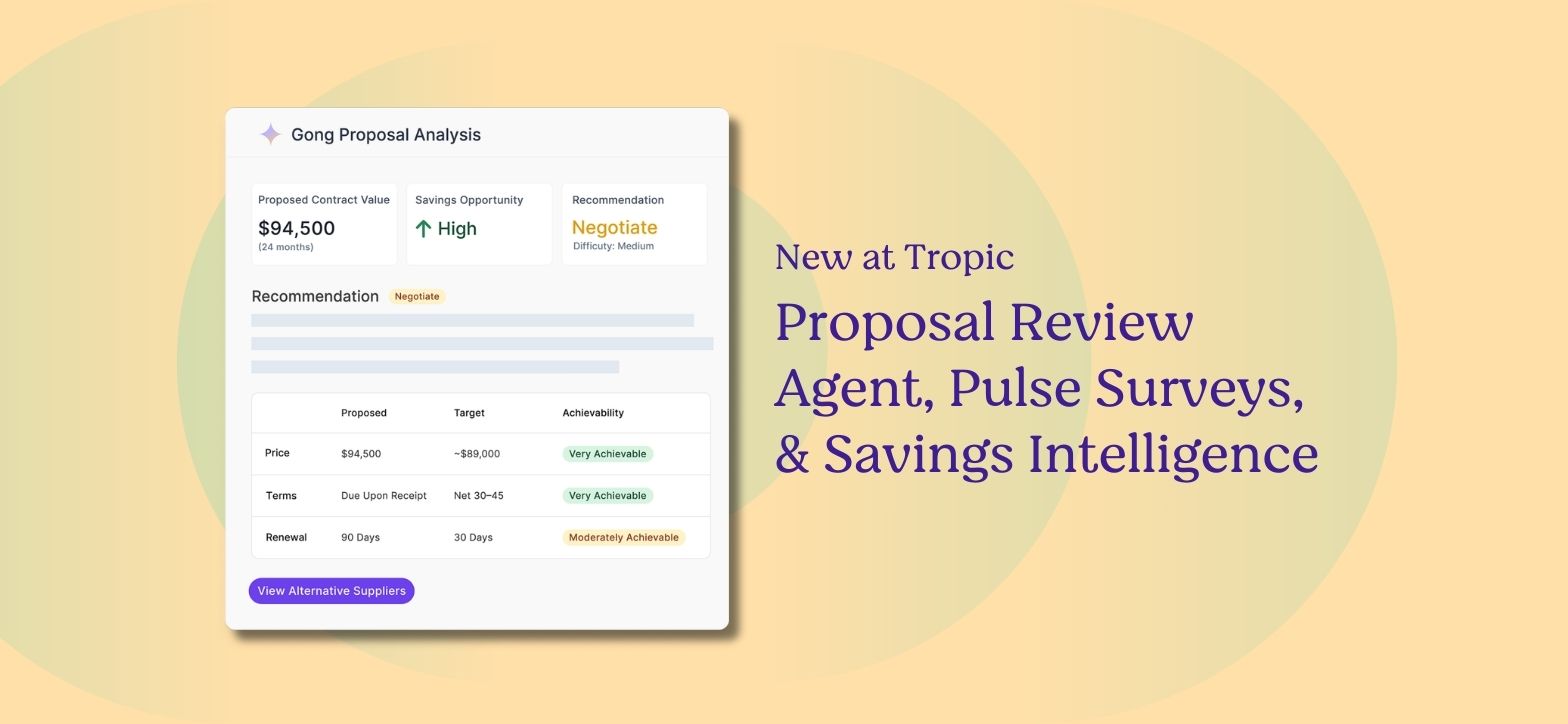
Tropic provides SKU-level price benchmarks, supplier alternatives and proven negotiation strategies informed by real, negotiated deals. Teams can evaluate pricing before a supplier conversation begins and understand where to push across both price and commercial terms.
Teams can use this intelligence independently, consult with a specialized commercial expert or bring in support to help execute the negotiation.
Plan for consumption-based AI costs
Traditional software planning was built around seats and headcount. AI contracts introduce commitments, credits and overages that make costs much harder to forecast.
Tropic helps teams compare committed and consumed AI spend, forecast overages or underutilization, understand what is driving consumption and benchmark AI pricing against the market.
Turn an urgent transition into a better way to buy
Productiv customers need to move quickly, but the goal should not be to reproduce the same technology stack as fast as possible.
- Export your data
- Protect your upcoming renewals
- Then determine which capabilities your organization truly needs for 2027 and beyond
For some teams, that will mean rebuilding application discovery and access management. For others, the larger opportunity will be gaining the intelligence and support required to make better decisions across every software and AI purchase.
If Productiv played a role in your budgeting, renewal or procurement process, Tropic can help you reestablish visibility, identify the most important opportunities and enter your next supplier conversation knowing what to pay and how to win.
→ If you're interested in making the transition, book a demo and we'll be in touch soon.
Frequently Asked Questions
When is Productiv shutting down?
Productiv notified customers on August 2, 2026, that its SaaS management platform would be sunset on August 6, 2026. That gives customers four days to export their data and prepare for the transition.
Why is Productiv shutting down?
Productiv has not publicly shared a reason for the shutdown. Any explanation involving funding, an acquisition or market conditions would be speculation. Customers should focus on preserving their data and protecting upcoming renewal and budgeting decisions.
What should Productiv customers export?
Customers should export their application inventory, contracts, order forms, renewal and opt-out dates, spend, license counts, usage history, application owners, supplier records and active workflows. Historical renewal and savings data should also be preserved wherever possible.
Is Tropic a direct replacement for Productiv?
Not for every use case. Companies that relied on Productiv primarily for technical application discovery, access management or automated offboarding may still need a dedicated SaaS management or identity platform.
Tropic can replace and strengthen the procurement side of the equation, including contract and renewal visibility, redundant spend analysis, price benchmarking, negotiation strategy, supplier intelligence and expert support.
How is Tropic different from Productiv?
Productiv primarily helped companies understand which applications they owned and how employees used them. Tropic helps finance and procurement teams decide what to buy, what to renew, what to consolidate, what to pay and how to negotiate.
Tropic combines contract and portfolio data with SKU-level price benchmarks, supplier alternatives and negotiation strategies derived from live software and AI transactions.
How quickly can Productiv customers begin getting value from Tropic?
Tropic’s price benchmarks, supplier intelligence and negotiation strategies are available from day one. Once contracts and portfolio data are added, Tropic can surface customized savings, consolidation and risk opportunities tied to upcoming renewal dates.

.jpg)
Related blogs
Drive savings and efficiency at any stage
Discover why hundreds of companies choose Tropic to gain visibility and control of their spend.