Good to see you, Russell. I don't know how well you stay on top of the rumor, mill, but have you heard the latest going around?
Oh, what rumor? The one that you actually read contracts or the one that I know what our budget actually is?
Okay.
Didn't think you'd go there, but, no, the other one apparently, just give you a little bit heads up, AI is coming for your job. Okay? And and apparently mine too. So you and me, whether we whether we like it or not, we're headed for an early retirement.
Oh, Shields. I have been planning for this for months.
Now check it out here. Okay? I'm gonna open up a t shirt shop. It's going to be called Russell's Radical Tees, and it will have slogans that are like, I used to balance books and now I balance some margaritas.
Okay. That is actually disturbingly solid. Ton of respect for that. I'm more of a mountain guy myself. So, I'm probably gonna have to be, you know, optimizing trail mix spend and and, I don't know, not as good as you, but renegotiate and hammock lease terms or something like that.
And see, this is this is why we work so well together. Because even in your retirement dream, you're thinking about procurement.
You know, it's certainly a gift, a little bit of a curse. But, no, just in all seriousness, I don't know. Like, lot of mixed feelings out there. Is this something where we just kinda stick our heads in the sand and and hope that AI passes us by?
Yeah.
That has worked out great for just absolutely nobody.
Well, that's that's honestly why I'm here. Like, I I know we're not here to hype AI, but I also don't wanna necessarily fear it.
But really to talk about how it's being used, how it potentially can be used, not to replace us, but to to amplify us, to take what we do well, to to to make it sharper, faster, and and smarter.
Yeah. I'm feeling like if we can do this right, it will be a wave that crashes into us, but not one that wipes us out. One that we ride, brother. You know? And so today is really about figuring out how we catch that wave.
Cool. I'm excited.
Everyone here has made an investment, of course, of time to be here today. And so time is one thing you can't negotiate a discount on. Am I right, Shields?
You know, there's a book that says you can negotiate anything, but I think you're right there.
And for my finance friends out there, today is really about visibility. You know, where's the money going? Where is the risk creeping in? And where is the leverage? Where does that lie? So spoiler alert, it is not in last year's forecast tab.
Yeah. And and for my procurement peeps or for people who find themselves doing procurement, whether they plan to or not, you know, this is your chance to to ask, like, hey. You know, are we being strategic or are we being reactive? Are we driving value?
Are we just playing, you know, the the cost police? And and while we tend to ask, you know, chat, GPT, everything, I don't think AI is gonna be the one to answer those questions for us. It can definitely give us an edge though to to finally move, you know, faster, potentially more faster than approvals on a Slack channel. I don't know.
Yeah. So we'll start off the day with a session called the art of what's possible, and you'll get to hear from folks that are swimming in this AI current for a while.
Where is it headed? What is height? What is real?
Okay. And then we're gonna shift to AI in action where, you know, CFOs, yeah, people like yourself and procurement teams like me, like, where are they actually putting their money? Right?
Not not well, like, they say what they're doing, but, like, what they're buying and what's working and and what's not.
And then we're gonna pull back the curtain on what have we been building at Tropic, and how can companies that are using it in the wild benefit.
Yeah. And that's leads us into the next discussion where we'll talk about, like, how we're using Tropic at Tropic and and how we're using our own AI. And it'll be fun to discuss that with some of my colleagues.
And, hey, if you're a Tropic customer, do not miss out on the AI master class that is gonna close out the day.
That's gonna be epic. You have the tools already, and so now it'll be your chance to figure out how to use them like a pro.
Yeah. I I'm definitely seeing my AI, you know, force multiplier. I think we, you know, we hear that term quite a bit, but certainly the case, you know, for speed, for for, you know, savings and and most importantly for impact.
So all kidding aside, it seems like it really isn't about us being replaced.
It's about us being ready. And the teams out there that lean in in this moment right now are going to be the ones leading the pack later.
Alrighty. Well, Russell, I'm glad you're here. I'm glad everyone else is here. Excited, you know, feel throughout the, you know, day, ask questions, you know, take notes, like, ride this wave with us.
Like, this is where the future of finance and procurement gets built. And, just just a quick housekeeping point. The questions box, will be open throughout all of the sessions. And so, you know, moderators moderators will do our best to get them answered during each session.
Alright. First session's gonna be coming in hot, so let's kick it off.
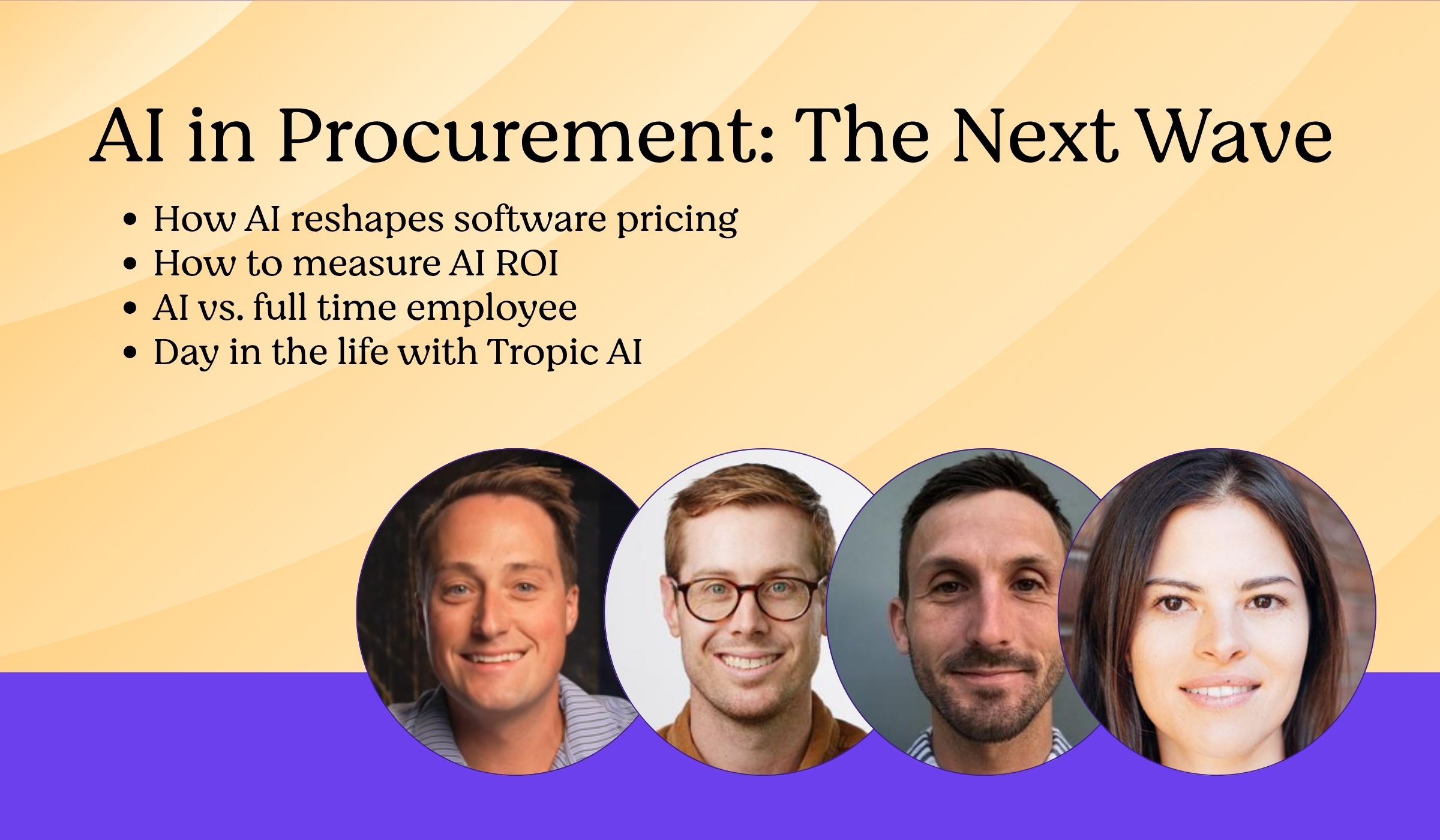
Alright. Well, I am pleased to welcome our keynote panel, CFO, tech investor and expert, Wuderborn, procurement AI evangelist, Tanya Wade, and Forrester senior analyst, Jeffrey Rajamani.
First off, thank you so much for being here. I wanted to set the stage just a little bit. You know, I was at a conference a couple weeks ago, and, it was in New York City. And, you know, admittedly, I've attended a few events this year.
And, certainly, like, at these events, they discuss AI. But this this particular event, every single session was not just, like, talked about AI, but that that was the topic. That was the theme. It was very focused around AI.
And I and I'm just convinced that, you know, in a very short period of time, regardless of whether I am an individual contributor or whether I'm a, you know, a team leader, I'm going to be managing a team of, you know, AI agents. And, you know, for the people that are, you know, if they're managing people, those people will also be managing a team of AI agents. So it's really exciting times.
Let's dig in. Tanya, hello to you. You're Hi. As I said, you're a AI evangelist. And among other things, I'm just excited to discuss with you specifically how AI will impact procurement transformations, both large and and small. So thanks for being here.
Thanks. Was that a question for me?
No. Just just to say hi.
Next, Wouterborn, as a as a partner at a VC firm, you specialize in CFO tech and specifically, as you put it, backing the future of finance with AI and automation. So I I you know, welcome and can't wait to get your take.
Thanks. Excited to be here.
And then, last but not least, Jeffrey, who leads, and co leads research on sourcing and vendor management in Europe for Forrester, but you're also responsible for technology services coverage. So welcome, Jeffrey.
Hi, Michael. Pleased to meet you again. Hi, everyone. Really looking forward to the discussion today.
Alrighty. Well, let's get started. So we're gonna have a great discussion today. But sprinkled throughout the conversation, I have what I'm calling lightning round questions.
And and so there's three of them, and these questions differ from other questions that might come up during the during the conversation. For the lightning round question, you'll each answer the same question, but you only have sixty seconds to answer that question. So these are short, fun, insightful questions. And so here's the first question.
Tanya, I'll go to you, and then we'll go to Wuder and then we'll wrap up with Jeffrey. But, what's one example of someone or a company you know, obviously you can keep them anonymous, but they're leveraging AI to push beyond what most people are doing. And they're, you know, truly, you know, pushing the boundaries even if they're not, quote unquote, like, successful yet.
Okay.
So what I'm seeing at enterprise level is that a lot of companies are more than anything doing what should we do about AI? So they're not actually doing anything.
By contrast, I know a CPO of a very large company, I do mean CPO, not a head off, who is actually actively speaking to startups rather than going to your standard very large vendors, which is what other heads of procurement, I, you know, are usually doing, going to them for innovation. He's he's reaching researching the market actively himself and having some pilots with agents to solve the actual problems that he has. I think that's the best way that you can you can approach it, really.
Alright. And look at that. Just under sixty seconds. Nice. Wooder?
So I'm gonna run my stopwatch with it just to make sure I don't take out two minutes.
So, you know, we coach our start ups in a portfolio on on like, many companies are AI companies and build AI products, but the other side is, okay. Are you using AI to build your company? And probably that's that's true for for a lot of companies, all different kind of sizes.
We've one specific portfolio company that really is one of the front runners here. Let me just give two examples.
One thing is that they at some point, they had, like, hundreds of inactive digital credit cards. They need to deactivate through their own software UI. This was a pain. And so they used Chetifyd operator to to just do this massive batch job, which is a public tool available for everyone in the US. And, it was done in in twenty minutes. You know? This would have costed them, days in terms of building features and stuff like that.
They also I'm I'm also running out of time. Give me give me fifteen seconds more. They organized a hackathon.
Every single employee in the whole company was participating.
Support people were building support agents. Salespeople were cloning, their own voice to to set up automatic WhatsApp, follow-up messages.
This is probably the mindset to have. You know? You need to experiment. Maybe not take it in production immediately, but but just experiment.
Alright. We're gonna dig into that quite a bit more. Experimenting, I love that concept. Now is the time to kind of, you know, experiment and maybe break a few things here and there. Alright, Jeffrey. We'll wrap up with you.
Yeah. Sure. So, let me dive straight into the example. A large, bank, US based bank, they were actually caught flat footed, during the pandemic.
Guess what? All the invoices that came from the suppliers went to the BPO centers in India. And because of the lockdown, people these the staff and the BPO were not able to access this. So they got everything over and said, okay.
We're going to now have a solution.
First of all, we're going to move it to Onshore. We're going to have a solution that is going to automate all the reading of the invoices and prioritize, you know, what, PO or PR does these invoices belong to. And then, to the extent of even forwarding it to the AP and AR folks, and if there is no need for them to check, set they have set their eyes on auto approval of these invoices. So something towards, you know, automation is their aim. As you rightly said, they are not yet there. They have started the first and the second phase of automating, you know, extracting information from invoices and prioritizing, but they have set their eyes on, completely having touchless automation.
Yeah. And that's that's a good point that you're talking about, Jeffrey. As we kinda move into discussion a little bit here, I I specifically phrase the question in a certain way because and and feel free to challenge me on this. We're all here to, you know, learn myself included.
But, you know, from my vantage point, I observe, you know, people and and companies adopting AI, but there's this big dis you know, distinction and and maybe gap between, you know, what's what's possible or hypothetically possible, which I really wanna talk about today, and and what's happening. So I love to see people kind of, you know, trying to bridge that gap even if we're not quite there. Right? Because we're gonna get there potentially, I think, you know, really, really quickly.
So, you know, most real world AI use case seems to be focused on, you know, low risk efficiency gains, automation of routine tasks, you know, data entry, cleaning, and and summarization of, like, I don't know, email writing. But in reality, it can be so much more than that. So let's let's definitely focus this conversation on on on what's possible.
Mhmm.
And and maybe we can encourage more people to kind of get into that experiment mode and, you know, try things. Right? So, Tanya, let's start off with you to kind of lead out in the discussion, you know, as you work on, you know, procurement transformation efforts, like, what's a pain point that you see perhaps frequently and, but you think, hey. This is an area I hope AI will make a difference.
It's really boring. Okay. But it's tails spent. Why have I not got to this with AI already?
And even the boring type of AI, like automations, simple automations can fix that. Right? So when you have loads of really low value suppliers that create a lot of complexity, and a huge administrative overhead as well.
So AI can, categorize, aggregate, eliminate suppliers. You can literally reduce your tel spend by a hundred percent or close to a hundred percent. And that, that can result in savings of, like, ten to twenty percent depending on the size of your tail and the maturity of your procurement.
And that's an easy use case for AI.
So it just baffles me that clients still have, this issue at the moment.
Okay. So you're you're saying there's gonna maybe they're already used to some degree, but you're you're thinking, hey. This is a ripe opportunity. Right? And then they kinda like would love you to kinda weigh in here because, you know, obviously, from the investor lens, are there any problems that, you know, these AI first, you know, startups, they they think they're solving, but but maybe, you know, kind of on the other end, like, maybe buyers don't actually care about?
Yeah. I think I think there are too many copilots built today. You know? Everyone wants copilot. I think we need captains. You know? Like, someone who can actually steer the jet and not someone who sits next to him.
In general, I think adding a chatbot to a SaaS product where you can ask questions about the data is a nice feature. Demo as well, it sets you on the map as like, hey. We have an AI feature. I don't think buyers actually would pay anything more for it because they can use ChattyPT, load some data into ChatTPD, and ask similar questions.
I think you need to really use AI words at a strength. And and, just answering some questions, that's not automation. That doesn't give you any real, real insight. So, you know, I hope companies are gonna build better better things, you know, in the in the in the future.
Yeah. I I wanna come back to this idea of of of agents and and copilots. I love what you said. Captains instead of of co pilots. That's that's pretty, you know, fun little tagline there. Jeffrey, you, you see patterns across the market.
What critical pain points do you think vendors are overlooking that, like, we as buyers are still struggling with day to day?
Well, they're not, really understanding what the buyers, face day to day. I mean, just think of a procurement person in a procurement department. It could be the CPO. It could be anyone.
They, you know, I mean, they have tasks that come to them, let's say, at six PM when they're ready to leave offices. An RFP has been pending for such a long time. It has to be sent out to set of providers.
These are boring jobs, and they actually become a pain in the neck. Now how do we address this? I mean, vendors should really address the the pain points that procurement staff face on a day to day basis and take them you know, meet them in the journey where they are and take them on. Now if you take the RFP example, right, if, an AI can actually, you know, scout the market, is able to kind of prepare a down list a down selection of potential suppliers based on criteria, based on history of, you know, scouting for employers and choosing vendors, then it's, like, half the job done.
Right? And then all that you have to do is evaluate the responses that come from these down selections. So what I mean is how can you move from a long list of fifteen suppliers to a downselection of, let's say, three suppliers using AI. It saves a lot of time.
It saves a lot of frustration.
And I think those are those quantum, you know, tactical work, manual work, which AI can come to the rescue. And I think these, these are very important, you know, on the ground problems that vendors should understand that procure I mean, people, buyers, fees, and organizations.
Yeah. I have a lot of thoughts, you know, specifically on the r RFP process in general. And and while I think it's, you know, certainly a valuable tool in certain instances, it's a it's a a heavy machinery, and and requires a lot of resources. So I I hope that AI is going to dramatically affect that. Wooder, you know, this this kind of reminds me of, you know, with with you being a VC, and I'm sure you've seen a lot of pitch decks at this point regarding AI, and I'm sure you're accustomed to having to, like, poke the holes and pull pull on those loose threads. So, just out of curiosity, when you are being pitched, like, how often is a tool truly doing something new versus, I don't know, just slapping AI on an existing product.
So I I I think a lot of companies are still building traditional SaaS models. Like, the business model doesn't change yet. So you can build a tool and you enable some AI features, but I don't think the future with agentic AI is going to that direction. I think in like, let's take the bookkeeper, for example.
Do we need better bookkeeping software, or do we just need a service that is gonna be bookkeeping done with AI that basically replaces the bookkeeper?
I think that's the that's the thing I'm still missing here and there. I see new startups pitching this. You know, I was typically sitting in the Y Combinator demo days, and and and they are very much stimulating this. So you see business models like that popping up. But that's gonna be really interesting because then you really solve something for a customer, and you don't just give them another feature.
Yeah. And, Tanya, this kinda reminds me of of something you were talking about during our our prep session where you were you know, obviously, the the buzzword right now is agent, and there's some awesome agents out there. And some other ones, I think, is is Wouter has kind of alluded to where it's, you know, maybe just a chatbot. Right? But but you you you said specifically that not all agents are are created equally, and and not all agents are are actually even agents. Right? So maybe, you know, from buyer in general, like, how should we be looking and and measuring this when when we are being pitched?
Maybe not from Wooter's point of view as, like, someone looking to get investment in the product, but someone looking to buy or get you to buy the product.
Yeah. So I I guess the, the line is between a chatbot and an agent, which are two completely different things.
So an an agent isn't just an automation or a classic chatbot that does just exactly what you tell it. Right? So an agent, a real agent is able to analyse very large volumes of complex data and then proactively anticipate future scenarios and then recommend strategic actions. So key on those strategic actions without explicitly having a command for each step of the process.
And they also learn as well. So a chatbot can learn from mistakes or from things that it does well.
So I think the three key questions I ask myself to kind of assess whether this is a chatbot or a or an actual agent is autonomy. So does it actually initiate tasks independently whether you happen to prompt it? So if you say go to x, it does a, b, c rather than just do a.
And then decision making quality. So can it think nearly as well as a as a trained procurement professional, and as nearly as reliable?
And then the the last thing is learning capability. So does it continue to adapt and improve from, the real world interactions that you're having with it? So those would be my three kind of dimensions to look at.
I love that. Love that you broke it down like that. Autonomy, decision making qualities, learning capabilities.
Really cool. Awesome.
You know, Jeffrey, you know, this this idea of agents, right, this potentially can be a game changer. Right? Do you I guess, like, let me ask an overarching question, but then maybe go down one more layer, but are we ready for that? Right? And and I guess Jeffrey, like, as you kind of look across the spectrum, like, what would need to change, you know, culturally, structurally, you know, for the full power of of agents, you know, in your case, you were talking about, you know, sourcing in particular, but for us to really adopt those at scale.
Well, I think, this is exactly what's, you know, going on through the minds of, procurement today.
So, it's actually when you typically look at a crawl, walk, and run kind of model, you can't start off with run. Maybe you need to set your eyes on a run, but really start small. And I think I agree to what, Tanya said. I mean, there are four stages.
You know, the the art of the possible with AI agents is it's perceptive.
It can take decisions.
It can take actions. It can learn from itself. And the more data you give, the more clean data you give, it can only get better. I mean, there was this video of, Will Smith eating spaghetti in twenty twenty, November twenty twenty two, this was generated.
And just about a year ago, December twenty twenty four, the same, chat GPT generated a video, and you can see a vast difference. It learns that, you know, spaghetti should not be eaten by hand. The spaghetti is eaten with a fork or, maybe use a spoon, but definitely not hands and so on and so forth. So that's how agents learn from, you know, historic, data.
Agents learn and perceive from the environment around them, and agents learn from other agents. I mean, that's setting your eyes on, you know, the big picture, but you need to start small. So you can start with automation. Right?
You know, how can you use robotic process to say these manual repetitive tasks that wanna automate? And then the next step is, can I prioritize? So automation to prioritization and then move to optimization. If you can just set your eyes on that, I think it's a big, step in the right direction.
Yeah. That's interesting.
Okay.
I I see we're kind of halfway through the session here. I wanna go to our lightning round question number two.
And I think this will be a good one. This was I I led off with this LinkedIn post, but, let's say I give you a blank check and a team of ten engineers.
What's one a use case you'd build for procurement or finance? Not because it's practical, but because it would really blow people's minds. Wouter, we'll start with you.
Awesome.
Well, first of all, ten engineers. Like, do we really need that in the time of, AI?
You know, one thing AI is really good at, it's coding. And and the speed of what you know, to Jeffrey's point, agents can learn. The amount of data that is available to learn of is explosively growing, and models get every time smarter and smarter and more code get trained on. So one thing is, like, do we really need ten engineers?
But still the blank check, I like it. I'll take it. I would build financial storytelling. Actually, I'm all, you know, being honest, I I I'm I'm building this.
I I I just launched a new company, FinStory dot ai.
We're taking raw financial data, pull it through an agentic model, and deliver ready to use board style reporting, including narratives and and all those kind of things. Can AI redo it autonomously? No. It needs to ask questions to the user. What happened here? What happened there? Users will give the answer, and together, you kind of build a story.
AI, I would use it at at its best strength. You know? Storytelling is something that's really good. It can write really well. It can present information really structured in a in a right order.
So this is something, I would do and I'm gonna do.
Okay. So it sounds like you're taking the check, but you're not sure whether you need the engineers at all. Okay. I love it. Didn't didn't necessarily expect that, but fun. Jeffrey, what what are you building with, with this blank check?
Well, you said procurement of finance. I mean, I would, say the, the general counsels, the, the contract managers. Okay? I mean, procurement has also got to play a role to play with contracts, finance as well.
So that's a pain area, I think. So I will use the, this funding to actually get an agent streamline the contracts process. Let me explain. So today, contracts come from, vendors, from suppliers, and you have, clients, user companies have their own versions of contracts.
Just look into any contract. MSA has run into hundreds of pages. Who's got the time to go through it? You go to our legal counsel. They say give me six weeks. And today everything is done at speed. If you if I build an agent that can compare these hundred page contracts, our own templates, vis a vis the templates from the vendor, from the suppliers, pull out, extract only those clauses or event statements that need that are, you know, completely apart.
Bring that, summarize it, and then say these need negotiations. You need to talk to each other stakeholders to say, which is, the vendor and the, user. You need to talk and trash it out and then say, now let's go ahead. Now we need a new clause because some new mandates have come. AI will actually be able to, in fact, recommend new clauses in, you know, aligning to, let's say, the latest mandate that just came last Friday out. So I think that would be a very good use cases that can really take away a lot of time. It can bring a lot of return on investment.
Plus, it can take away, you know, couple of people off from, the contracts department.
Okay. Okay. I think it landed well with me, Wudera. I mean, we'll maybe have to go back to you as the VC at the end to see, like, how how well the pitch landed with you as as a VC. But let's go let's hear let's hear Tanya's pitch first. Right?
You know, Tanya, you have this blank check and team of engineers whether you decide to use the engineers or not because Buddha's not convinced that they're even needed. What what are you building?
Well, I probably need twenty of them.
So Okay.
I just came up with an idea that is maybe the name is not very creative.
But I'm going to call it Procurement GPT on steroids.
So the challenge is that procurement in general, as a rule, is full of complexities. You have loads of data.
So imagine training, like, a very, a large, like, language model exclusively on your your personal organization internal procurement data. So, like, think every contract, every negotiation transcript, every video transcript, every email exchange, like messy Excel files, your ERP systems, every literally everything that you have. And then on top of that, you layer it with, live data from market indices, supplier databases, all that. So, like, in real time. And now you can ask and not just solve the problem that Jeffrey was explaining, but like every single procurement project or issue that you may have. So for example, you can ask, this GPT, show me immediate savings opportunities for, Q4.
And you get back not just okay. This is the recommendations, but you have confidence intervals, actionable negotiable scripts, full drafted emails, everything you can imagine to action that particular plan, on top of that. I mean, the options are limitless.
So I think I'll be very excited if someone builds that.
K.
I love it.
Woodrow, we'll have to discuss later who you're giving the check to, but those are some, interesting ideas.
Awesome. Yeah. It's pretty good.
I'm ready to write checks here.
You're ready to write checks. Okay.
As long as they're not using engineers to to as part of that money. I I get it.
No. But, like, I I think this topic is relevant. Right? Because, obviously, we as buyers are being, you know, pitched, you know, pretty regularly. Right?
And and, you know, it's like, hey. This is gonna solve our problems. So it's it's important for us to kind of do our own assessment of like, hey, are we going to invest? Not like in terms of like for the company, but are we going to invest in in, you know, buying the solution? I I guess maybe an open question here is like, let's talk about trust or the lack thereof and and how is that impacting adoption results. And I don't have that targeted towards any one of you. So if anyone wants to weigh in, that'd be great.
Quick comment I can make on it is that, there there's definitely a lot of reasons for companies to say, let's wait with AI because we haven't figured out, you know, how to do this reliably.
What about adoption? What about hallucinates? Like, there's probably twenty reasons to to say, let's not do it yet. I think you have to do it in a smart way. Look for a platform that supports, some SOC two type two certification, like use a Checkatrade enterprise, for example, that that treat your data much more, confidential.
But you wanna start experiment with it even even whether you know, if you still feel trust issue, that will be solved in six months. If you if you look at where we were six months ago and and Mhmm. Eighteen months ago, this is this is an unprecedented pace that we've ever seen never seen in in, in in any kind of technology development.
You know, if you don't jump on it right now, even if you distrust it, just, you know, dive in the deep and go for it. You know? I I I think if you don't do it, you will be, you know, someone AI won't replace you, but someone with AI will replace you, basically. And I think that's, that's just a a wake up call for finance leaders. You know? There there's no, option here to to to not do it.
Yeah. I would Yeah. Yeah. Go ahead. I I would agree, with Wouter.
The only thing that I wanna add is, you know, I've been talking to a lot of user organizations there. And, I mean, they have this apprehension. You need to jump onto this bandwagon and get started. There's no point in kind of, lying low or staying back from this and, you know, stare and watch at others.
But the point is, you know, in order to scale, it's very important that, you know, you need to pick up use cases that can, you know, start small, show those low hanging fruits, but have a potential to scale because that's when the management, the c suite takes a look at it and says, hey. This is this has got the capability to move the needle. You know? We will be able to save x, people on this ROI.
We could redeploy them there. Simplest use cases too. We could save, you know, millions of dollars here. So if you have a use case that can be scaled, start small exactly as Vorta said.
You know, get onto the bandwagon, show those low hanging fruits that it can meet. I mean, the invoice example that I mentioned right at the beginning, you know, if you can just, you know, be able to detect duplicate invoices and frauds, vendors send out invoices, suppliers send out. If that is a good starting point, we can save a lot of money, duplicate invoices a lot of companies don't have a hang of.
Yeah.
Yeah. And and speaking of kind of starting small and and starting, you know, experimenting, but also knowing that, like, that trust issue, what I heard you say, Wooters, is is is gonna go away, like, with the the speed of evolution right now. I wanna stick with you, Wooters, just in double click just for a little bit because it feels like from my vantage point, we're seeing a lot of pilots, for AI, probably more frequently than I ever saw, like, pilots, you know, for SaaS, and and maybe that's because of, you know, the ease of implementation. So I guess my first question is, would you agree? But number maybe the follow-up question would be, like, how would you recommend listeners kind of approach this this pilot philosophy?
I think it's a it's a great thing to see more pilots because a lot of these tools are meant to be self-service. And, you know, you can like, pilots are expensive if you need to guide a customer through through the process. And and but if it can do it themselves, you know, it's it's actually for vendors really attractive to over pilots.
I think it's good to try things, but, you know, collaborate with IT. Make sure because a lot of these tools that just swipe your credit card or or not even that. You know? You can just sign up for an account. But make sure it complies with, with your with your internal, IT, standards and policies and stuff like that.
But but try things and and, you know, if they don't kill it. If it doesn't work for you, don't continue with it. But we're really moving towards, say, let's say, the buyers in power. Before you had to do a selection of ten vendors and and shortlist the group and then try, like, you know, do do proof of concepts of of three months each and spend a lot of money on it.
Nowadays, you can you can just try two one, two two two two three and and pick the one that works best for you.
Yeah. Tanya, I don't know about you, but, like, when I hear him talking about that, it feels like it's fundamentally changing potentially how we're kind of you know, what we've historically done is, you know, from a procurement angle and in terms of, like, you know, trying to vet it. But I do think that there still should be, you know, ROI analysis. And so maybe help me understand, like, from your angle, how we should be thinking about ROI for these new products. That way, you know, we have this conversation and, and do the measurements before we have to move it completely into this realm of like sunk costs. Cause I think, you know, there's the pilot, which is great, but then there's, you know, this this concept of, you know, if whether it has the impact or not.
Yeah. So I would probably discuss RAI at the very beginning of these conversations and link it to measurable KPIs that, you know, have either procurement or financial outcomes. That's essential, not important essential.
And I actually agree with what Jeffrey was saying. So once this is agreed, I would use very quick kind of agile iterative pilots instead of, like, one lengthy deployments to solve a big problem. It's like, just to, like, quick different pilots on diff perhaps on different topics. And something that you probably won't hear many consultants saying, pivot or even stop. If at some point you realize that the ROI is not there and you're not gonna get it, simply stop.
So there you go to maybe perhaps still still some cuts, but rather, it's better to get out, as soon as you realize it and wait until the pilot just finish to, to kinda fail.
Yeah. I hope, like, my my my mind is going a lot right now because when I used to think of, like, buying SaaS, it was, like, not only big evaluations, but it was also long implementations, you know, implementations of, you know, months, maybe even years in some cases. And so what I kinda hear you hear you saying is with AI, these AI tools are probably not going to have that same level of of implementation because a lot of that is being done by AI in general. So it's it's this notion of, yes, there is still is, you know, ROI validation required upfront, but there's also more potentially of a willingness to kind of get started and try things, especially in the in this world of pilot. So am I am I kinda capturing that correctly?
So so it's, first, it's cheap, and it is also very quick to implement as well. So it's not like a you know, you can do in weeks. So I heard anything between six to fifteen weeks, for example, for an agent to be implemented depending on complexity and integrations and a few other things as well. But, yeah, these are really quick projects that you can do very quickly. So your your ROI is realized, quite rapidly.
And if the ROI is realized rapidly, there's also a cost of inaction of going slow, potentially.
Oh, well, yeah. That's a great point. Absolutely. Yeah. I agree.
And I think, Michael, one one of the things I I can see changing is the buy versus build decision. You know? Before, you would you would need a lot of engineers to build something internally, like a custom solution.
Maybe vendors will go to more building blocks, delivering, you know, an agent building block, but the customer will do the finishing touch there, or or they will build their own agents. You know? I think this is the vendor buyer relationship will change a lot because of the cost of building going down.
Yeah. That that that resonates really well with me. I guess what I'm thinking about right now is, and, Jeffrey, I'll I'll kinda go to you on this one.
Shelfware. So, you know, it was a big problem in the world of SaaS, you know, something we struggled with on the procurement and in the finance end for a long time, still is something we struggle with. Do you think this will be a big problem for AI as well, given the fact that we've talked about, you know, the the quality differences, you know, the, you know, the the newness of the technology? Or or is that is not not gonna be something we should worry about?
Well, one of the, you know, researches that we do is, in terms of what skills are required, when it comes to agent AI. And we see that, you know, when we asked, companies as part of a survey, they said ninety percent of them want to jump onto this AI bandwagon. Right? I mean, there's a huge interest in this.
Now in order to get onto this bandwagon, they have to kind of put on new skills. Then they kind of look into their own backyards and say, what shelfware do they have? You know? Can we use, public large language models?
We don't wanna kind of have our cause shoot up through the roof just with the small pilot case that Tanya was referring to to start with. So those are the questions that people need to take the bull by its horns and address it. And, you know, I mean, if you are able to bring that ROI, small pilots bring in those ROIs, and those will speak for themselves. And that will then, decide you to have a kind of an overall look into your landscape of systems.
How do I traverse from here with myself? What should I have? Bring your own agents, or could we use one of the the public, publicly available LLMs? And mind you, all these are improving every day.
Right? So you will have really good set of technologies out there which have been tried and tested.
So technology can, you know, be an answer to most of your problems and can tide over all the other things about investments that you talk about.
Yeah. That makes sense. Alright. We only have a few minutes left. I saw a question that kind of ties to this.
So what I hear you all saying is, like, let's go. Let's let's get going. And and yet the question in the chat is, you know, how can we accelerate this when maybe we're getting pushback from legal and and security, especially when data is involved?
Anyone have a a quick answer, for maybe overcoming those obstacles?
So, well, the question was how do we have been internal, business case? Is that the question?
Yeah. It's how do we come the internal objections from maybe finance, legal, security who might be pushing back a little bit. Right?
Yeah. I know. So when I talk to user organizations, I ask them, what does success mean to you? Where are your where are your current problems? So that that's a very good way of saying that invoices are my problems.
Sourcing events are my issues. RFP issuing is my issue. CLM is my issue. Spend under management, I have no idea whatsoever.
P two p. I mean, start from there. Right? What does success mean to you? Where's your current problem?
And then who are the personas who are relevant to that? And more often than not, when you look at that, source to pay cycle, finance, procurement, supply chain. Maybe if CLM is involved, general counsel will be involved. Get them all together because you are at any point in time, a sourcing decision could have impacts on contracts.
Right? You need to get the stakeholders to think you know, come together on the same plane and think together and saying, how are we going to trash it? You know, that's the the way to go because both of both personas are greatly benefited out of this. Similarly, when you look at each of those six components of SOP, you need to, you know, get all those personas together aligned.
I I can add to that.
Go ahead, Tanya. Go ahead.
How I've seen it, resolved, is, companies actually building their own, maybe not LLMs, but their own GPTs is a front end. So everything is managed internally and the small control of the data. So then security and legal are are happier.
But, yeah, kind of banning general GPTs, Charge GPT, for example, just because of the concerns around sec data security, for example. So building internally has been the work around it in companies where security is a huge concern.
K.
Alright. We have two minutes left. I'm gonna do my last lightning round question, but you only get fifteen seconds to answer it. So this is a headline.
Okay? So it's twenty twenty seven. A headline drops about AI and finance or procurement that makes people stop and say, Wow. That's pretty cool.
So what does that headline say?
Tanya?
Something like, hundred percent Maverick spend all gone, all addressed. It disappeared. AI has done it.
Some something previously thought impossible. Okay. Jeffrey?
Operational procurement disappears. So something very similar to what I I actually, did this, prediction, very recently. Twenty twenty seven is a little too early, Mariel.
Okay. Well, finally, we get to work on that strategic stuff, which we don't always have time for. Wouter, bring us home. What's the headline say?
Yeah. What what really would impress me is, you know, the the first AI CFO successfully managed a one billion dollar company. No no human finance team required.
So even a step higher, I would say.
Alright. I love it. Well, like, thank you so much to our amazing panelists.