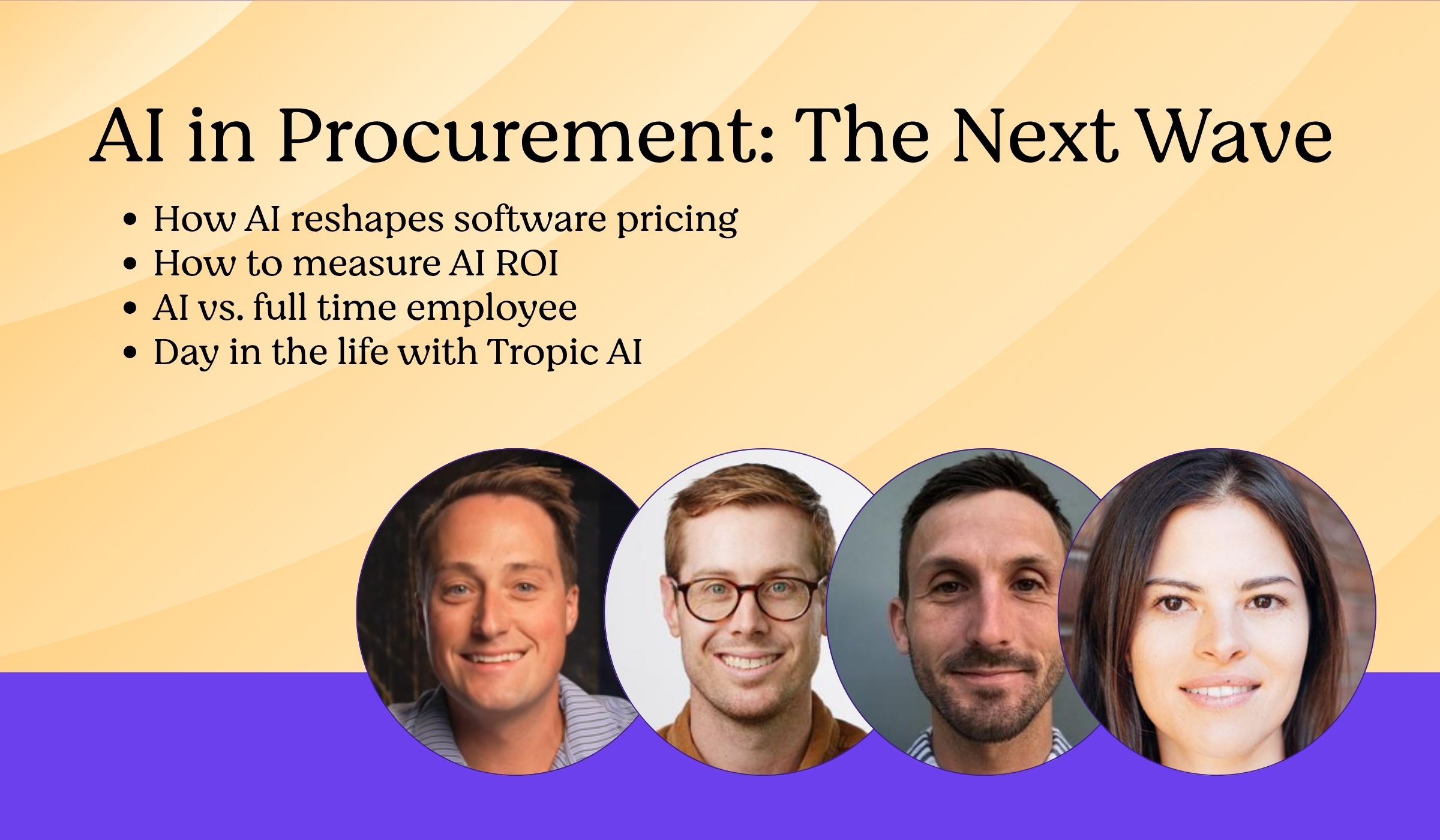
We are about to shift gears a bit and, bring on a group of panelists.
And the people you're about to hear from are not in the, kind of experimentation phase. They're leading and testing, and they're questioning. They're trying to drive their organizations and think about what should AI be within the office of the CFO and the office of procurement.
They've been hands on in figuring out what actually works inside real companies, so we will bring them up.
First, we have Isaac Eidenberg, CFO at Human Security.
Welcome to the show, Isaac.
Hi, Ethan.
We've got Abhijit Hussain, strategic sourcing and procurement lead at Plaid.
Hello, Abhijit.
And lastly, we've got Kunal Agrawal, CFO at Gorgias.
Hi, everyone.
Alright.
Welcome, guys. Thank you for joining. Excited for the conversation.
So we are also going to start with a quick lightning round of questions.
So, oh, before we do that, actually, we'd love just a quick intro from each of you guys.
The role that you are in the organization, how long you've been there, and in one word, if you had describe the future of AI in the Department of Finance procurement, what is that one word you would use? So, Isaac, you wanna kick us off?
Yeah. Sure. So, thanks for by the way, thanks for having me. Isaac Eitenberg, CFO of human security. Been there about four and a half years now, and the human is a in in cybersecurity.
So we'll we'll see if someone's bought or not, pretty quickly.
For in terms of one word, I guess. Right? I would say, may maybe the maybe the word is very patient.
I guess that's two words. But, let let's let's try it. Start there.
Great. Patient. We will take it. Patient is patient is good. Abhijit, you wanna go next?
Yep. Hello, everyone. Abhijit. I'm the head of strategic sourcing and procurement at Plaid, and we are a fintech infrastructure company. Worked with, like, lot of fintech apps, like Robinhood, Coinbase, and all of those. I've been here for almost four years. And if I had to describe a word when it comes to, like, on top of my mind, it's, like, transformational.
And, also, if I have to, like, say another word will be, like, augmentation, it definitely gonna help us create more impact using AI.
Awesome. Alright. And, Kunal, let's let's take it to you.
Hi, everyone. I'm Kunal Agarwal, the CFO at Gorgias. I've been there for about ten months now. So, you know, still early in on my journey. One word to describe AR, I think, Abhijit took my storm here with transformative. What I'd say is, like, kind of exciting is is a word I would use.
Great. Alright.
So let's let's get into it. And, first, I wanna do a quick temp check for each of you guys and, kinda get a get a a vibe on your excitement and, interest in AI. Let's get out any of the skepticism, the the glory that it that it could represent. I think everyone here wants to understand what our CFO is thinking about when it comes to AI. So we'd love to let let's start there. So, Isaac, you wanna kick us off?
Yeah. Sure. I I think my verb was probably the opposite of the other two, or at least I was trying to be in the middle here.
I'm I'm let's call it, like, patiently skeptic or at least skeptic for a little bit, you know, or pessimistic on on ultra short term. I think long term, it's gonna be there.
But in terms of just for the finance function, I think it's still you're gonna have to wait for some time for to see some of these big benefits, for for some of these companies. Now, that's not to say I'm not, you know, pushing AI at my company for, you know, the g and a function in general. We are looking at it, and I look at it as a way to improve processes and and keep doing there.
But I think there's a little bit of, you know, is it is it gonna completely transform my finance function in the next twelve months? Probably not. And frankly, for me at least, I wanna look at it and and as a CFO, look to go to go to market or r and d because I think those are the bigger cost centers. And that's where I can get some great improvements, some great, product improvements. And so if anything, I'm I'm pushing that even faster than for the g and a function.
Nice. Great.
Abhijit, do you wanna Yeah.
Like, a lot of people think that, you know, like, with AI, there's a missile misconception. Right? It will, like, help us, like, make solid decision making. But, again, based on what we have learned, based on what we're trying to still learn, you still have to put, like, lot of controls, guardrails, and you have to, like, think about how we are feeding the data. So that's something that we're working on. But, yeah, definitely, we already see some value how we can help on our day to day operations.
But, yeah, I'm definitely, like, optimistic about the future. But, yeah, definitely, like, need to do some work from our side.
Great. Yeah. And Kunal?
Yeah.
Listen. I think, for from my perspective, AI is not like a luxury. It's a necessity. Meaning, like, I think across the company, we are pretty pretty explicit that, like, everybody kinda similar to what, like, Toby said from Shopify or even what, like, how Aaron is talking about this at Box.
Like, everybody in the company is is not an option to kind of embrace it now and get more efficient. Right? It's just like you have to do it or you're not gonna be here anymore. And so, like, I think now the question is, like, what's that time continuum?
How long does that take to get up to speed and to start using it? But, you know, the the reality is, like, we're not gonna be in a position to continue to grow headcount like we did in, like, the heyday of, like, the SaaS boom. Right? Like, everybody's gonna have to get more efficient with what they do, and that requires process rearchitecture.
And, like, AI is a piece of that. It's not the only, component to that.
So, like, we have to rethink process and get more efficient. And I don't think it's, like, AI hundred percent. It's AI is a piece of that that enable us to do that. But I do think it's an incredibly important thing, especially, like, as you pointed out in the r and d function, right, where it's much more measurable to me to kind of look at engineering output. But I also feel like, you know, we need to lead from the front on the CFO org, and we need to make sure that the folks in our org are embracing this and getting more efficient.
So, yeah, I'm excited about the transfer about the opportunity. I think AI and finance is probably a little bit of a laggard. Doesn't mean we can't get near term, benefits from it, though.
Yeah. That's great.
So let's let's shift gears a bit and talk about, you know, what's going on at your respective organizations. You know, companies often look towards the CFO, towards leadership to set the culture and, and determine what everyone should be focusing on prioritizing. You know, Kunal, you mentioned some of the thinking around, you know, everyone needs to be embracing this. So, you know, Abhijit, let's start with you. You know, what what's the what's the culture right now at Plaid, and, you know, how in your role are you responsible for driving that, for, kind of, controlling it? What's your you know, what what's what's happening right now at Plaid?
Definitely. Like, we definitely wanna be AI first company, and, again, that's the mandate that we have from our executives. So definitely, like, expectation that, you know, like, each and every role, you have to use AI in your day to day work. And especially for engineers, like, they are supposed to be, like, applied AI engineers now. That's what we call it. So yeah. Definitely, like and my role is to make sure that, like, how can we enable that ecosystem and infrastructure to make sure that engineers and non engineers, they they get the tools that they need.
Yep. And so as you're, you know, in serving in that responsibility, in that role, what what are some things that come across your desk for, no brainer, green light, but this is consistent with the goals versus, hey. We need to think about this, you know, be a little bit more skeptical.
Correct. So, I mean, like, if I have to, like, call up, right, there are, like, two buckets. First one is, you know, like, high impact and low risk. So this, you know, like, our internal operations where we don't have to worry about, like, data sensitivity.
We can just, like, enable those, AI features and get more efficiency and more effectiveness. But, like, when we try to use AI between our products and, again, being fintech, we have, like, lot of sensitivity in terms of, like, PI data. This is where we have to do we have to be very cautious how we deploy AI within our products, and that's why it takes a lot of time, efforts, and alignments with our, like, privacy, security risk to make sure that, like, how can we sensibly deploy AI within our products. Again, that's where, like, the focus is right now.
I think we only, like, tackle all the lagging fruits, but, like, if you really wanna, like, get to the next level, this is where we have to work with our product councils, to make it happen.
Yep. Got it. And and and Isaac, as the, the patient skeptic or optimist, how does that how does that translate into how the organization thinks about AI in their respective areas?
Yeah. I think there's, there's a couple of ways you can take this. I I you know, I I think as you just mentioned, like, there there's that risk factor of, you know, there there's a little bit of, a feeling of, you know, how, like, you know, cloud services were in the, you know, late two late nineties and early two thousands where people are just getting different AI tools on their credit card and you're finding out later. And and, you know, look, that's a risk that you gotta be careful on, you know, especially in, like, a fintech or a cyber industry where you're like, you know, I don't know where this data is gonna go.
And there's a lot of implications there. Right? And so I think that's that that's almost like one bucket of, you know, making sure, like, you know, our information is secure and being used properly. Right?
So, you know, I think that's that that's kinda one part. I think the other part that you were kinda, like, leading toward in the question is, like, you know, in the group, I I I do think there's it's starting to be a you know, there's definitely people that are like, look. I'm going to go all in on this. I'm gonna teach myself how to get as good as possible.
I'm gonna see what big implications I can have in my respective area. And you're seeing a lot of tools, like internal tools being developed with the help of a chat g p t or others, that are that are interesting. But but funny for me, what what I wanna start seeing is, okay, which of these tools, tools stay? Which ones are gonna be, you know, overtaken by, you know, a a sales were saying, hey.
I we better do this before anyone else or for us, like, you know, NetSuite saying, oh, no. Like, let's get something there before, like, they you know, everyone develops their own and doesn't need NetSuite. Right? So I'm interested to see what happens there.
But that's absolutely happening. And I think the other part is, you know, look, you know, I think in terms of, like, what, you know, what are, like, things you say slow down when things you say, yeah, go for it. You know, if someone says, hey. Look.
I've got this great thing. I'm gonna go, like, do this for a couple weeks. Either it's gonna impact the product and we're actually gonna put Ingentiq, you know, features into the product or it's just gonna make it better or machine learning, that's a no brainer. It's it's scale.
It's less people. It it's when people start saying, hey. I need more people to go do this. That's when you start slowing things down saying, why?
Start telling me you know, start doing that. And I think that's you know, it's almost like you're you're introducing I think AI has this advantage of, like, look. You're introducing a new tool for process improvement and scalability at a time when you have a market that is, like, much more, you know, unsure. Right?
And so that's like a you know, for a CFO, you're like, look. I'm gonna do what I can to to, you know, get that scale without adding more people, especially in an unknown macro environment, right, or much more variable. And so I think that is the thing that, like, if anything, yes, I'm I'm leaning more towards opening it up.
I'm absolutely, you know, doing much more of it if I can in the go to market and r and d just because there's more scale there. But, like, you know, for g and a, I think you are starting to get people saying, hey. Look. I wanna, you know, pick this up and get better at it. I think they're gonna have an advantage over the next five years in their careers versus others. Right?
Yeah. Yeah. I think that's great. And and one of the things that that you mentioned, which is, you know, hey.
I've got a two week project that I wanna try, and let's see what the results and look you know, looks like. And really what that, you know, says to me is experimentation is is encouraged. Right? And we want people trying new things, seeing the results.
You know, Kunal, is that similar when you're saying in in Gorgias and, like, similar to the Shopify ethos, experimentation is really the name of the game right now? Or are you thinking more, you know, broadly in in kind of from an infrastructure level?
Yeah. I think it's, you know, I'd say, like, there's probably a mismatch right now of where I want people to be at versus people's, like, where they're at actually with, like, experimentation and tools. I think it's very much of, like, casual experimentation versus how do I embed this into my day to day to, like, actually really kind of transform processes and efficiencies. Like, I think we're pretty still far away from that as a company, and we need to do a better job.
And I think that's, like, setting executive tone, measuring some of these things. Like, that's the hard part. Like, for me is even for my org. Like, how do I measure output efficiency?
Right? Because the g and a org, it's like it's not the same as, like, an engineering org where you can look at, like, the number of commits or stuff like that. So I think part of that is, like, how do we instrumentalize that? I do think it comes a lot of this as cultural tone.
I think the the one kind of slightly maybe different take I have on AI is not just to make you more efficient in your job, but it's, like, enable us to make better decisions. Right? And I think the office of the CFO, a lot of this is, like, building a decision science function where, like, we are partnering with the org to enable them to make better decisions and do it quicker quicker. And so, like, I think one of the more, more important things is, like, how do we build some of that underlying infrastructure?
And so that's where like, for Gorgias' example, like, the data team reports into me, and we've actually made an investment in building the underlying data infrastructure and a data lake, where that can all go to one centralized query that we can now start instrumenting and pulling information out of. And so that is now, like, I think in unlock because, like, a lot of times people think of, like, AI as I go into chat g b t and putting in a prompt. Like, that's one aspect of it. But, like, I think AI is, like, you have to also build some of the foundational infrastructure.
And so, like, we made a casual or a very concerted effort to build that infrastructure. But now that enables, like, self serve information, self serve access to a bunch of information across go to market, customer success, r and d, to get access to a bunch of information to enable our teams to move faster and to make better product decisions, to make better go to market decisions. So I think that's another aspect of AI that's probably not talked about enough. It's like, if you really wanna harness it to make better decisions, you do have to make some underlying infrastructure investments so that data is, like, highly has high integrity and easily accessible.
Yeah. I think when I when I think about some of the AI applications within organization, there's there's kinda like the bottoms up testing experimentation and and fluency that you might see at an employee level, and then the top down kind of strategic alignment around the big bets and opportunities that might exist. And so, Isaac, I don't know if you're seeing something similar where, you know, encouraging, you know, people to become more fluid, understand what the opportunities are to therefore unlock some of these bigger top down initiatives where people can really make big bets and and create some of that infrastructural change.
Yeah. I mean, actually, as Kunal was saying that, I I I was actually, like, nodding in agreement on you you know, you almost look at it as, like, there so even if I think the impact on AI, you know, with AI specifically on the g and a function or or the rest of the thing, you know, the rest of the company also is is a little slower than, you know, immediate just transformation in twelve months. I do think there's, there there's the building blocks that you have to actually start doing. Right?
And and as Kunal mentioned, like, oh, I I think data and getting a centralized data team, one and we have a similar setup here for us as well. But then getting that into a place where, like, you know people can access data in a standardized format, is an important investment. Now I think AI can help actually take some of that unstructured data and put it into the right places even faster. But if you think about it, like, you know, that's what you're gonna really want is get decision making even faster.
So instead of going into Looker, go into Slack, go into other things to be able to, you know, have anyone Slack, you know, or or ask chat gbt something, you know, that that will give them a much more informed decision based on the data that you've made sure is is clean, is is an important thing. So I do think that is that is there. I think, you know, and not to to to keep talking about other parts of it, but, like, I I think the the the big aspects of, like, look, what, you know, what kind of productivity can I get for developers, with a copilot type thing? Right?
That is an investment we're making, and I'm I'm gonna guess, you know, most most other people are, you know, into, you know, into looking into that. Because if I can unlock, you know, a a fifty percent impact, twenty percent, it doesn't matter. These these have huge, huge implications.
Yep. Totally. And and, obviously, I'm I'm curious on on your side.
You know, you see, obviously, all of the the the projects and the the undertakings across the organization from big strategic sourcing, like, this is now, you know, massive infrastructure change that we're, you know, pursuing in support of an AI, ambition versus, you know, the individual, you know, tools and, tests that are happening across the organization. You know, what's the what's the breakdown and and the level of attention that you're paying on, you know, those two different buckets of of work?
Correct. That that's a great question. So it's all about the trade offs. Right? We definitely wanna make sure that we are solving for scale.
At the same time, we're also solving for velocity. So, definitely, like, my focus is making sure that we are, evaluating our big bits. That's, you know, like, most of the LN providers, you know, like, all of these big companies who are, like, transforming transforming the landscape of AI. But at the same time, based on, like, the pre the framework that we had developed with our risk privacy security, we're also, like, enabling engineers to do, aggressive but control experimentation.
Again, we have definitely, like, created a lot of criteria to measure that there is no ambiguity, like, which data you can test because we definitely wanna make sure that engineers to get their hands dirty with, like, lot of, evolving tools that we have, and we don't wanna, like, slow down with our, like, typical sourcing or procurement process. So we have definitely given, like, them a framework which tool they can do experiment and also have allocated a specific budget. So at least we are making sure that we're also looking at cost versus the ROI.
Yeah. We'll we'll get into some of the security things because between, you know, you and and Isaac who, you know, obviously, is a security company. There's a lot of, there's a lot of strong opinions around the risk and opportunity there. One of the things that I've been thinking a lot about also is, you know, the differences between, you know, AI explosion and SaaS explosion.
Right? SaaS explosion from, you know, ten years ago, they all of a sudden became very easy. Swipe a credit card, you bring on a SaaS tool, and you, are able to, you know, get more efficient in your in your day to day. AI is kind of that same concept but on steroids, where now you swipe a credit card and, presumably, an agent can be doing the work for you.
So, you know, obviously, I'm curious, like, how are you guys you said the controls in place, so it's not running crazy. But how do you still keep the, fluidity and flexibility for people to do some of that, self driven exploration and experimentation?
Correct. And, again, as I mentioned, right, again, like, there are, you know, like, big player when it comes to, like, LTM providers. Yeah. We definitely have some customer agreements to make sure that, like, specific use cases can be, like, tested out internally before we actually do, like, you know, like, big, big pilots on that one. But in terms of, like, how do we achieve that, again, as I mentioned, right, like, we definitely have provided, like, over communicated to people, you know, like, what is the risk involved and which are the which are the things we can definitely try internally and what is, like, the approved guardrails from, you know, like, our risk and privacy team to make sure that they have very clear directions from, you know, like, which tool they can evaluate, what is, like, specific threshold that we have allocated, and what are the resources they can utilize to to do a better, job at direct the experimentation.
Yep. Got it.
Great. Well, we're about halfway through, so we're gonna do a quick round rapid fire question.
Starting with you, Kunal.
What is the last AI tool that you used and your thoughts on that?
Okay. Good question. Actually, we the last, funny enough, last AI tool we used was actually OpenAI AI Deep Research. So we we just signed up, like, an enterprise account, so we kind of have access to all of this. It was actually pretty interesting.
I wanted to understand. There's some questions we had. We're an ecommerce company, and so we had some questions around, like, what's your exposure on tariffs? Right? How many of our customers have exposure in Chinese manufacturing operations? Like, not an easy question to kinda answer. And we actually just, like, dumped in a bunch of information into deep research with, like, our customer, their domains.
And it came back with, like, an actually like, I mean, I'm not gonna use this in a board meeting, but, like, it was a pretty interesting, like, set of information there about, like, how they thought about the macroeconomic exposure, which customers have kind of research or, basis in China and other kind of foreign subsidies where tariffs were really high. So, like, it was just something where it's like, you know, I didn't really know what the starting point was and versus, like, having someone on my team spend fifteen, twenty hours trying to research this. Like, I got an answer pretty quickly that was, like, actually relatively helpful to kind of baseline the conversation. So Yeah.
We we're you're solving the you don't know what you don't know, piece of it and now getting a basis. So, yeah, we've we've seen a lot of of value to deep research. Isaac, what about what about you?
What's your No.
I feel like I'm a little vanilla. We we we actually just got a, you know, OpenAI Teams license. So we're we're we're kinda taking baby steps. It's one of those you have to do anyway, though, for for security to make sure your teams yeah.
Your teams can use it anyway. But, funny enough on the g and a side, I'll give you two examples. One was, you know, we were trying to you you know, trying to figure out which of our clients had a, you know, certain characteristics of old you you know, we were trying to figure out who has, like, old, some old MSA paper and who's on new ones. And, you know, it wasn't easy to get to in just doing through Salesforce.
And so we just actually, we were able to, like, dump some data pretty quickly and get the answer and, you know, something that would have taken probably two weeks for me to see was was, you know, probably done in, like, you know, in hours worth of time and right right in front of the team. So that was that was fun.
Another random one though on the other side is where you just gotta be careful. Right? Like, you know, had a a new lease coming up, and I said, let it like, you know, let let's just have chat GPT quickly summarize this thing.
And, you know, actually, it got the format right, but it did the calcs on the, you know, the the foreign currency wrong. And I just don't know what it used to get there. Luckily, we looked at it and did it.
So, you know, look, it's the two two smaller g and a, chat g p t things. I will tell you the, the one I'm I'm most excited about, once again, r and d side is Cursor.
You know, I I I think there's just, you know, a lot of upside there, and it's almost back to, like, you know, as Kunal was saying also, like, being able to actually, like, look and and, you know, put KPIs or OKR, that side of the house has been something I I think people have been trying to do for fifteen, twenty years. And, look, I think this is an opportunity for it.
Yeah. I'll, we'll come back to that in a second because ROI to efficacy of different AI is a is a big, is a big topic.
Alright. Abhijit, what what about you?
Yeah. Again, as to Nala, as I mentioned, right, we definitely use deep research capability for market intelligence and especially when we look at, you know, like, big migration projects. Because, again, definitely, in order to run AI, we definitely need to have, like, a data warehouse. And in order to look at, like, the migration strategy, what are the thing that we should be thinking, definitely, like, deep research, like, gives you that point starting point and, like, how to think about the next steps.
So we definitely use for that. In terms of, like, day to day tactical, we also definitely use, like, lot of, AI tools like Dashworks, Zania, to make sure that, like, how can we streamline more data to the operations. So for example, right, within procurement, again, like, we are, like, a mighty team of, like, two to three people and serving, like, more than, like, thousand employees at Plaid. And we deploy, like, AI Slackbot within our procurement channel.
So, like, people just get ninety percent of their, like, questions answered just by using, like, the internal playbook, internal procedure that we have developed so that we can spend more of our time on actually, like, driving savings for the company.
Yeah. That's great.
I'll I'll share mine. I'm finalizing honeymoon details in August and have been an active chat g p t user in researching, hotels and other accommodations. So, lots of lots of personal chat chat activity is happening in in my life.
Alright.
So let's talk different use cases. I think the the r and d one is a great one to to start with, Isaac, just to kind of pull on that thread a bit more. You mentioned r and d, go to market, clear areas for opportunity. What is it about those functions that seem so compelling, in the kind of broad scheme of where AI can be deployed today?
Yeah. I mean, it's where the money is. Right? So, you know, percentage of revenue or, you know, just overall cost, that that's where traditionally both, you know, every company is.
Right? So, you know, whether I like it or not, g and a has almost been forced to be the smallest function forever. It's always the first place if you're looking for cost cutting from your investors or just like, you know, if you've been around the business, you're you're gonna try to keep it as lean as possible, to avoid that bull's eye. Right?
And so I just think there's opportunities in other places. And so if I can you know, if you're thinking about, like, you know, percentage of revenue, if you're like, you know, I don't know, like, in the mid twenties for r and d, that that's a significant portion of your business. Right? And so they're just more scale there.
And, you know, just like anything else, like, if you've got, like, you know, I think as we mentioned earlier, I think, this is just a tool for process improvement. Right? And so, like, you know, the the more dollars, the more, you know, ability to to, you know, save using those process improvements. Right?
So that's why I think for us, at least, it's exciting part. I think the second part for, you know, for the r and d specifically is just, like, the measurement part of it has been hard. And that's always been a constant, you know, I would say struggle for a CFO saying, wait. Why do you need that next engineer?
And I I think this kind of at least gives them you know, what I've seen is for CTOs that are leaning in, a tool for both ways of measuring it and being accountable for them.
Engineers everywhere are shaking in their boots now being evaluated based on lines of code written and all the things, that that they that they, fear. But, I totally I think that there's there's a ton of new ways to measure ROI that otherwise have not been possible. Kunal, what about, you know, mandates across the board, but any specific functions that seem to have the biggest uptake right now?
I think, yeah, I think Finest is probably the slowest adopters, to be honest, on this. Although, I've seen, like, funny enough, our accounting team, like, really kinda start embracing it in the last three months and have, like, draft again, part of this is process improvement of, like, focusing on, like, the most important things, and then AI is helping that process improvement versus the other way around, like, AI driving process improvement.
But we've seen, like, a pretty substantial, like, reduction in time to close be and AI is, like, helping with driving a lot of the efficiency and stuff. So I think you think that's pretty interesting use case, especially on, like, the revenue accounting side. I think, r and d is probably the the natural, adopter. I think what's difficult though is it's kinda like being done in pieces.
Right? And it's not like a systemic approach to, like, how to use Cursor or Windsurf or Cloud or whatever the different tools is. Like, people are kind of using a bunch of different things. And I think what, is helpful actually and one of the things we're contemplating internally is, like, do we need, like, a dedicated person or maybe two people who are company ride responsible for, like, driving AI adoption and measuring it and, like, setting up the programs and the systems. Because, like, I think what's we're starting to see a lot of it is, like, there's a lot of talk of it, but it's hard to take to the next step of, like, operationalizing it and then measuring it. And so that's probably where we struggle the most as a company right now.
Yeah. I think that you can take that in a couple of directions. Like, you know, if you really wanna measure the efficacy, like, do you set up AB tests? How are you wanna really, like, measure the, you know, the productivity increases based on the, you know, control group or not and just make sure that we're driving that broad based adoption across, organizations. So I think we're seeing, you know, similarly lots of the the AI program management, roles and and capabilities pop up.
Abhijit, anything on on your side from a functional area where you're seeing the most value, the most interest, as you're supporting different requests across the org?
Correct. Yes. I mean, like, we definitely have company wide AI days where, like, people are encouraged to think about, like, what are the areas that they can target. Again, based on, you know, like, high impact and low risk and all of that.
So, yes, I mean, we do already see, like, huge, increase of AI adoption within our engineering r and d functions. So that's the way again. Like, as you mentioned, like, Windsurf Cloud and all of that, we are using those tools. But we also have department level AI days, especially, like, we also have done, like, lot of, great work in terms of accounting, FP and A, and biz business operations as well.
Great. Great.
Alright. One more question here.
This is a a big one that's on everyone's mind, thinking about how CFOs are thinking about budget allocation towards AI. You know, we did a survey in advance of these these events to talk about, you know, the percentage of CFOs that are thinking about, you know, AI specific budgets now versus the plans and intent for twenty twenty six. And we're seeing a massive increase that as people are starting to think about twenty twenty six, the approach towards budgeting and headcount and, you know, vendor spends and AI is all starting to get a little bit, you know, different from how it might have, existed in the past. So, I'm curious, Isaac, as you're thinking about, you know, the budget, and and how you're, enabling your functional leaders to spend money across the organization, are we giving specific AI earmarked budget? Are we incorporating into the overall kind of vendor spend expense landscape? How are you approaching it?
Yeah. I mean, one, if if others have already figured out their twenty twenty six budget models and stuff, I'm I'm really excited.
Twenty twenty five just started. Right?
Yeah. Yeah. Tell me what you're do tell me what I'm doing wrong here. Here. But joking aside, here's kinda how I'm thinking of it.
Like, you know, one, once again, you go back to the earlier parts. Like, I I I'm using AI as, like to me, it's another tool set and another cost item there. Right? I still have goals for the company that I wanna do.
Right? And whether AI enables them, it's either gonna help it on the, you know, less burn, better EBITDA, or better revenue growth. And, you know, beneath that, if people are using those tools to help get to those places and, you know, to our twenty twenty six goals, great.
But at least for me and my my guess is, you know, Kunal and Abhijay are gonna say the same thing. Like, it's not like we're gonna sit there and increase our burn just to go do this. Right? A normal investor or any anyone else sitting here is gonna say, you know, fine.
If you really wanna do that, it's no different than, like, adding more people. I gotta see the investments later on for it. Right? So my my guess is most people, you know, most CFOs are gonna be looking at, like, look.
Next year, with uncertainty, I need to get more efficient. I need to either, you know, show up in revenue growth or, you know, cost, cost improvement. So I don't think they're gonna increase one and and just, like, let everything else go. I think it's gonna make up for other parts.
Right? So, like, you know, my this is no different what I did in twenty, you know, twenty two, twenty three, or twenty four. If someone comes in with a new technology, I'm gonna say, great. What are you doing in you know, to to offset that cost in your group to still hear your goals?
Yep. Yeah. Absolutely.
Obviously, I'm curious on on your side, you know, as as people are starting to look towards their, you know, their vendor spend out into twenty twenty six, out into twenty twenty seven, you know, are are their decisions getting made now, in favor of and thinking towards an AI future and that impacting what the overall spend envelope might look like within the department?
So lot of budget owners definitely have, like, a lot of control, like, how they wanna spend it, for example. Right? We what we have done, we have, like, a central budget for, like, r and d level spend because that's gonna, like, be transformational. Like, there's a lot of impact.
But for other, operator software, what we have done, we have given budget functional leads to make sure that, like, again, lot of the SaaS tools that we're using, they're also, like, rolling out a lot of different AI features. So up to the budget owners, how they wanna use their budget. They can definitely, like, upgrade to the existing platform that we have and get, like, more add ons to, like, create more impact and more efficiencies up to them. But the way that we have budgeted is, you know, like, we only put, central, reserves for, like, big base and for other function leads. They can definitely, like, try to tweak the budget to get, like, the most out of, like, the current SaaS tool they're using through our through our air runs.
Right. Yeah. So then so they're they're they're able to use that budget and make it as efficient and as, you know, high volume, low concentrated as possible to to get the most bang for their buck.
Right.
Yep. Got it. And, Kunal, how about how about you? How are you thinking about, you know, budget allocation and, functional, you know, budget owners and what they're empowered to do?
Yeah. I think it's pretty similar to what Isaac was saying. You know, from my perspective, we don't have a centralized, like, AI budget, amount. I think we wanna try to, have the budget owners kind of responsible for, like, how they wanna get to their goals.
I think what we start with, though, what we will approach this planning cycle with, and, you know, we haven't started FY twenty six planning yet. But when we do approach, I think it's gonna be like, hey. There's to me, like, I don't think a dollar on headcount is the same as a dollar on, like, AI tools. Right?
So I think first of all is like, hey. Head count growth's gotta be pretty efficient. And if you're hiring heads, there has to be, like, a really high bar for why you need ahead and, like, what that's gonna do. And I think that's going to naturally force constraint into the system to say, like, oh, you're still holding me accountable to do all the same things, but you're holding so, yes.
That's the answer. You gotta do more with the same amount. So how are you gonna do that? Now you can come back to me and would say, like, hey.
Here's the type of tools I need. Here's what I wanna invest in. The one thing I'm starting to see a little bit that I think is a new kind of concern for the CFO, office is that see a lot of, like, tool proliferation. Right?
So if you're not, like, centralizing stuff, like, every single person or every department is kind of experimenting with their own tools, which is great. But at some point, like, I don't want a subscription to, like, twenty five different AI tools. Right? Where it's like, we saw the same problem with OpenAI until we got into an enterprise plan.
We had, like everybody was charging an OpenAI subscription to their company credit card. And I started to look at this, and I was like, oh, this is kinda crazy. Like, we're spending a lot on credit cards for OpenAI. Like, we could probably get the same dollar spend and get, like, a much higher level of tier service, enterprise customer success, all that type of stuff by consolidating.
So that's just one thing we need to kind of be sent we're a little curious about is if we're not centralizing kind of a centralized AI budget to make sure at least kind of centralizing software spend across tools to make sure we're getting leverage there.
I think that's a perfect segue into our last little bit here on risk and compliance, because you're it's totally right. You know, the the proliferation of of tools, we're in we're in SaaS world two point o, and there's a balance between the encouraging of everyone to go out and experiment and what does that actually mean, if you can't, you know, quickly and easily make decisions around swiping a card for a license versus having to centralize all, you know, flow of requests and and, and asks for those tools. So, you know, sounds like, Kunal, you guys are, you've take you've you've let people get a little bit more, flexible around how they can bring things on and are opting to control a bit more on the back end once we see, some of that proliferation. Is that is that fair?
Yeah.
Cool. Yeah. And, Isaac, I don't know if you if you're how you're balancing you know, you guys are you guys do this for a a living.
So it's in compliance with what exists.
Yeah. Obviously, I think my CISO sleeps slightly less this year than he did the year before, you know, on this stuff. But, you know, look, I I I think the interesting thing is I I probably am more worried about the compliance and risk and the data factor on it than I am right now on the cost factor because I think we have good cost measures or good, you know, enough controls on cost that it's not gonna go too crazy. We'll see it.
Right? I think I'm more concerned about a rogue agent or rogue, you know, something that someone's just playing with and they, like, you know, take our Salesforce instance and put it in there, like and and then it's for everyone to see. That's probably my bigger concern. Right?
So I think that's what we're that's what we're trying to balance and make sure, like, we you know, like, I wanna let people experiment, especially now with different tools to see what else is out there and and get efficiencies. But, you know, we've gotta be careful on that. And, yes, like, that's that's that's why we're all in this tropic call for having a centralized PO system or some some tool to help you manage it. Because I do think it actually helps pop things up, if they don't use the credit card right on there.
So I think that that that's kind of how we're looking at it, but I think it's, it's a little bit of, like, you know, I wanna watch it. I don't I don't wanna stop creativity.
But, you know, obviously, there's there's controls. There there's risks and controls and compliance issues there, especially if you're in a, you know, a more sensitive thing. Like, you know, if you've got ecommerce, if you've got fintech or or cyber there, the those are things we have to worry about. And, you know, will the, you know, will every employee think about that when they're downloading a tool and saying, hey. For four hours, I can hack on this, and I'll save, like, three months of work. Let's see. Yep.
You know, that's that's that's the balance you gotta do.
Totally. Yeah. And, obviously, obviously, you guys in fintech are I know that you stood up a bunch of new processes for keeping track of the AI spend and security implications. You know, talk through a little bit around what what that's looking like at Plaid.
Right. So at Plaid, right, we have AI data usage policies. And what we have done, each AI tool is governed by a specific data data tier policy.
And if a specific AI tool needs to get, like, high level of data, for example, if it's gonna have, like, an PII, it has to go through a expedited, level of approvals with our, like, CISO, with privacy, legal to make sure that, like, in decision models that we are gonna, like, employ or deploy within our products, they have, like, explicit approvals. And whenever we are doing any change of scope, we definitely, like, work with the vendors, get, like, lot of, back end, data about, you know, like, what is your data retention? Are are you guys gonna use our data to train your model? So, like, all of those things we collect, and then we take decision based on that one. Because we just wanna make sure that, again, we definitely don't want to, like, hinder the creativity velocity for engineers, but we definitely wanna make sure that anything that's gonna be, like, sensitive in nature, we have, like, lot of guardrails in place.
Got it. Great. Alright. Last rapid fire question for you guys before we go.
What is the, the big unlock that you're hoping to see to take you from your current stance on AI hype and take you even further on the hype train?
So give you ten, fifteen seconds to answer that.
Kunal, you wanna you wanna lead us off?
Sure. I think what I would love to see is a way to just prove out the efficiency gains. Right? Because, like, in my head, I know it's possible, and I'm probably more of an optimist than most. But I would love to kind of figure out how do we kind of track and show the ROI for what this is because I think that's the hardest thing that I'm struggling with now. And I think we can solve that gap. It'll just incentivize people to kinda see the progress and then to double down on it.
Yep. Great. Isaac.
I I I think to actually, you know, get on the hype train for me because I'm not on you know, I'm I'm I'm waiting for that, like, trough of disillusionment or I don't know. Maybe it's like the hype cycle is this part. I'm waiting for that, and then I'll kinda, like, jump on in. Right?
But, you know, honestly, I'm waiting for vendors to come in with good tools for the, you know, for the finance side that start changing things. So, like, you know, if we start seeing those tools that, like, you know, make invoicing and close and and, you know, journal entries and all those fun things that, you know, like, that we look at the account. So if we start seeing some tools that actually have a big impact versus us saying, hey. Look. We did this in quad or we did this in ChatGPT. That's what I'm gonna start looking forward to. I just I haven't you know, I I know there's people out there doing it.
I don't think we've seen anything quite yet that we're, like, locked in saying, oh, man. This has changed. This has changed it. And I think for for the finance side, that's what I'm waiting for. I I think similar to what Kunal said on on the other side. It's like, we're starting to see that, especially in r and d. I think go to market, I'm hoping for the vendors to come in also on it.
Great. Alright. Abhijit, let's take us home.
Yep. Again, I already see, like I'm, again, I'm optimistic about that was, AI is gonna bring us. But, again, a lot of the focus right now is more about, like, efficiency, productivity, and ROI. And if I really wanna, like, put my, like, ideal situation thing, thing, like, I would definitely wanna make sure that, like, how AI can help us understand, okay, is the current business model working for us? Like, do we need to change anything from that side of things? And also, like, instead of just focusing on, like, efficiency and all of that, how can we make our consumer or customers' experiences better? That's where I really wanna see the impact of AI in in future.
Amazing.
Alright.
Thank you, guys. We have we we did it.
Very much appreciate all of the thoughts and perspectives.
Everyone here is super appreciative to hear how real companies are thinking about this stuff on a day to day basis.