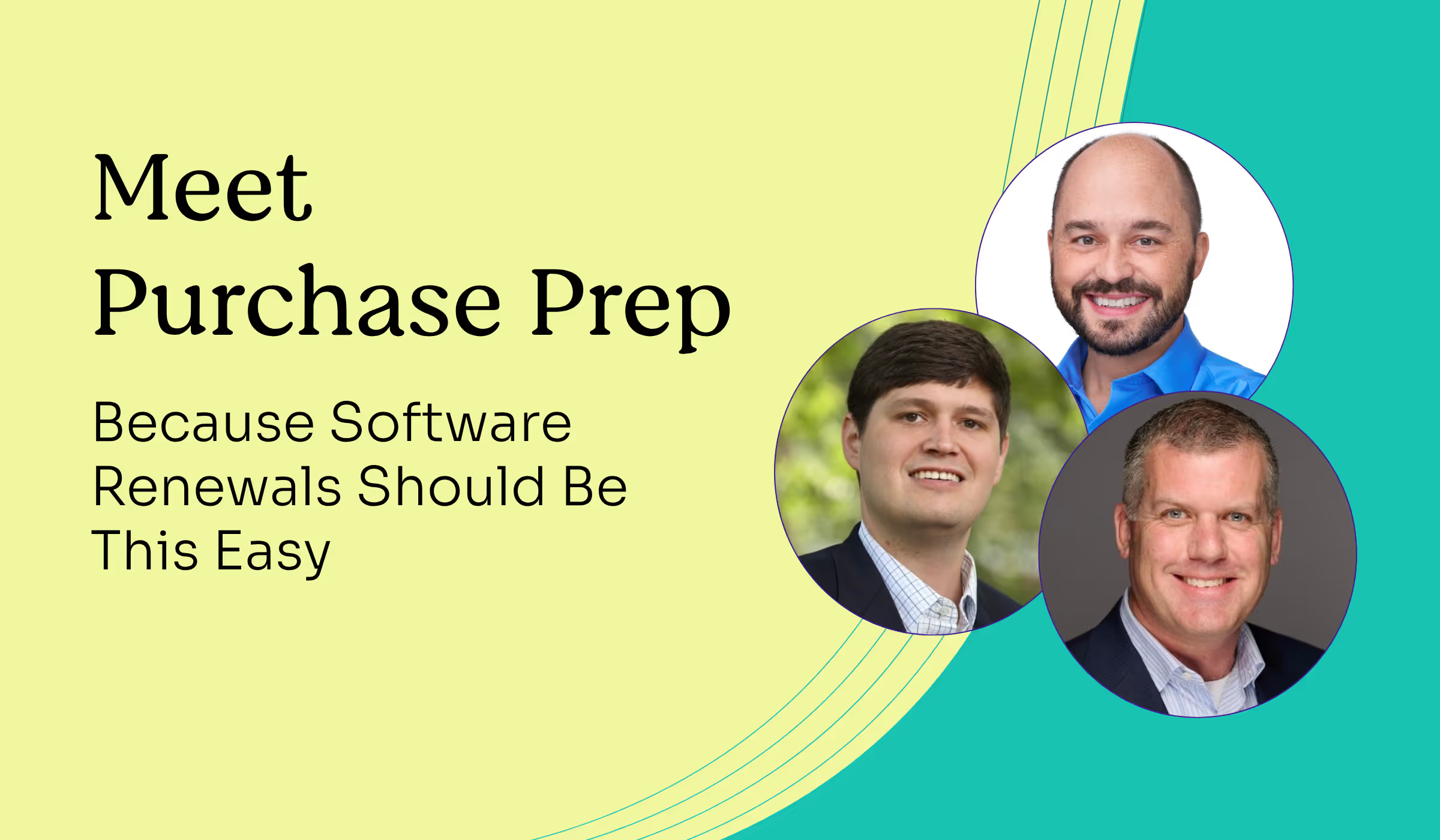
Wow. Mandy Faulkner, Jacob Leichman, two of Tropic's finest. It's a privilege to share the virtual stage with you today. Thanks for being here.
Thanks for having us, Shields.
Happy happy to be here.
So for those of you who don't know, these are leaders on Tropic services team, the team that's actively out there doing procurement, negotiations on behalf of our customers. And and you both have a long tenure here at Tropic, and so is I'm excited to dig into the wealth of experience that you have.
But but first and foremost, like, I genuinely think this conversation is extremely important. It's one that I'm having basically every week with with different business leaders.
I posted about this yesterday. It's it's kinda like advertising for for the webinar itself. And, you know, in the past, I talked about how, you know, times have changed. Right? Like, there's this thing called Spice Coke at the time, which, by the way, I brought. It's, like, my favorite version.
But it was also in that era where, you know, money was free. Okay? And, you know, I'm sad to say that in today's market, like, the only place you can find Spice Coke is on eBay. But, you know, also, money is, like, very tight and budgets are really tight. And and so let's admit, like, those times were fun, but they're if we're being honest, like, those times are also gone.
And so the conversation we're having with business leaders is those adjustments that need to be made. Right?
And so I guess if I kinda sum it up, there's three different approaches that I've seen companies make. You know, number one is is, I don't know, kind of, like, do, like, the minimum they have to or or kinda bury their head in the sand, which, you know, I don't think is a great approach. You know, then there's the enthusiastic type who, you know, wanna whip out the machete and and make a lot of cuts. And I think that there's actually a lot of costs associated with those savings, which is kind of ironic if you think about it.
But then, you know, I think there's another way which is where you can be very surgical about, you know, how you, you know, manage to the budget and and you can still get savings. There's still lots of savings to be had, but it's not having the pain, you know, to the business or as much as the pain. It's it's not you know, there's not all those costs associated. It it's it's removing tools that, you know, aren't being used, you know, to the fullest.
It's it's, you know, it's it's negotiating smarter, that sort of thing. So I guess, Jacob, like, or, you know, Manny would love you to kinda weigh in on this. You know, from your perspective, you know, what are you hearing that's changed? And and, you know, how are most companies kind of approaching this spend in twenty twenty five?
Yeah. I can kick us off. So I think it's like you said. Right? It's it's different than twenty twenty one, twenty twenty two, not just because, spiced coke, whatever that is, is no longer on the shelves and you can only purchase it for free.
It's like raspberry and and cinnamon flavor.
Oh, you have to send me one because I can't get it at the store. But, yeah, times times are different. Right? Money isn't growing on trees.
It seemed like back then, everyone was raising very large rounds of funding. Interest rates were were super low. So, peep there's a lot of money coming in. A lot of it was being spent on SaaS and spent on SaaS not so diligently.
Right? People are buying too much, not spending the time to negotiate. And so now that we find ourselves in twenty twenty five, you know, things are are different. And I think what I'm seeing is there is more of an emphasis than ever on being more efficient with spend and and getting savings and taking a critical look at your tech stack in a way that maybe you didn't, back in twenty twenty one or twenty two.
But it's it's not the easiest thing to do. I would say, you know, there are tons of suppliers. A lot of the data isn't organized for a lot of different organizations. And also you're unsure of, you know, where are the opportunities for savings?
Where might my pricing be good? Where might it be bad? Where should I dedicate my time? So that's really where we're seeing, companies start to dive in is kind of a renewed focus on spend optimization and and savings.
And also, it's that's kind of working in tandem with, this kind of, like, rise of AI we're seeing. Right? There's a ton of new emerging disruptive suppliers. And so another trend I'm seeing is procurement leaders and and, organizational leaders want to know, like, what are the new emerging suppliers?
What are, like, the new hot tech companies that can kind of move my, you know, my own company forward by purchasing them? And so it's not just a, hey, like, let's save money, let's slash cost, but it's also, like, let's purchase the best suppliers for our business, let's purchase high performing suppliers, and what are those new suppliers, in in the various spaces of technology that we're buying.
So I love that.
It's admittedly a really big task to, you know, obviously, be focused on the sourcing end and stay on top of what's new while also trying to, you know, you know, drive, you know, cost down, etcetera. So I totally hear you looking forward to kinda jumping in that with you. I guess, Mandy, you know, what I would love is is some kind of validation of of kinda what I've seen earlier. Right? That that savings doesn't have to always come with pain. Is that something that you would agree with?
Absolutely. You don't have to always take, you know, the machete approach and and feel that pain like like you mentioned.
You don't need to jeopardize your value to realize some savings too.
May it continue to ensure that business operations are unimpacted.
Reminds me of a a renewal recently that I worked on. Team really had a strong initiative internally to reduce their spend. We were able to, you know, take a deep dive into their contract, uncover that they had a lot of unused features that hadn't been touched in years, professional service hours that hadn't been touched since implementation, and unused support too. So by cleaning up their account, we're able to drive about fifteen percent of savings and ensure that their business operations remained unimpacted and the team was able to operate as if they were six months prior.
Love that love that example. Okay. I think that that's a really good intro. So just kinda summarize, companies out there need to be more efficient with spend.
And to Manny's point, it doesn't have to be painful, but we also need to stay on top of those emergency tech emergency, you know, emerging technologies to make sure that we are, you know, being efficient from that regard too, which is another form of efficiency. So let's let's dig into this, you know, playbook, if we can call it that. Mandy, kinda stick with you for a moment. You know, where where where do we start?
Yeah. We start with data. You know, it's really important to know your tech stack. And what I mean by that is, you know, collecting your metadata, making sure you know when your renewals are, what is renewing, and where your spend is going. If you don't have that visibility, then you're already kind of behind the curve there.
This is an area that a lot of customers don't really or a lot of companies don't really have a lot of visibility into. So taking that time to really dig into it is already gonna set you apart. And what we've uncovered over at Tropic is quarter over quarter, a lot of the suppliers that we're seeing is your the the that's driving the most value spend is your infrastructure contracts, your ERP solutions, CRM, HR, all of that that's driving a lot of your costs. So once you have visibility into that, gives you a good start starting point to to kind of navigate your playbook from there.
I love that you said that. That certainly, in my experience, having having been kind of, you know, starting a procurement function and build it from the ground up multiple times, it's it's that foundational layer. It's getting that visibility.
On the one hand, I don't think it's really hard to get, like, the raw data. On the other hand, it can be a little bit difficult to kinda sort through and get and get that metadata. Obviously, Toolic Tropic can help.
But but, you know, so, Jacob, let's let's assume for a second that we can get the the, you know, the report from, you know, our ERP or something like that. Like, where do you recommend, you know, starting to sort and and and kind of analyze that data?
Yeah. I mean, I like to typically look at your your biggest spenders there. Right? So sort of by where am I spending the most, what renewals are coming up quickest? Like, that's where I'm gonna tackle.
You know, typically, we see the spend distribution look like, you know, something like your top twenty percent of suppliers, eighty percent of your spend, or even, even more than that. So you really wanna tackle those those big ones first, and also the renewals that are coming up the fastest as I know we're gonna talk later about starting early.
But, yeah, really the ones that are are coming up quickest, you're gonna wanna start tackling ASAP.
Love that. Love that. And is all of the data is all of that point from your ERP, or are you getting it elsewhere as well?
Well, I think there's data that you're gonna get from from your ERP, to kinda get a holistic look of your spend and where to start. But once you kinda narrowed in on some suppliers to start working with, I think there's a deeper level of data that you're gonna wanna collect.
And it's data on those specific suppliers and how, how your company and how your users are really using those suppliers. Right? So I kind of I would I would call it, like, supplier criticality data. But, essentially, you're gonna wanna take a look at how your team is using the product, and that'll help shape renewal conversations.
Right? So, what what I like to do and what I've done in the past is kinda send a poll out or a survey to the users of that tool, and I'll ask them three simple questions typically. And it's like, the first is how, how critical is the supplier to the business? What business goals does the supplier help achieve?
And how open are you to exploring other solutions? And that'll give me a good sense as a procurement, leader. Like, hey.
We we a hundred percent need to renew this tool. It is so critical and, like, the specifics of the tool are, you know, the only one that match this use case for us. Right? That'll set the conversations up a little bit differently.
If I'm getting different feedback, if I'm getting feedback of, like, hey. You know, we've used it for a couple years. It's useful, but not the best. Or, hey.
We've used it for a couple years. We haven't been happy with this feature, and we know there's, like, an emerging competitor in the space who's really, you know, who's very good very strong at that feature. So getting that data is super critical because it'll help kind of frame, the renewal strategy for me going into the conversation.
And we have technology, you know, at Tropic called pulse surveys that help, help facilitate this process. So as a, as a procurement leader, if we have a if I have a renewal coming up in a few months, I'll get a renewal reminder, to start actioning the request. And what I can do is send out this poll survey to all the users of the tool or to the contract owner to get that extra layer of detail that wouldn't exist in in an ERP or something like that. And it's it's super useful to the renewal conversations and can lead to, a number of, you know, a number of good outcomes.
I think one I'll use an example while while I'm talking here, but we have, Well, before you go into that example, I just I hope everyone that, like, that's resonating with people because this is something it's like the story behind the data.
It's it's it's it is that layer of data that you can't pull really from a system because coming from the people, it it it's coming from the stakeholders, and I think it's so valuable. I think this is something that sets apart, you know, the average procurement methodology from the really good ones and and a great way to take this surgical approach because, like you said, those three questions. And and and I'll try to recite them, but, like, how critical is the supplier to the business? Like, imagine you you get that for all of your all of your suppliers, you know, and and and you're like, oh my gosh.
Like, you can start begin to sort those. And it's probably like a, you know, a multiple choice type question. The second one was, what what business goal does does it, you know, does Spire help, you know, us achieve? It's really making sure that we're aligned and and with the right suppliers that are helping us achieve business goal, you kinda connect those dots.
Right? And the last one, how open are they to explain other options? You know, that that doesn't mean, like, the technology needs to go away. It just means, like, hey.
This is an opportunity to do sourcing. They may say, hey. Like, we we need a supplier like this, but maybe but we're very open to exploit other one else. Like, that is data.
That is data that I like a lot of procurement finance people don't quite get, and then it does became become painful. So I I know, you know, it's something I've kind of managed a little bit manually in the past. And and now that Tropic has these poll surveys, very excited about that feature. So I hope that resonate with people because if you if you wanna know more about let's let's chat.
It's very powerful. But go ahead and go share share your example.
Yeah. The example we have, like, collaboration tool renewal coming up. We use it for, some, like, customer service collaboration on on a lot of our accounts. And it's a tool my team loves and and, you know, loves to use, and we find a lot of value in it.
But, like, we they have a ton of different tiers. And so when we were coming up for renewal, we were evaluating, hey, which tier is right for the business? We're on a pretty high tier. Can we get away with perhaps using a lower tier?
And so we looked at all the features, and the one of the biggest difference between the two tiers was, like, it's called the amount of, the amount of rules in place. And we noticed we had, potentially, like we had some dormant ones existing, so but we didn't know for sure. So what we did was we looked at all the users using the the service, sent out that poll survey, asked them, hey. Do you guys need these rules still, or could we get away with a lesser amount?
And everyone said, hey. We're not using those anymore. We used to use them. We changed our process a little bit, so they're not required.
Because of that, we're able to easily shift down a tier, which saves, like, a hundred dollars per user and was a huge win on the renewal.
If we didn't have that extra layer of data, we would have never known that. We would have said, oh, we probably need the same thing as last year. You know, the business hasn't changed that much. And so let's let's renew it on the same tier and try and negotiate pricing.
Yes. We did eventually try and negotiate pricing. But because we had that data, we're able to start, just with some pure savings from, reducing the tier there. So that was a that was a big win simply from having more data.
That is such a powerful example because once again, you're making an impact here. The business requirements, I understood, have changed where they used to need that tier. They don't need it anymore. You collected that data. And right out of the gate, you're able to start off with basically guaranteed savings because you're you're you're dropping to a lower tier. And and it wasn't, a negative impact to the business because it wasn't things that they were using or really needed.
Very, very cool. And once again, it's that that underlying data. And and this kind of brings me to, you know, another kind of point that I wanna make sure we we we talk about. And, you know, as a procurement person who's operate in the world of indirect for a long time and sometimes being a team of one or a small team, you know, sometimes, it's hard for us to, like, know even that those different kind of tiers, you know, kind of exist. Right?
Well, similarly, you know, we talked about how the landscape is changing.
And I know a lot of companies are evaluating their text tags, and it feels like there's some redundancies. It feels like there's overlapping or duplicative suppliers, but they're they know they can point to maybe some obvious examples, but then but then there's also somewhere they're not quite sure of. Right? And if you think about it at a high level, the market has changed dramatically.
We're used used to have a lot of point solutions, you know, back when dollars were free like we talked about. Companies can buy best in class solutions. Companies would grow revenues just because, you know, they could get budget from anywhere. And but then as budgets became harder to come by, they started to expand their offerings horizontally.
Meaning, like, hey. We used to offer point solution a. Now we offer this another point solution, or now we offer a platform fit a platform type concept. So this is something a lot of people are are talking about.
Mandy, we'd love to kinda go to you because I I I I have a feeling that, you know, your team kinda runs into this. Any recommendations on on how to approach this?
Yeah. I mean, the the lateral expansion is definitely something that we see more and more common, like you said. You know, one one that comes to mind is, like, it's a lot of dev solutions.
Typically, you know, you're not you're not getting rid of that. You know you need it. It's critical to the business. And so a lot of these solutions, they've expanded. One that comes to mind is GitHub. As they've expanded their their from their core product to their advanced security options, you know, it allows customers to keep one invoice, one source of truth, for all things dev, which I'm sure finance leaders can always appreciate having one invoice to track down as opposed to multiple.
But it also allows customers to really hone in on negotiating and securing more preferable rates for a core tool that they know that they're gonna need while also adding this additional functionality and deprecating another solution to ensure that, you know, they're getting the best best cost for the core solution that's going nowhere and then also, coming out on top and driving those overall savings, by deprecating another tool that now does the same thing, and it's all in one place.
One one source of truth there.
Love that. And and, Jacob, your team is helping to kind of power this. I know they're they're pumping out, like, lots of insights to the to customers, etcetera.
I guess, like, talk to me a little bit, like, why they're in such a good push position to do that.
Yeah.
So, yeah, it's like you said, companies are expanding laterally either through acquisition, which is, you know, always an option, or or building their own own products.
My team of buyers, is segmented into different supplier specialization.
So what that means is, you know, every a specific resource on my team specifically negotiates with exclusively suppliers from one category. And we we our categories are engineering, analytics, security, HR, finance, operations, which kind of a catchall for a lot of productivity and collaboration tools and then, sales and marketing. Right. So if you're the sales, if you're in the sales specialty, you're exclusively working with CRM suppliers, the sales enablement, sales intelligence suppliers over and over again. And so you get a lot of experience in that specific vertical.
And so you kind of have your finger on the pulse of like what all the suppliers are doing, who's introducing new technology, where it might have overlap with other existing technology, and you have visibility into our customers, tech stack as well. So when you are working renewal and you see, that, you know, you're working renewal for a supplier and they have, and the customer already has a similar supplier who's coming out with a new feature, you're the first to notice that and you're in a good position to use that as leverage. Because as we know, you know, increasing spend with one supplier can help with leverage.
It's oftentimes cheaper to buy an additional tool from an existing supplier than starting that new relationship because again of that leverage. And so because my team split into those different specialties, they're well armed to acknowledge those new overlap or the overlapping suppliers that might exist. And I mean, aside from that, it's also good for just negotiation as well. You know, you get repeated bats with suppliers.
You know which levers are going to be effective. You know which price points to target. You know which suppliers might have some nuanced contract terms that you might want to watch out for. You know, sometimes who knows, things are buried in the terms and you might not know that they're there unless you've worked with that supplier many times before. So specialization has really been a useful tool for my team, not just for identifying areas of overlapping spend, but once those are identified to sort of, capitalize on that through through negotiation.
Yeah. And then and the the latter part, which I know we'll dive into a little bit more, is certainly for a long time how I saw the value of working with your team. Because once again, I I might be working with a hundred suppliers, and and there there may be one or you know, obviously, there's a bunch that I have some familiar with, but I wouldn't call myself a a quote, unquote expert. And so sitting down with one of them and and really, like, getting that download of information is amazing.
But but the second part, which, you know, is maybe a little less obvious, can be as as impactful, if not more impactful. And it's it's around, like, not only, you know, the specifics of one particular supplier, but also the the competitive landscape. Right? Which which that becomes, like, increasing to that layer of data and that information.
I don't know. Mandy, any any examples that you could share to kinda, like, showcase that?
Yeah. I mean, I think you see it you see it a lot within the competitive landscape, like, as a whole. You know? A lot of customers, they're diving into one tool, and that's one tool that they'll be, using and they're renewing just because, you know, it's the incumbent solution and not really tapping into the the fact that, you know, there's so many emerging competitors in a space. And like Jacob mentioned at the beginning here, the rise of AI has really brought forth so many of these competitors that that kind of allows you to to kind of jump in and leverage that and determine, like, hey. Is this a need to have, or is this a nice to have? And what other tools can we we look at to accomplish and get the same same outcome here?
Yeah. I'm trying to think, I I know, you know, every everyone's companies are that they're either all their tech stacks are a little bit different, but there's probably more overlap, you know, than than than not.
I guess, like, what's an example of of an area where because you have these suppliers where it's like it's only like one to one. Right? Where, hey. If you're using supplier a and supplier b, they basically do the same thing, maybe slightly differently, clearly overlap. And then there's examples where you use supplier a and supplier b who are, you know, one to one, but you also have supplier c who actually plays in this other space here, but then also offers kind of a meet you product which competes there. Does that make sense?
Yeah. Yeah. I mean, one example that comes to mind on exactly the one to one is a lot of customers with that undergo a lot of mergers and acquisitions.
They're, you know, renewing these tools just for sake of renewal. They might not have that that data that we're talking about, like the personal anecdotes.
You know, one customer that comes to mind prior to leveraging traffic, they were they were exactly in that boat, you know, renewing products just for sake of renewal. It had been that incumbent solution for years prior, but they weren't really digging into understanding, like, what what what value are we getting out of this. And so, even going back to the those poll surveys, you know, that really is beneficial and understanding, like, hey. We have two of these BI tools.
They're doing the exact same thing. We're paying two things we're paying two invoices for the exact same tool, and our data is living in in two separate separate, houses. So how do we that's where Tropic really comes in to give you that visibility, ensuring that, you know, you're bringing them all together, based on our expertise to say, hey. You have this tool here and this tool here that are doing the exact same thing.
But if you combine here, then we'll have, you know, some economies of scale that we can play to, and overall, like, drive some savings for your team.
Cool. Really cool. No. I mean, I'm envisioning, like, some sort of list, right, where it's like, hey. Here's kind of a a list to consider recognizing that how they use a particular supplier or what their appetite is for for rationalization.
Obviously, it depends. Right? But you're still arming with that data. Love that. Cool.
Look, I and and, look, I we could talk all day about overlapping suppliers. I I think that they get a a ton of focus for the reasons we talked about. And and, you know, in the past, once again, you could kind of do what was best for a siloed part of the business. Now you kinda need to do what's best for the business as a whole, which which may mean one tool instead of multiple tools. So don't get me wrong there. Like, there is opportunity that cannot and should not be ignored.
But and maybe this is a little bit of a hot take, because once again, this is one lever that you should pull, but I don't know that that's the most powerful lever out there.
You know, when it comes to knee moving the needle time and time again, what I've seen is that the biggest lever companies should first analyze or maybe not first, but definitely analyze is this, you know, idea of, like, rationalizing your usage. And I and I think I kinda think about that in two different ways. I think the first way is pretty simple where, you know, we're we're seeing a trend right now where, you know, companies are choosing to build versus buy, which, you know, once again, I'm not suggesting, like, they they deprecate their ERP and try to do in house. But I am suggesting that, like, hey.
Maybe there was this kinda nice to have solution, and now we have a resource who can who kinda maybe our needs have changed or our needs aren't as complex as we thought. And so instead of paying fifty thousand dollars for a point solution, they can get eighty percent of the way there with with a spreadsheet. Right? And it's it's ten percent of, you know, an employee's time sort of a thing.
So that's one. And then and then number two is is just looking at, you know, just how many licenses you truly, truly need. And I found that time and time again, when you dig into how many are being used or how many are being used to the point that justifies the ROI, it's actually as a a lot smaller number than maybe what you originally thought. I don't know if that resonates with with either to you.
Yeah.
But I agree, Michael. It's not just pay. We have eighty users. We should buy eighty and making sure you only buy eighty. It's making sure you're buying the right types of licenses for the use case.
Like and and this is also kind of a data thing. Like, these are data points you can get, you know, from the supplier directly, but it's it's really like true utilization. You might say, oh, I bought eighty licenses of this, and you look at you know, the supplier sends you data that shows all eighty of those logged in, but maybe thirty of those logged in one time. Right? Does that really justify paying for a full license for someone who simply logged in to maybe set up their account and then logged out?
So I think utilization is is a few different things.
And just really quick on that note, I wanna I wanna echo what you just said. I'm gonna go out on a limb and maybe take some heat for this. I don't think sign on information is is the right way to analyze utilization, and I think that's how most people do it. So most people will say, hey.
It's like it's like, yes, no. Did they use the tool or not? Well, to your point, Jacob, if we are coming off of a twelve month term and, you know, we're buying a hundred licenses and ten of those logged in once, and by the way, five of those haven't logged in in six months, That's not a really good, you know, use case. So and and I think that the tools out there that try to do this, they they they do look at single sign or they do look at sign of data, which by the way is is is further complicated by the fact I know I'm going a little bit of tangent by the fact that, like, maybe you only have to reauthenticate, you know, once every thirty days or something like that.
So the the you know, I may use a tool every single day, and it may look my uses might look the same as as you who, you know, or, you know, not suggesting you don't use your tools, Jacob, but maybe you log in twice twice a month or something like that. And they're and they're actually very different use cases. So I I think that's a great point.
Yeah. And and I agree. Right? If I'm a supplier, I would and the data shows, hey. Everyone logged in. Like, that's a data that I would I would send to the customer. Right?
But I think this is also where, like, when we talk about data collection, this is where a pulse survey can kind of come in handy. Right?
A, let let me get true usage on this data or on this tool across my user base. Let me see if people are actually using this the way, that, you know, actually using all the functionality that we're paying for because, you know, we might be on a really high tier or something like that. And if someone is using twenty five percent of that functionality while other users are using seventy five percent, might not make sense for them to have a full license or, you know, a license at all. It really depends on on if they're getting value out of it. I would say one example I've run into is is Gong, actually. Gong's a super powerful tool, and we're working through our renewal.
But, you know, it's a little pricey. And and I think for sales reps, you know, there's the ROI is often there. It's a compelling tool.
But for my team, right, it's it's a procurement team. It's not as strong of of a Gong use case. Right? So so we do use Gong right now.
It's not built for, like, your use case either.
Exactly. Yeah. It's not it's not built for the procurement use case. And so when we're looking at a renewal and we're looking at, hey, can we justify their ROI here?
I think, you know, ROI is potentially clear on the sales side, but not as clear for for my team. So we're looking at potentially some lower cost solutions that might fit the specific use case of of my team. So that's another interesting example of utilization that you might not traditionally think of, you know, because it's a tool that that the company likes that certain teams like. But for my team, it's, hey, can we can we find a like different solution that's more fit to our use case that's a better value and can lead to some spend optimization in that regard?
Yeah. Yeah. And and, you know, once again, I kinda started off with kind of a strong take. And so that's one example. I guess, Mandy, from your experience, how big of an opportunity is this?
Yeah. I think the to both of your points, you know, rationalizing that usage and digging in a little bit deeper than just, hey. Are they logging into the solution?
And, you know, sometimes that is offsetting that with a different tool. But in some cases, you know, it's it's sticking within that same tool and digging a little bit deeper. Think like BI tools. Like, a lot of the business intelligence tools, you know, you might have a user who's logging in every day, and they're using it day in and day out.
But if you're not drilling into the roles and permissions to really understand what they're doing within that that login every day, you know, you're not you're not really truly uncovering what the usage is. And what I've seen many, many, many times is, you know, they they're they're logging in day in and day out, but their use case is something relatively smaller that one of them may be a lower license tier can can accomplish. Interesting. If you're reducing that license tier, it can yield, like, fifty to a hundred dollars depending per user per month.
So it's a lot of savings while, again, not risking any value or, impacting your business.
Yeah. So, you know, I think about you know, start to do some of the math here. Right? So let's say you've historically bought, you know, a thousand licenses, whatever the case may be, and you look at some of this data and you're like, oh my goodness.
Like, you know, ten percent of these weren't used at all. Another ten percent is using some round numbers, you know, weren't used enough to justify it. Well, that's twenty percent right there and that we can just remove twenty percent. I mean, that's yeah.
And you remove a license and it's basically a hundred percent savings. Does Does that make sense? So rather than, you know, cutting two percent, you're negotiating better here, which I'm not saying you shouldn't do, but that's why this is so so impactful. I remember we we did this, a few months ago for a tool that we liked.
We used. We had every intention of renewing, and we did renew, but we looked at how much of it how much what they were creating. It was it was something where they could, like, record videos and stuff like that. And they're like, how many videos have they actually recorded?
And we were able to jump drop that number by half.
Okay?
Half. And and that is that's why I, you know, going on my soapbox one more time. This is the biggest opportunity, generally speaking, for companies to move the needle the most. But there's kind of the the least effective way to do it, which is just like, hey, are they using the two or not?
Or there's a more effective. And so for me, here's how we've done it at Tropic because because once again, I manage our own spend. It's built into our process. Okay?
So if we have a renewal reminder, Jacob, that you talked about, say a hundred and twenty days out, well, a hundred and twenty days out, I'm sending off that pulse survey to the employees to saying, hey. You know, once again, how critical is this to the business? What are are you with seeing? What's going well, not going well, that sort of a thing.
But then I'm also reaching out to the supplier and saying, hey. We're coming up with a contract end date in in a hundred and twenty days.
We need to build a business case to justify, are we going to renew or not? And by the way, we're looking at this other option.
Send us data, and they're gonna have probably the best data available. Send us data that helps us justify it at the user level. So you're working with them from a partnership perspective.
Now when you, you know, start that process, you have all of that information, and that is powerful, but it's built into this process, so it's automated.
Yeah.
I love the, Manny, I love the data analytics example because those I always see that those are, you know, very high with the opportunities for just tweaking some license types. Like, there's just small differences sometimes and, like, hey. Someone edited a dashboard versus just viewed it, and maybe they edited a dashboard once, like, accidentally. Who knows?
Like, I see that sometimes happening, and that person no longer needs their, you know, editor license, and they can settle for a viewer license instead. And, you you know, if that happens at scale, like, those are those are big savings. So, yeah, the the data analytics one really, really resonated with me. And I think that's just you know, we've talked about all the different data that you need to collect to to have a successful, procurement strategy.
So it's just it's interesting to see that it's not just a like, it's not just, like, you know, where is our spend or, you know, who is using you know, what tools are using? Do they have overlap or how many users? It's like, how are they specifically using the tool? Because if you can figure that out, you're gonna set yourself up for success and in your procurement strategy and each renewal that you're working.
Yeah. Self work continues to be a massive problem with billions of wasted every every year.
And and what we've been talking about, all this data we're collecting, there's this term out there that a few years ago, I didn't see very often. I'm seeing it more and more. It's it's this idea of supplier intelligence.
Okay? It's it's being familiar is having that familiarity with the the suppliers, having that specialization whether you have it firsthand or you have it through a partnership or or something like that.
And and I know from experience, you know, before these tools existed, I would spend so much time meeting with suppliers trying to get that information of not only, you know, how are we using the tool and and and who are the competitors and things of that nature, but also what's a fair price. Right? So at the end of the day, you've collected the feedback from your stakeholders. You've looked at utilization. You kinda know about, hey. This is what we need. We've defined what we need going forward.
How do I know if it's a good if it's a good deal or not? And and, I guess, Jacob, like, having been, you know, leading the services team for a few years now, talk to us about the role, like, you know, of of supplier intelligence, specifically benchmarks are kind of playing in negotiations today.
Yeah.
I think, yeah, I think the emergence of supplier intelligence is is kind of been one of the biggest game changers for negotiators over the last couple of years.
I think previously, if you're buying a technology and you're going in that renewal a little a little outmatched sometimes. Right? You maybe you bought three years ago.
A little unmatched. A little less. You have a salesperson who sells that same tool today. They have gone through all these trainings, and and this may be the first time a a stakeholder is like, hey. We need to buy this tool. And you're like, I've never heard of this tool in my life, but okay.
Little outmatch. Maybe a lot of outmatch, but, you know, not not much longer now that supplier intelligence has come in. But like you said, right, you might have never negotiated with them before. Maybe someone who's not even at the company anymore bought that tool three years ago.
You know, you haven't talked to that supplier, that supplier rep you're dealing with training every day. Like you said, they have a million sales intelligence tools. So right. Traditionally, you were outmatched, but now we have supplier intelligence, which which is a useful tool.
And in NetTropic, what that looks like is, both price benchmarks. So, you know, hey, what's what's a fair price for volumes at this size, for this tier that I'm buying? You know, how hard should I push in this negotiation? Because historically, right, there's suppliers that will give you a fifty percent discount and you might think, hey, fifty is a good number.
I'm sure that's fine. But in reality, everyone else is getting seventy percent discount for your volume and things like that. If you don't have that knowledge, you don't know how hard to push. So what you know, when I mentioned specialization earlier, having those repeat at bats with suppliers, you start to get a sense of, hey, what is a fair price for this specific supplier?
What is a fair price for this use case? What is a fair price for this type of technology? When when you work with a lot of different suppliers in the same space, you get an accurate read on that. So if a supplier is bringing you an offer and it's simply not compelling based on what you've historically seen, you know, you can start to make ask of them.
You know, you can start, you know, getting a little, you know, not aggressive in your negotiation, but, you know, pushing harder and making sure that you land at a fair price because what you don't want to do is overpay for anything, specifically software. And when you have the data to support your asks, you feel a little bit more confident in them and you feel like you can get to a better, more fair price price more quickly. Right?
I I actually think it it removes some of the contention negotiation because, you know, once again, to your point, there would be times I'd be able to get a five percent discount. There'd be other times I get a eighty five percent discount. So if a supplier is off me a ten percent discount, I may be like, I'm gonna push harder on this not knowing that, like, ten percent is already a freaking good deal. And so, you know, here I am pushing really hard, and it's kind of generating this unhealthy negative contention because they can't go any lower. Does that make sense? So it's kind of knowing that, yeah, that's that's, yeah, that's that's, that's powerful.
It works it works both ways. Right? You know, maybe you get that twenty percent discount and, that the supplier, you know, the suppliers to say that's that's the best I can do. And it truly is right.
Maybe they've they've it's a supplier that historically doesn't discount. So getting, you know, being able to remove a lot of that contention, landing at a fair competitive price, it works both ways. And I think it also saves time. And, you know, it's a more efficient effort for the sales rep and for you when you can land at these outcomes and they're verified.
And, yeah, I think it's just a win for everyone.
Yeah. I I honestly think in this day and age, if you are doing procurement without benchmarks, you're you're doing it inefficiently, unless you have a very large specialized team. And, of course, there there have been tools out there that that does it, but, you know, wanna make sure it's it's, you know, it's a it's a great investment for the business, phenomenal investment for the business.
Mandy, you know, I think about you and I think about me. You know, the business comes to me and says, hey. You know? And there's a request out there, you know, and I do that internally for Tropic.
But you're doing on behalf of customers where they're reaching out to you and say, hey. You know, our contract's coming up. You know? We wanna engage with a member of your team.
Like, what's the ideal setup for you there?
Yeah. I mean, first and foremost, it's engaging early. So, you know, we talk about these benchmarks, and these benchmarks are super helpful, super impactful. But if you're reaching out, you know, twenty days before your renewal and you had an auto renewal clause, you know, your your the cards are stacked against you in that regard.
And I think about this, it's super topical right now, you know, as q four is very closely on the horizon here, and more than thirty percent of renewals happen in q four. So some companies, you know, you you get bogged down with your day to day, and they end up waiting, and leaving savings on the table. But, you know, with the holidays approaching, getting engaged as early as possible is gonna drive the the best possible outcome. You know?
Engaging two months out versus thirty days out is the difference of about eight percent savings from what we've seen historically. And if you're asked, you know, any finance leader, if they want to save eight percent and all they have to do is just reach out thirty days prior, I'm I'm inclined to believe that they they'd be, more than happy to do so. But, beyond that, you know, these poll surveys, really understanding if the tool is mission critical or nice to have, like, we've been talking about.
These things really help our team help enable our team to ensure that we're driving the best possible outcomes on behalf of our customers, making sure that, you know, their renewals are there's no gaps of service, and they're getting the best cost possible.
Love that.
Somehow, folks, somehow, we have, you know, burned up most of our time. Although it's been a it's been an awesome conversation. We have two minutes left. I want I want to kinda go around the horn here.
Thirty seconds. You know, start your timer. You know, we've talked about a lot today. We've talked about, you know, different levers, you know, obviously, data, etcetera.
But, you know, what's one thing? You just wanna make sure that that certainly was heard or or if we didn't talk about, you wanna summarize in thirty seconds. What's that big takeaway for you?
Yeah. I thought it was a big takeaway, but I want also wanted to add, you know, supplier intelligence is not it's not just the price benchmark data. Right? It's one thing to have.
Hey, what what should my price be that that's fair? It's another thing to know how to get there. And so, you know, Tropics, supplier intelligence platform offers you, like, common levers that work with the supplier specifically, you know, tailored strategies for your specific situation because, you know, it's, again, it's, you know, one thing to know what you should be spending and then another to have that playbook to get there. So those two combined together is what is gonna be really compelling going forward.
And, Shields, like you said, if you're purchasing in twenty twenty five, if you're purchasing SaaS without that data, it's it's gonna be a much tougher road. It's gonna be less efficient, and it's worth the investment to get a platform like that in place.
K. Mandy, he took forty seconds. So, you know Sorry.
Okay. We'll we'll keep this the same tier. Yeah. Knowing your contracts, taking that that extra time to be granular and really, really understand what your team's needs are, how they're using each tool, it's really gonna make the difference.
Making sure, you know, that you're staying adaptable in an ever changing market is gonna be huge. You know, you're staying ahead of the curve there by evaluating suppliers in an emerging space. You know? And, you know, at the end of it, if you wanna take the BS out of buying SaaS, just put Tropic in.
There you go. K. I'm gonna I'm gonna take us home really quick. At the very beginning, we talked about, you know, how the the landscape's changing.
Right? So going into renewal, assuming you should renew, I think, is is is not a mistake. Like, truly evaluating what is one other option or a couple other options I should truly look at, and not just leveraging a quote, but truly looking at, hey. What supplier is best for me and and doing, you know, a competitive analysis that way.
That there's an art of sourcing. I think in some ways, we we forget that and we lose that. Alright. Mandy, Jacob, thank you so much.
This was awesome. Love picking your brains. Love sharing the insights, and and hopefully we'll do this again.
Thanks.


.avif)