
Renewal season sneaks up on you every single time.
Sixty days out, you suddenly realize you have no idea whether anyone on the engineering team actually uses that $80K tool. You fire off a Slack. You build a Google Form. You manually add 14 email addresses, hit send, and then spend the next two weeks chasing people down for responses — while also trying to handle the 47 other renewals on your plate.
By the time the feedback trickles in, you're negotiating on gut instinct anyway because there wasn't enough time to actually use it.
Sound familiar? We thought so.
That's exactly the problem Tropic's Pulse Surveys was built to solve.
The feedback problem nobody talks about
Here's the quiet chaos that lives inside most procurement teams: the renewal decision gets made by the people who know the least about how the software is actually being used.
Procurement manages the process. Finance owns the budget. But the engineers, marketers, and ops folks who live in the tool every day? They're lucky to get a three-question Google Form two weeks before signing.
The result is predictable. Teams renew software nobody uses. They miss consolidation plays because usage data was never collected. They negotiate without leverage because nobody surfaced the "we've been thinking about switching" sentiment sitting in the engineering team's Slack channel.
The procurement team isn't failing — they're flying blind. The feedback infrastructure simply doesn't exist to give them what they need, when they need it.
How Pulse Surveys works
.png)
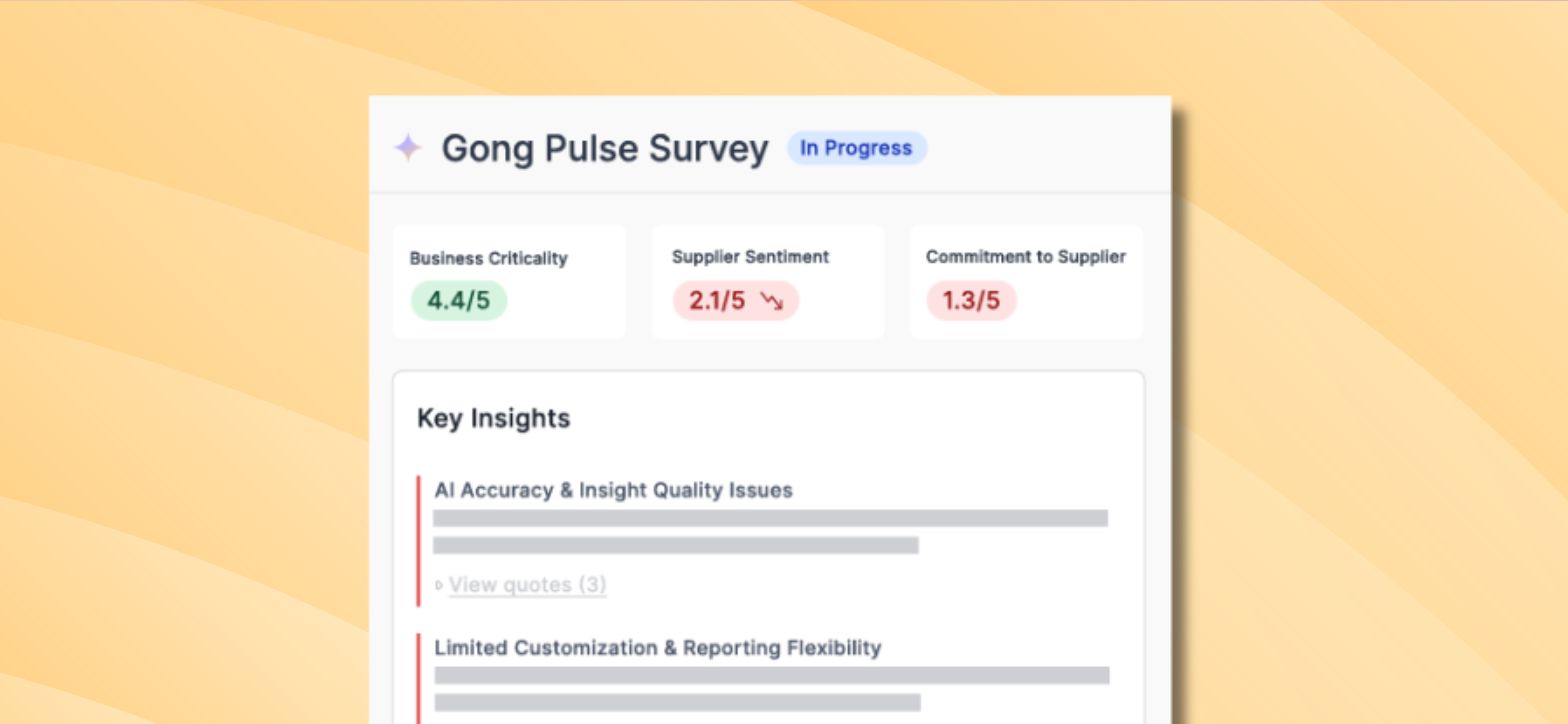
Pulse Surveys automates the entire feedback loop — from collection to insights — so your team walks into every renewal conversation with real data instead of educated guesses.
- Surveys run themselves: Configure automation once and surveys trigger automatically before every renewal, defaulting to 30 days before the reminder date. No manual sends, no forgetting, no "I'll do it next week" that spirals into the week of the renewal. Zero ongoing lift from the moment you set it up.
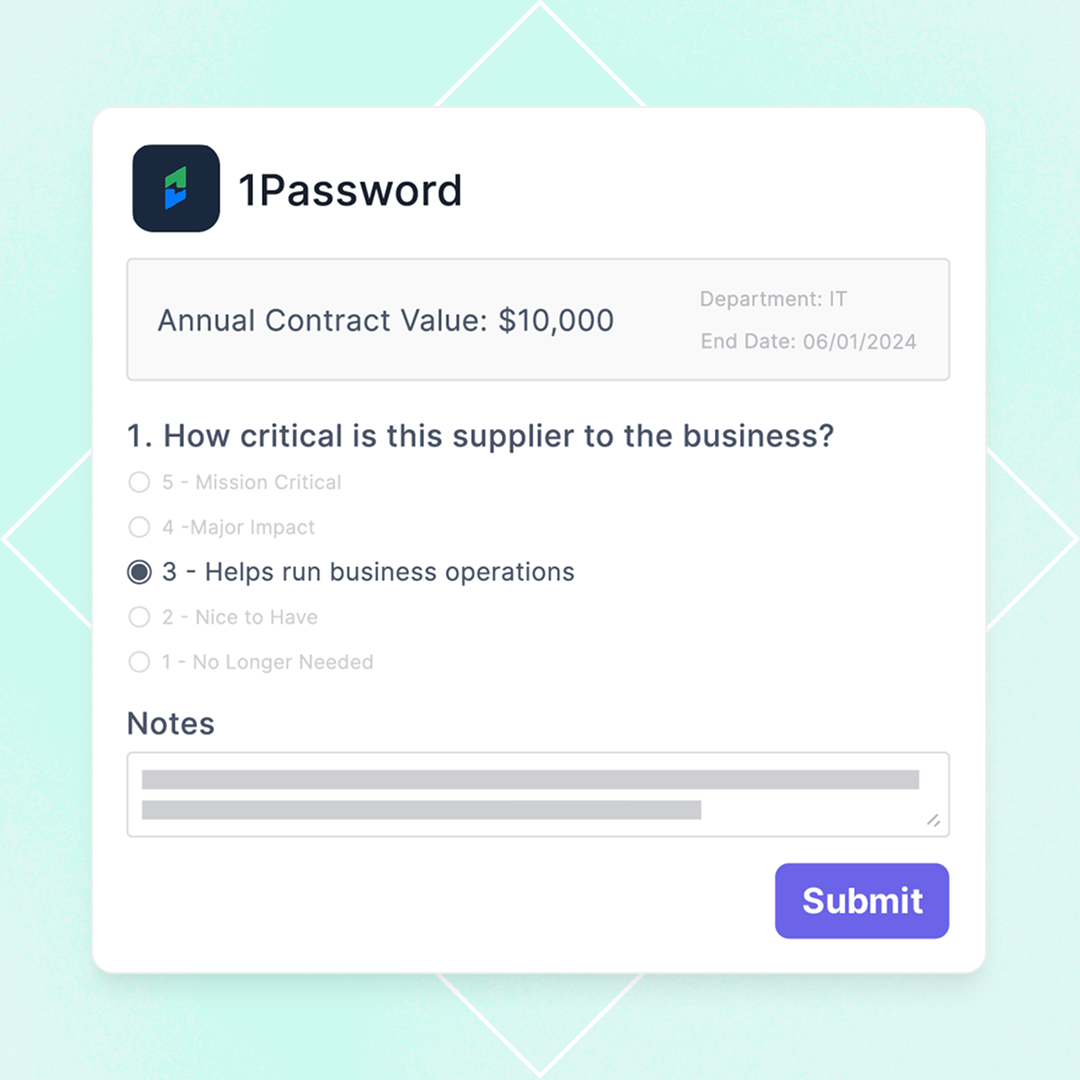
- Reaches everyone who matters: Surveys go to anyone with a stake in the decision — internal teams, external contractors, consultants, even vendors — via SSO auto-population (Okta and Google both supported) or a shareable public link. If someone has relevant feedback, they can give it.
- Custom questions, so you get the answers you actually need: Pulse Surveys includes procurement-specific baseline questions on criticality, usage, business impact, and sentiment. You can also add up to three custom questions per survey — so if you need to know whether the team is open to a competitor, or how they'd rate vendor support, you can ask it. The limit is intentional: it keeps completion rates high while ensuring data stays consistent and comparable across your portfolio.
- AI surfaces the signal from the noise: After responses come in, AI aggregates sentiment, usage, spend signals, and criticality scores and delivers specific renewal recommendations. Renew. Renegotiate. Replace. With negotiating talking points to back it up. You're not reading through 20 open-text responses trying to synthesize a strategy because that work is already done for you.
- Dead simple to set up: Everything lives in one place: Settings → Pulse Surveys. Configure questions, connect SSO, and set delivery preferences from a single screen.
What this looks like in practice
Imagine a procurement team managing 300+ contracts. They'd normally manually email stakeholders for every renewal: building lists, sending reminders, tracking responses in a spreadsheet. For a team of one or two, that's not a process. That's a second job.
With Pulse Surveys, they configure automation once. Surveys go out on schedule before every renewal. Responses come back from users, contractors, and external stakeholders alike. AI summarizes the findings and surfaces a recommendation. The procurement lead walks into the renewal conversation knowing usage is declining, sentiment is mixed, and there's negotiating leverage — all before they've typed a single message.
That's not incremental improvement. That's a completely different way of working.
The bottom line
The gap between "we should gather stakeholder feedback before renewals" and "we actually do it, consistently, for every contract" used to be an enormous manual lift. Pulse Surveys closes that gap entirely.
Available to all Tropic customers across every plan. If you're currently managing renewals with a mix of Slack messages, Google Forms, and good intentions — this is what replaces all of that.
Want to see it in action? Book a demo and we'll walk you through it.
Frequently Asked Questions
Can I send surveys to people outside our organization?
Yes — public links let external stakeholders (vendors, contractors, consultants) respond without needing a Tropic login. External respondents are tracked by email in your results.
Can I customize the survey questions?
You can add up to three custom questions per survey on top of the standard procurement-focused baseline. The limit keeps completion rates high and data consistent across your portfolio.
How does automated distribution work?
Once configured in Settings → Pulse Surveys, surveys trigger automatically before renewals based on your set reminder date (default: 30 days out). SSO integration with Okta or Google auto-populates recipient lists so you never have to build them manually.
What does the AI output after responses come in?
AI aggregates sentiment, usage, spend, and criticality data and surfaces a renewal recommendation — renew, renegotiate, or replace — along with supporting insights and negotiation talking points.
What if a contract doesn't have a renewal reminder date?
Automation requires a renewal reminder date to trigger. If one isn't set, surveys can still be sent

Related blogs
Drive savings and efficiency at any stage
Discover why hundreds of companies choose Tropic to gain visibility and control of their spend.