

Survey Methodology
158 U.S.-based executives and managers, both in finance and non-finance roles completed the full Tropic / CFO Dive survey fielded July 30, 2024 to August 12, 2024. The survey goal was to explore how spend management is supporting companies' priorities.
The research participants work for companies with 100 to 1000 employees in the following industries: retail/e-commerce, technology/software, professional services, financial services, or media/entertainment. All participants have titles of Directors and above, mainly in finance and procurement.
The role of the entire CFO office is changing. Striving for efficiency, finance and procurement teams are working together now more than ever as companies increasingly look to them as strategic partners and decision-makers that drive ROI. This demands a fresh approach to spend management. And for those investing in it—it's paying off.
Yet, procurement and finance leaders face a spate of challenges in identifying the best path forward as they struggle to balance effective growth with increased investments in AI and tech. They're navigating a complex landscape of economic uncertainty and heightened regulatory demands, as well as skills shortages and burnout across finance teams. Making matters worse is reliance on outdated systems, many of which still involve tedious manual processes and frustrating procurement experiences.
Outdated and legacy systems make it incredibly time consuming to near-impossible to manage organization-wide spend, which means finance and procurement leaders operate with limited visibility and waste time on manual tasks that could otherwise be spent on strategic planning. This ultimately ramps up the workload on already-stressed teams and increases the risk of burnout. It also makes it harder to attract the new digital skills these teams require to keep pace with the demands of today's modern workforce.
Each of these challenges has long-term consequences for companies. Lack of organization-wide insights mean CFOs miss opportunities to manage spend without sacrificing growth, while burnout or a frustrating employee experience can prompt top talent to leave the company, creating a "brain drain" that could take years to recover from.
“Finance executives are realizing that if you look into your investments more deeply and optimize where you're spending your money, you're driving growth as well as back-office efficiency.”
Against this backdrop, finance and procurement leaders are increasingly turning to technology to manage organization-wide spend and procurement processes, as well as improve efficiencies across the organization. Over a third of finance executives consider "more efficient deployment of operating expenses" (34%) among their top three 2024-2025 priorities, according to new research from Tropic and CFO Dive. It's crucial for them to invest in a modern spend management toolset, and incorporate the right data and controls into their procurement processes.
"Finance executives are realizing that if you look into your investments more deeply and optimize where you're spending your money, you're driving growth as well as back-office efficiency," says Russell Lester, CFO of Tropic. "Although these are cast as opposite ends of the spectrum, they are more symbiotic than that, because the very tools that make the back office more efficient help the entire organization be more efficient so everyone can spend more time on growth-oriented activities."
In this report, we highlight the key findings behind how modern spend management practices are driving efficiency today, and how to make the business case to get the resources you need to modernize your program.

Finding #1
Spend management investment gains momentum, but growth software continues to take center stage
By and large, finance and procurement leaders recognize the value of automation and orchestrated approaches to spend management, particularly as companies' technology and supplier investments continue to grow. Solutions that break down silos and support procurement orchestration are in particular demand because effective spend management blends efforts across multiple departments—from finance to IT and procurement to operations. As a result, finance and procurement teams are seeing some signs of relief, but that relief is not keeping up with the pace of demand.

Growth spend currently outpaces procurement and finance spend 3:1.

70% of finance executives report that the percentage of software spend that their companies are allocating to spend management is higher than it was last year.
“Achieving efficient growth goes beyond just managing your company’s travel and expense investments. It requires a comprehensive understanding of your supplier landscape—how many suppliers you have, who they are, the discrepancies between contract expectations and actual payments, identifying areas of duplicated spending, and ensuring all expenditures are aligned with the company’s strategic priorities,” said Michael Shields, Vice President & Head of Procurement Strategy at Tropic.
However, back offices see far less investment than the growth-oriented parts of an organization's technology stack. While that is to be expected, what's interesting is that finance and procurement teams still face opposition when advocating for new spend management tools—despite seeing greater efficiency when they're in use. The majority (60%) of finance leaders report allocating less than 10% of their software budget towards spend management software. While 77% of respondents reported spending up to 50% of their software budgets on growth investments—such as sales, marketing, product, and engineering tools. Additionally, Forrester recently published a study that found that 9 in 10 IT leaders expect software budgets to continue to grow in 2025 to enable scale and productivity—which will undoubtedly add to this already complex balance.
What is an intelligent spend management process?
An intelligent spend management process includes:
- Integrates data sources for a 360-degree view into suppliers, tracking spend against budgets and flagging overages with proactive alerts.
- Contracts are managed in an integrated solution with risk audits, real-time updates, and automated renewal processes.
- 90%+ of spend managed through AI-powered intake and approval workflows, reducing manual work across Finance, InfoSec, and Legal.
- Supplier portal and automated PO processes streamline accounting, ensuring efficiency and accuracy.
- Centralized, data-driven negotiation strategy maximizes impact on top spend categories.
- Consolidated spend with clear business cases and RFP requirements ensures strategic purchasing and tracked savings goals.
Finding #2
Investment in spend management is driving measurable efficiency and sustainable gains
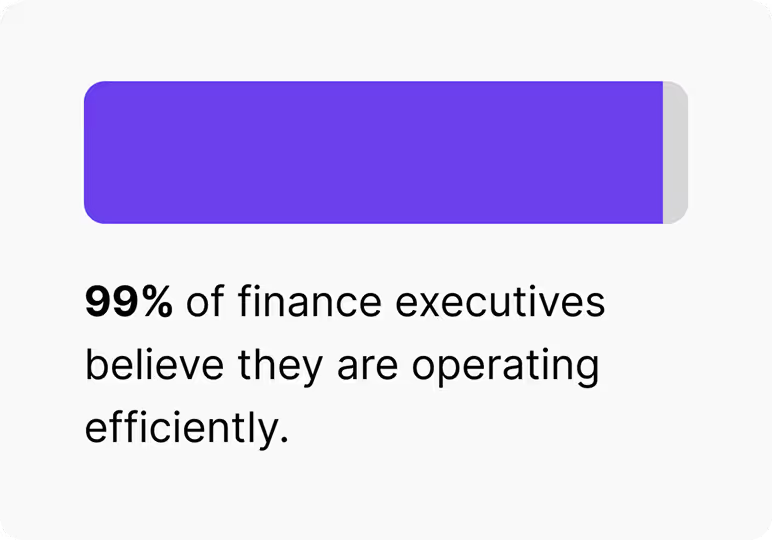
Across the board, finance leaders have made significant progress in boosting efficiencies. 99% of them believe they are operating efficiently and 71% of respondents report a healthy burn multiple of 2.0 or lower, indicating not only a belief in their effectiveness but also tangible metrics that back it up.
Efficiency is only part of the story. Survey respondents also report that their spend management process is showing dividends across other parts of the business. For instance, more than four out of five finance executives (84%) believe their spend management process has been extremely or very effective at helping accelerate digital business efforts. But, this is by no means the only area in which the spend management process has been effective.
More than seven out of ten finance executives believe that their spend management process has been extremely or very effective at helping:

Turning spend management into a powerful growth driver requires high-visibility tools that help finance leaders understand where their spend is allocated, who their suppliers are (and the value of their contracts with them), when their contracts renew, and what market intelligence has to tell them about what they should be paying.
The companies driving the most efficient growth are more likely to have invested in modernizing spend management with those high-visibility tools. This includes looking beyond traditional expense management and actively managing supplier contracts to stay ahead of renewals and reduce unnecessary spend, as well as using supplier data and insights to inform purchasing decisions.
Most companies reporting burn multiples of 1.4 or less—indicating efficient growth—are managing their supplier contracts using spend management software:
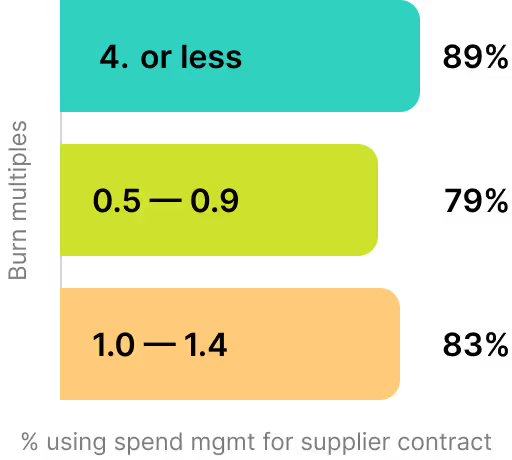
The more ways companies leverage spend management software, the more efficient they become. Finance leaders who use spend management for both supplier contracts and software management are 26% more likely to strongly believe that their company is operating efficiently, compared to those who only used spend management for one (or none) of those functions.
Finance leaders who strongly agree that their company is operating efficiently:
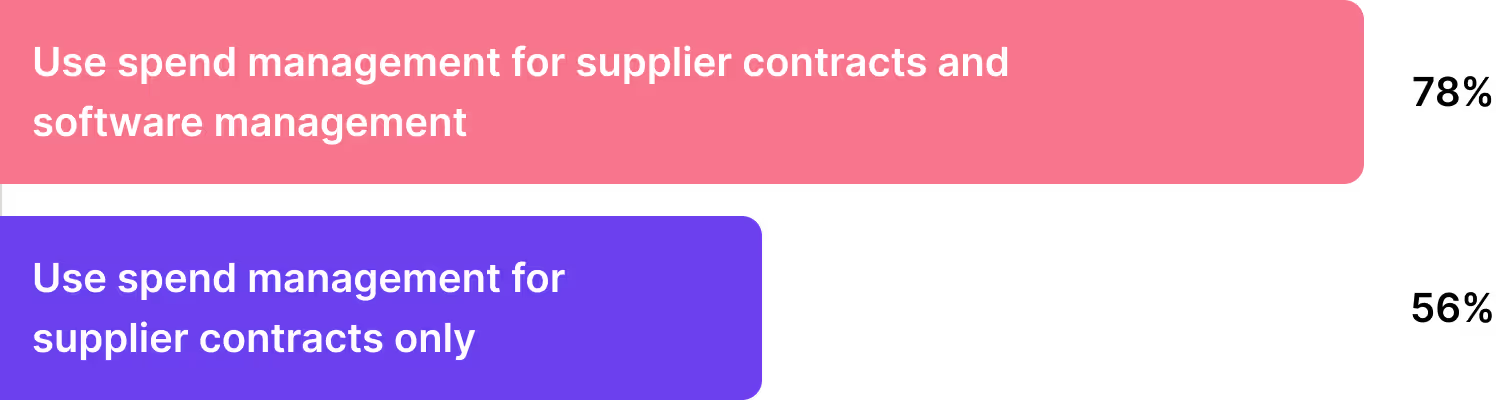
Those who use spend management for both supplier contracts and software management are more likely to strongly believe that their company is operating efficiently compared to those who do not have spend management software for both functions.
Just investing in spend management doesn't automatically equal success, it's what organizations are doing with the information that has made it so powerful. Almost all finance executives (99%) agree that their companies use data and insights to inform spend management decisions and drive negotiations. There is also essentially universal agreement (99%) that companies maintain visibility into all of their vendor/supplier contracts and spend through a contract management system and centrally enforced intake process. Last, but certainly not least, we know modern tools aren't effective if you're not actually using them. We found that more than four out of five finance executives (83%) have at least 75% of spend under management with an automated approval process that tracks new supplier and spend requests, illustrating it's about truly integrating spend management across an organization.
By embracing visibility, data insights, and comprehensive spend management, companies are proving that modern approaches are what truly power the efficiency they are seeing.
Finding #3
Despite efficiencies gained, internal resistance remains a key barrier to spend management modernization
While there are several reasons spend management takes a back seat to growth-oriented software investment—including a lack of resources within the organization—CFOs struggle to align investment in business spend management software with the organization's overall goals.
"Ultimately, companies want to approve spending that drives ROI, but without quality data, they can't make informed decisions quickly," says Shields. "Despite gains in efficiency, many finance leaders still face resistance when seeking additional support."
“Despite gains in efficiency, many finance leaders still face resistance when seeking additional support.”
More than two-thirds of finance leaders (68%) say that inadequate investment in spend management is driven by a lack of prioritization at the business level, while others struggle to demonstrate ROI and communicate how spend management contributes to growth.
Top 5 barriers to investment:
1. Lack of resources
70%
2. Lack of prioritization at the business level
68%
3. Inability to connect the dots in how spend management feeds growth
68%
4. Lack of belief in impact potential
66%
5. Hyperfocus on growth
63%
Identifying the hidden ROI
How finance and procurement leaders can make the business case for modernization
Finance leaders have an opportunity to champion modernization by raising awareness and educating stakeholders about the importance of spend management in fueling growth. Here are three strategies that finance leaders can leverage to demonstrate ROI and gain stakeholder alignment.
1. Highlight the hidden costs of outdated processes
Unfortunately, legacy systems are "business as usual" for many organizations, which means stakeholders may not be aware of the true costs of outdated processes. Finance leaders should seek to quantify these costs, when possible, to demonstrate the ROI on modernization.
Consider highlighting the labor costs associated with inefficient legacy systems, for example, noting how much time you—and your team—spend on tasks that could be streamlined with automation. Given tech spend is only expected to increase with the continued focus on AI, the demands on already under-resourced finance and procurement teams to manage that spend efficiently will certainly increase.

9 in 10 finance leaders spend at least 10% of their time on tasks spend management.

Approximately 1 in 5 (20%) spend at least half their time on spend management tasks.
"To make the biggest impact, finance leaders should tie these costs to broader organizational challenges—like how labor expenses reduce the company's cash runway," suggests Shields. "The objective is to align spend management modernization with the company's overall financial performance, so stakeholders view it as a strategic investment, not just another cost."
Without scalable tools in place to help back office teams automate and process intake requests, evaluate supplier contracts and pricing, and easily identify whether the new supplier is duplicative or even aligned with key corporate initiatives, it will be impossible to ensure these investments are driving the desired performance or simply burning cash.
Other cost drivers to consider:
- Paying too much for suppliers
- Missed supplier discounts due to late payments
- Payment errors (e.g. duplicate payments)
- Costs associated with employee burnout (e.g. recruitment costs, paid leave)
- Opportunity cost or loss of time for strategic planning
- Compliance and audit risks
- Shadow spending
- Higher administrative costs and labor costs associated with manual or inefficient processing
2. Focus on the employee experience
Amid a rising skills shortage, companies are looking for strategies to safeguard their top talent. Finance leaders can make the case for modernization by focusing on how outdated processes impact the employee experience.
"Outdated spend management processes affect more than just the finance department—they ripple across the entire organization," says Shields. "When you can show stakeholders how modernization will directly benefit their teams, you're much more likely to gain their support for the investment."

42% of finance executives identify improving employee satisfaction/engagement/retention as one of their organization's top goals.
As a baseline, finance leaders should survey their teams to learn how outdated processes negatively impact their performance and engagement at work. But consider looking across the organization, too—for example, at how an outdated finance tech stack impacts IT teams.
This process will not only yield happier employees but is critical to ensuring employee adoption of a system. If employees aren't using it, it's nearly impossible to gain complete control over your spending.
“When you can show stakeholders how modernization will directly benefit their teams, you’re much more likely to gain their support for the investment.”
3. Look ahead to sustainable growth
Ultimately, the business case for modernization isn't just about what's happening in the company today, it's also about how outdated processes will hinder the company tomorrow. Explain how modernization fits into the organization's short- and long-term goals, highlighting how outdated processes may undermine the company's progress—or prevent it from reaching these goals entirely.
"Inefficient processes can quickly overwhelm finance and procurement teams as the company grows," says Lester. "Without investing in modern solutions, you'll likely have to expand headcount to keep up. Given the current dynamic labor market, there's a real risk of overpaying for talent or settling, just to meet critical milestones."
Focus, too, on how a modern spend management platform can help finance leaders identify opportunities to negotiate favorable terms with suppliers and take advantage of early payments and bulk discounts, freeing up cash that can move the business forward.
"Closely examining how you're spending money can become something that is rewarded, celebrated, and interesting to people because they see that the better you do at it, the more you can invest back into the business," says Lester. "Broadening the aperture of what spend management is, and what the fruits and benefits of it are, can help finance executives connect the dots about how it's not just about time savings, but also about driving growth."
“Broadening the aperture of what spend management is, and what the fruits and benefits of it are, can help finance executives connect the dots about how it's not just about time savings, but also about driving growth.”
Key takeaways
Why invest in a modern spend management solution?
- 1
Greater insights into organization-wide spend to inform decision-making
83% of finance leaders agree that their companies have at least 75% of spend under management with an automated approval process that tracks new suppliers and spend requests.
- 2
More leverage in supplier negotiations with insights and intelligence
99% of finance leaders agree that their companies use data and insights to inform spend management decisions and drive negotiations.
- 3
Greater transparency and consistency across the procurement process
99% of finance leaders agree that their companies maintain visibility into all of their vendor/supplier contracts and spend through a contract management system and centrally enforced intake process.
- 4
The end result: More efficient growth with lower burn multiples
Almost two out of three finance executives (65%) report that their companies' burn multiples typically fall between 0.5 and 1.9.
The bottom line
Investment in technology and a company's reliance on suppliers to power those investments are only going to continue to grow. Simply put, sustainable growth and scalability demand modernizing spend management for finance and procurement teams. And organizations that have invested in a platform that streamlines their intake-to-procure efforts—with contract management, supplier intelligence and more—are already reaping the rewards.
"Now, more than ever, companies are looking for efficiency, visibility, and the empowerment of data and insights to make better decisions," says Lester. "Software that allows finance executives to better understand how a company is spending money and producing returns can be one of the most strategic investments a CFO can make."
By revealing the hidden costs of outdated processes, and showcasing how a spend management platform aligns with the company's goals, finance and procurement leaders can make a compelling business case for modernization—and play a pivotal role in helping the company achieve its goals.
“Now, more than ever, companies are looking for efficiency, visibility, and the empowerment of data and insights to make better decisions.”