Introduction
The line between SaaS and AI is blurring, and that's making software buying more complicated than ever.
Twelve months ago, the question was whether AI tools were worth the investment. Today, the question is which AI tools, from which vendors, at what cost. Legacy SaaS providers are racing to bolt on AI features, while AI-native companies are scaling fast enough to show up on everyone's renewal calendar. This is all creating a software market in transition, where the rules of procurement (and budgeting and pricing) are being rewritten in real-time.
For this report, we've analyzed patterns from over $18B in spend under management to understand how AI is reshaping software budgets and in other ways, how it’s not changing everything as much as we may think.
- We've broken down some of our analysis by use of AI —AI-Native, Hybrid SaaS + AI, and Primarily SaaS—to see where dollars are actually flowing.
- We've also grouped companies into two cohorts: SMB/Growth (1-250 employees) and Mid-Market/Enterprise (251+ employees) to surface clearer patterns.
What we found:
- AI spend is growing exponentially, but the long tail hasn't fundamentally shifted yet.
- Your top 10 suppliers still dominate your budget.
- Vendors are getting more aggressive about AI pricing.
- What continues to remain a truth we will always stand by, the companies that are winning at procurement aren't just negotiating harder, they're negotiating earlier with the right insights by their side.
Now, a few predictions for 2026 that we’re seeing stem from the analysis
(We'll check back in December to see what we got right)
We're only going to see more consolidation among suppliers, especially Primarily SaaS vendors acquiring young, AI-Native competitors or complimentary services to accelerate their product roadmap. 2025 ended with many of these — Grammarly and Superhuman, Salesforce and Qualified, and most recently, Snowflake and Observe.
1AI-native tools are already moving from experimentation to core infrastructure. By year's end, engineering and GTM teams will see their stacks completely transformed as these tools become essential rather than experimental line-items.
2Credit-based and consumption pricing will become the default for new AI tools, making benchmarking and forecasting significantly harder.
3Expect vendor pushback on short-term contracts as AI-native suppliers mature and seek predictable revenue.
4
Average Spend
by Company Size + AI Category
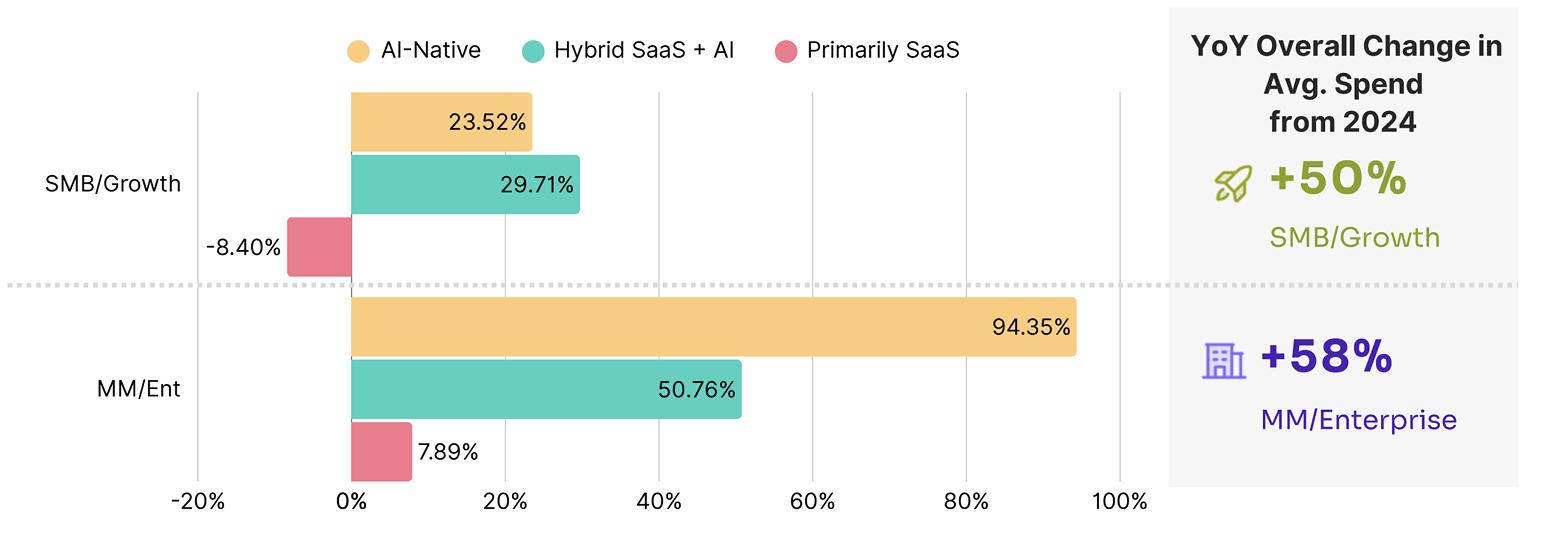
YOY Change In Average Spend by AI Category

Marketing Insights
The line between SaaS and AI is blurring, and that's making software buying more complicated than ever.
- For Mid-Market/Enterprise: AI-Native spend grew 94% YoY, nearly double the growth rate of Hybrid tools (51%) and dramatically outpacing Primarily SaaS (8%). Companies are placing serious bets on purpose-built AI solutions, not just AI features tacked onto existing platforms. But, with company lock-in at the enterprise level, SaaS companies are still growing slowly.
- For SMB/Growth: The pattern is similar but more measured, AI-Native up 24%, Hybrid up 30%, and Primarily SaaS actually declining 8%. Smaller companies are being more selective, letting go of traditional tools that aren't delivering enough value to justify their place in the stack.
- The takeaway: AI isn't a line item anymore, it's becoming the line item. And traditional SaaS that hasn't meaningfully integrated AI is starting to lose wallet share.

Negotiation Insights
- Calculate your AI layer mix. If more than 30% of your spend is still in "Primarily SaaS" tools, you may be over-indexed on legacy solutions, or you may have negotiation leverage as vendors try to keep you from switching.
- Use the declining growth in traditional SaaS as a signal: vendors in this category are feeling pressure. Come to renewals with competitive alternatives and be prepared to consolidate.
- For AI-Native tools, expect less pricing flexibility, growth is strong and these vendors know it. Focus negotiations on terms like price caps, usage guardrails, contract length rather than discount percentage.
The AI Tax: What You Need to Know
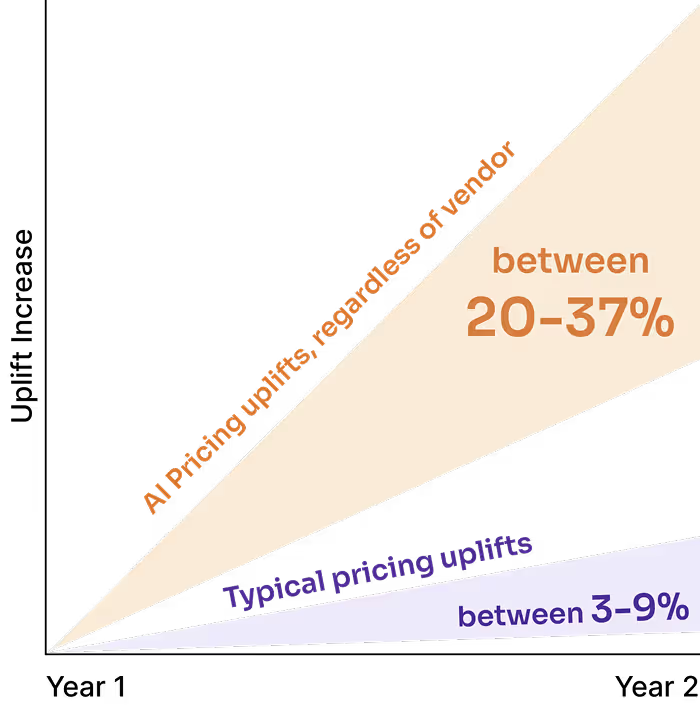
Over the past 12–18 months, a new cost structure has emerged in enterprise software: the AI Tax. Based on real-world renewal data across Tropic customers, we're seeing AI-driven price increases of 20–37%, far exceeding the typical 3– 9% annual uplift. Beyond straight price increases, vendors are also fundamentally changing how they charge for AI via credit and outcome based pricing, making costs harder to predict and benchmark.

Key Takeaways
- Fewer than one-third of companies can tie AI investments to measurable P&L impact. The core challenge: efficiency gains are often captured by employees (better work-life balance) rather than converted into redeployable business capacity.
- Negotiation works. Negotiation reduces these asks by roughly 55% on average. Across deals with flexibility, final uplifts averaged ~12%—down from initial asks of 20–37%. Start renewal conversations 6+ months early, request legacy pricing explicitly, and demand ROI evidence before accepting premiums.
4 Tactics Vendors Are Using to Apply the AI Tax

Forced SKU Migration — Vendors consolidate existing tiers into new AI-inclusive packages, eliminating the option to renew at previous pricing

Unbundling-Then-Rebundling — Vendors break apart all-in-one products into multiple SKUs, then position AI features as premium add-ons required to restore previous functionality.

Credit-Based Obfuscation — Vendors move from predictable per-seat pricing to consumption-based "credit" models that obscure true costs and make benchmarking nearly impossible.

Conditional Discount — Vendors offer discounts on base products only if you agree to purchase AI add-ons, reframing AI adoption as a savings opportunity rather than an additional cost.
Most Commonly Used Tools
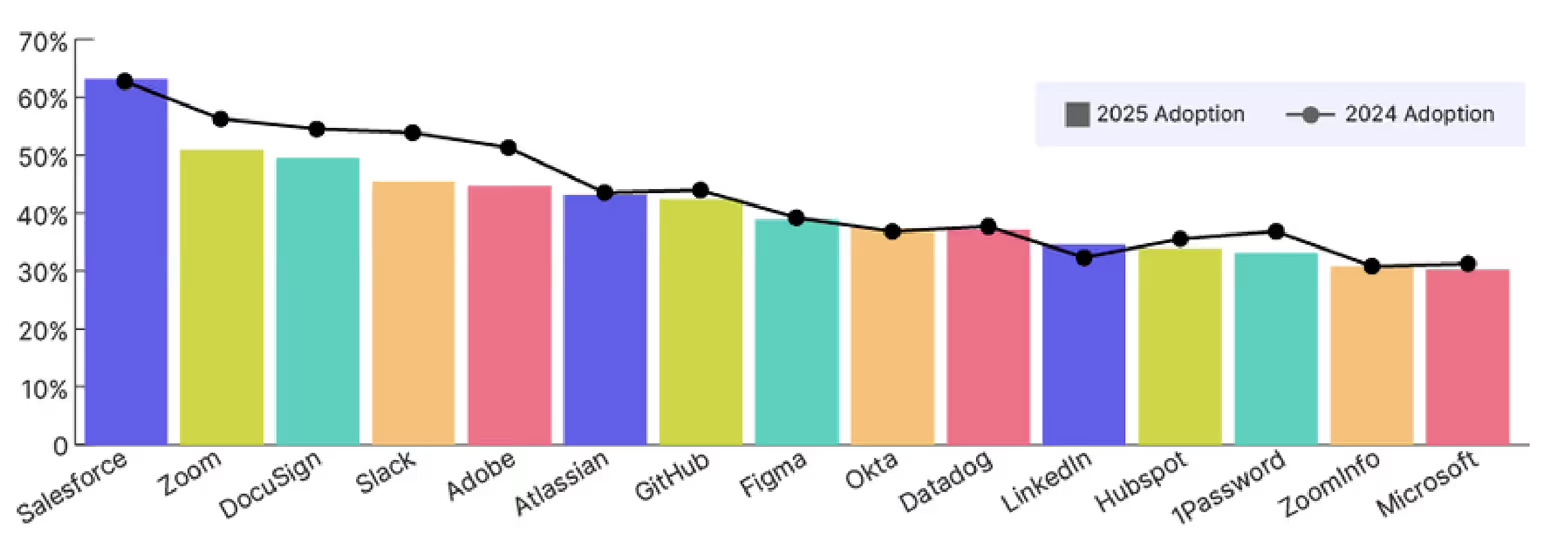
The top of the adoption chart looks familiar—Salesforce, Zoom, DocuSign—but the year-over-year trends tell a more interesting story. Several legacy leaders are showing flat or declining adoption among Tropic customers, while engineering and infrastructure tools continue to gain ground. The slight declines, especially on collaboration platforms, are a clear sign that consolidation efforts are maturing. Tools that enable engineering velocity, design innovation, or infrastructure scale continue to thrive.
Top 15 Suppliers by Adoption Rate
Supplier & Market Insights
- Consolidation is continuing, especially among collaboration tools. We're seeing some decreases in Slack and Zoom in favor of bundled alternatives like Google Workspace and Microsoft Teams. But, don't count these point-solutions out completely.
- Tools that support engineering, product, and infrastructure (Atlassian and Figma) are seeing rapid adoption as organizations prioritize scalability, intuitive UX, and integration.
- Buyers are becoming more selective and ROI driven, security and operations platforms like Okta.
Negotiation Insights
- High adoption ≠ irreplaceable. Tools like Zoom and Slack face real competitive pressure from bundled alternatives, use this as leverage.
- Watch for tools showing declining adoption in your peer set, this is a signal that switching costs may be lower than vendors claim. Ask your vendor directly: "What's your retention rate for companies our size?"
- When exploring consolidation, tie conversations to real business outcomes like reduced overlap, license optimization, or increased adoption.
Pricing Variability for Top Suppliers
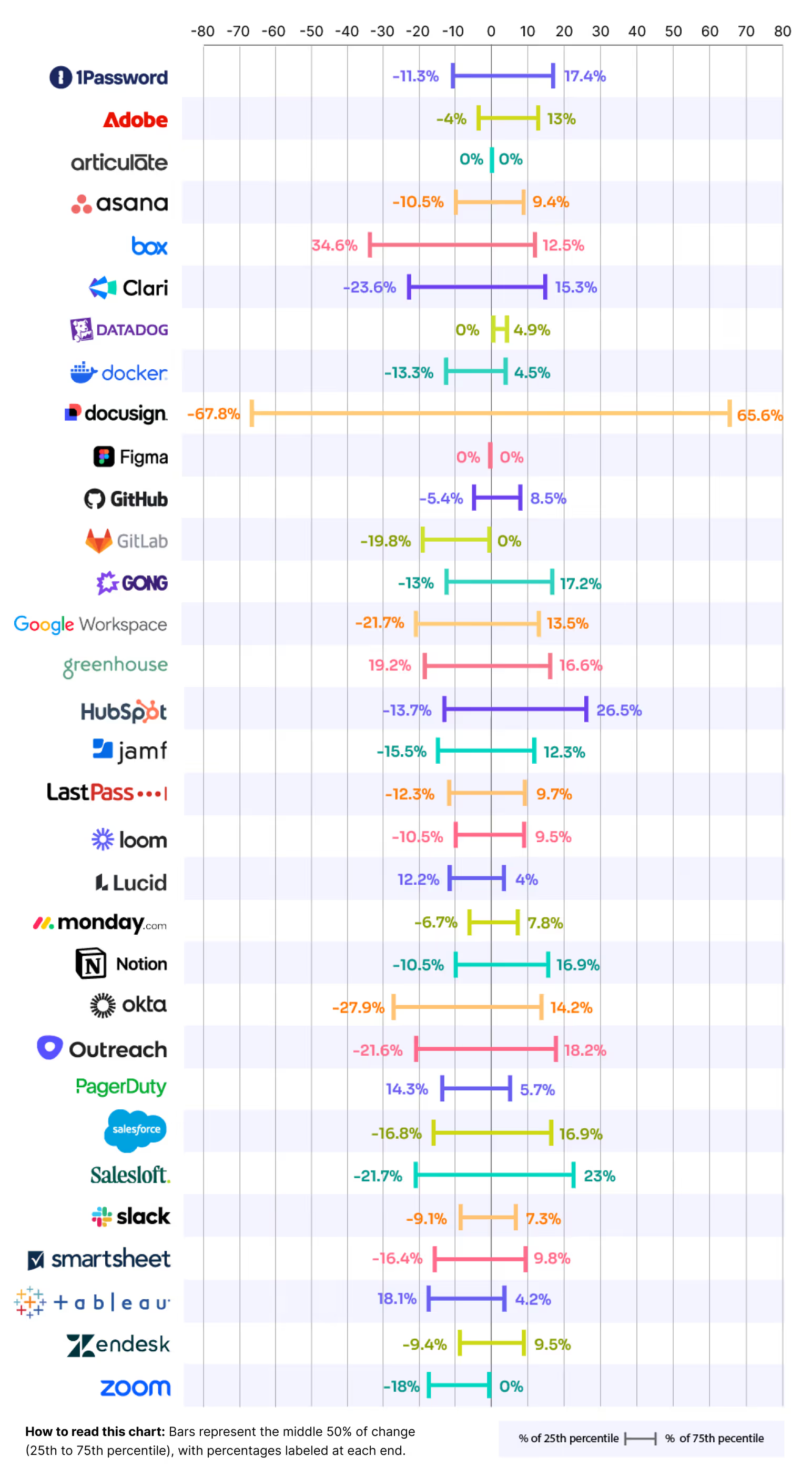
Pricing variability tells you where negotiation effort actually matters. The spread between what companies pay for the same tool can be dramatic, or almost nonexistent.The chart below helps understand this volatility. Bars represent the middle 50% of change (25th to 75th percentile), with percentages labeled at each end.
What drives variability? Generally, it's a combination of competitive pressure in the category, sales team discretion, contract term length, and how aggressively the vendor is pursuing market share. High-variability vendors are often ones facing meaningful competition or undergoing pricing model transitions.
Understanding price variability can help exponentially when you're negotiating and helps you prioritize negotiation effort on high-variability suppliers. For low-variability suppliers like Figma and Articulate, don't burn cycles trying to move price. Focus instead on terms: payment timing, auto-renewal clauses, and user addition rates.
Use variability data to set realistic internal expectations. Telling stakeholders "we should get 30% off Datadog" sets everyone up for disappointment.
Top 15 Suppliers by Adoption Rate
Fastest Growing Suppliers by Contract Count
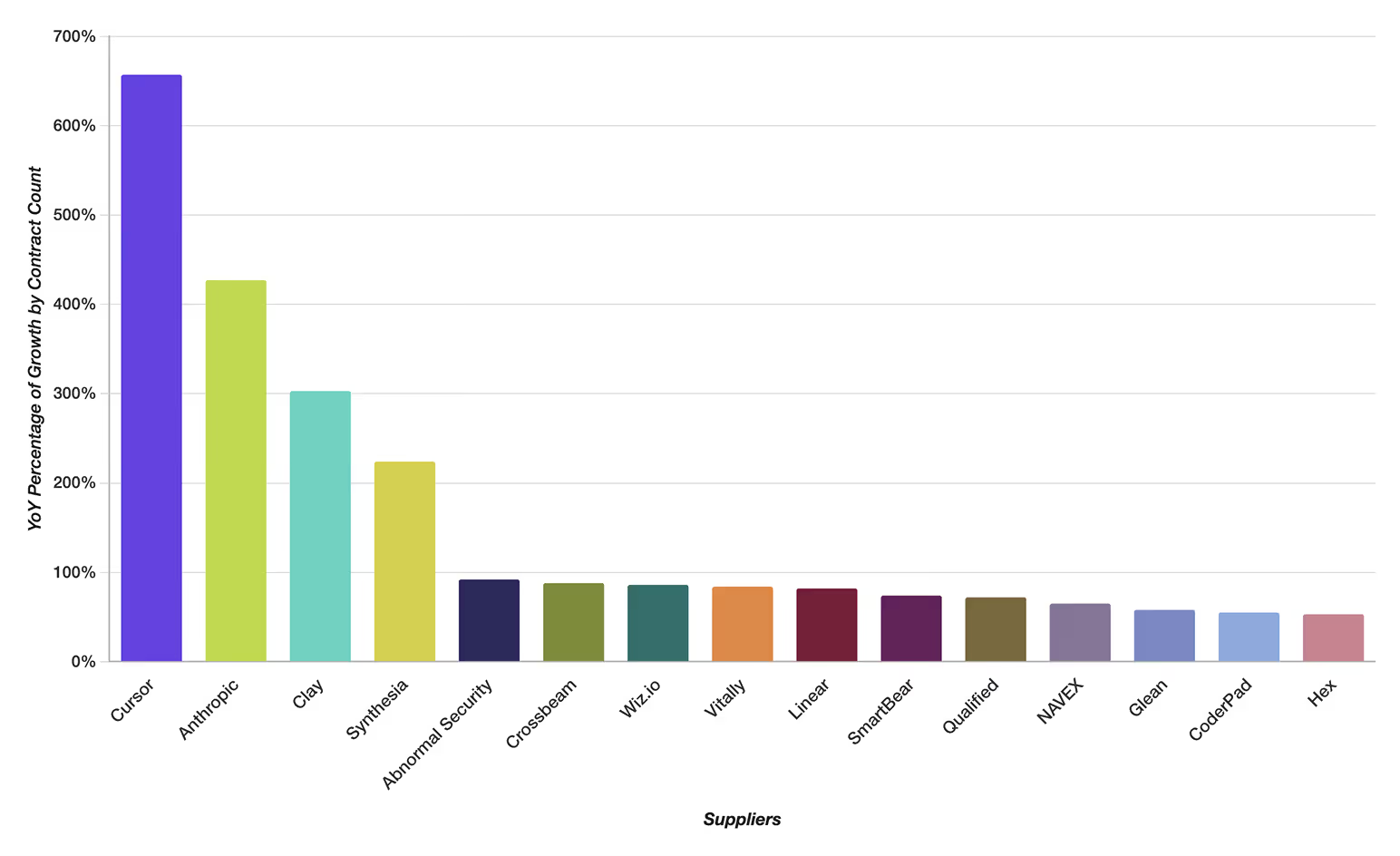
The top of this list reads like an AI startup portfolio: Cursor, Anthropic, Clay, Synthesia. Notably, OpenAI has dropped off the fastest-growing list, not because adoption is declining, but because their explosive growth phase has leveled into mature, steady expansion. First-mover advantage eventually normalizes.
Beyond AI, we're seeing growth in security (Abnormal Security, Wiz.io) and developer productivity (Linear, SmartBear, CoderPad).The enterprise vs. growth split is tells us:
- SMB/Growth companies are adopting developer-focused AI tools (Sonar, Cursor, Anthropic) and GTM automation (Clay, Orum)
- Mid-Market/Enterprise is prioritizing security (Zscaler, Wiz.io, CrowdStrike, Qualys) alongside AI infrastructure

SMB/Growth
- Sonar
- Anthropic/Claude
- Clay
- Cursor
- CoderPad
- OpenAI/ChatGPT
- Orum
- MUI
- Wiz.io
- SmartBear Software
- ThoughtSpot
- Ramp
- Hex
- Jellyfish
- Virtru

MM/Enterprise
- Cursor
- Anthropic
- Clay
- Zscaler
- Crossbeam
- Ramp
- Qualified
- Fortra
- Wiz.io
- PortSwigger
- Qualys
- NAVEX
- Progress
- Cognism
- Vanta
Negotiation Insights
- Fast-growing vendors have less incentive to discount. For Cursor, Anthropic, and Clay, focus on locking in current pricing with strong uplift protection rather than chasing discounts you won't get.
- Security tools (Wiz.io, Abnormal) are growing through enterprise land-and-expand. If you're an early adopter, negotiate for enterprise pricing now before you scale into their target sweet spot.
- For "second wave" AI tools (Synthesia, Glean), there may be more room to negotiate as they're still building market share and case studies matter to them.


5 Ways to Use AI in Your Renewal Workflow
Modern AI (especially ChatGPT-style tools) can streamline numerous procurement and finance tasks, especially renewals. Below are five high-impact use cases, each with a real-world example and a sample prompt to illustrate how AI can be applied in practice:
1. Spend & Usage Analysis for Optimization

What it is: Using AI to analyze spend data, software usage metrics, and expenses to identify waste and savings opportunities. This helps finance and procurement teams pinpoint underutilized licenses, duplicate tools, or anomalous charges that inflate costs.

Real example: A finance team exported their expense data and had ChatGPT audit it against company policy. The AI flagged multiple out-of-policy transactions (e.g. personal purchases and unusually high charges) that manual reviews had missed. Similarly, AI-driven spend analysis can reveal "idle seats and misaligned tiers" in SaaS subscriptions that are easy to overlook when data isn't connected to actual usage. These insights let teams cancel or downgrade licenses and rein in "shadow IT" spending.

Sample Prompt: "Here is a list of all our software subscriptions with user counts and last login dates. As a spend analyst, identify which tools have low utilization or redundant functionality. Highlight any licenses we can safely downgrade or apps that overlap in functionality, and estimate potential annual savings from optimizing these."
2. Contract Review & Risk Assessment
What it is: Applying AI to review vendor contracts, especially SaaS agreements, to extract key terms and flag risks. AI can summarize renewal dates, termination clauses, price escalation terms, and compliance issues hidden in contracts. This use case ensures no critical detail is overlooked before renewals.
Real example: Procurement leads often face "hidden risks" in the fine print. AI can automatically scan contracts and alert teams to troublesome terms. For instance, an AI might flag an auto-renewal clause or a 10% annual price hike that could kick in if notice isn't given. Procurement specialists and finance leaders alike can have AI summarize a software agreement's renewal and liability clauses; the AI provides a bulleted summary of obligations and highlights red-flag terms that warranted negotiation. This saves legal review time and helps non-legal teams understand contract implications.
Sample Prompt: "You are a procurement contracts expert. Summarize the renewal and termination provisions in the following contract excerpt, and list any terms that could pose risk to us (e.g. auto-renewals, high penalty for cancellation, unilateral price increases). Recommend if we need to negotiate changes to these clauses."
3. Supplier Research & Market Intelligence
What it is: Using generative AI to gather and summarize information about vendors, products, and market benchmarks. This helps teams quickly perform due diligence on new suppliers or alternatives, and stay informed about market rates and vendor news.
Real example: Before approaching a renewal or new purchase, procurement can ask AI to do a background check on the supplier. For example, "Find key info about Vendor X – company size, key products, recent news, any financial or security red flags." The AI can comb through public data and return a concise briefing. This not only saves research time but also helps avoid decisions that lead to buyer's remorse. (Notably, 60% of software buyers experience purchase regret, often due to unmet expectations – thorough research mitigates this.) Armed with AI-curated intel (e.g. a vendor's recent pricing changes or an announced merger), a small team can negotiate with the same insight as a larger enterprise.
Sample Prompt: "Act as a market research analyst. I'm considering [Vendor A] for a CRM tool. Provide a brief on [Vendor A] including their product offerings, target customer size, notable clients or case studies, and any recent developments (like funding, acquisitions, or major partnerships). Also, list the top 3 competing solutions in the market with one line on how they differ."

The Information Advantage
What used to take procurement teams 4-6 hours of manual research per supplier now happens in minutes—with better results than any human could compile alone. The teams winning renewals aren't just negotiating harder, they're negotiating smarter.
5 Steps to AI-Powered Purchase & Renewal Decisions
Step 1: Establish Your AI Foundation by Auditing & Preparing Your Data
Before diving into prompts, set up your data and processes properly.
Key actions:
- Audit your current contract and spend data (AI needs clean inputs for quality outputs)
- Identify your highest-impact renewal decisions (start where you'll see the biggest wins)
- Gather the relevant data for one or two target contracts (usage statistics, the contract document/PDF, last year's pricing, and any requirements or vendor communications)
- Document your current decision-making process (so you can measure improvement)
- Choose your AI tools (ChatGPT, Claude, or specialized procurement and finance AI platforms)
Ensuring this information is organized will make it easier to feed into an AI. For example: compile a vendor's last proposal and your internal usage metrics for that service.
Step 5: Scale Your AI Impact
Before diving into prompts, set up your data and processes properly.
Key actions:
- Audit your current contract and spend data (AI needs clean inputs for quality outputs)
- Identify your highest-impact renewal decisions (start where you'll see the biggest wins)
- Choose your AI tools (ChatGPT, Claude, or specialized procurement and finance AI platforms)
- Gather the relevant data for one or two target contracts (usage statistics, the contract document/PDF, last year's pricing, and any requirements or vendor communications)
- Document your current decision-making process (so you can measure improvement)
Ensuring this information is organized will make it easier to feed into an AI. For example: compile a vendor's last proposal and your internal usage metrics for that service.

3 Ways to Measure AI ROI in Procurement
1. Hard ROI: Direct Financial Impact
Time Savings
- Baseline:Audit your current contract and spend data (AI needs clean inputs for quality outputs)
- Target: 40-60% reduction in manual processing time
- Calculation: (Hours saved × hourly rate) × frequency = Annual savings
- Example: Save 8 hours per renewal × $75/hour × 50 renewals = $30,000 annually
Cost Avoidance & Savings
- Baseline: Document current contract terms and pricing
- Target: Identify 10-20% more negotiation opportunities
- Calculation: Additional savings discovered through AI analysis
- Example: AI identifies $200K in overlooked renewal savings = 1000% ROI on AI investment
Process Efficiency
- Baseline: Current procurement cycle times (days from need to signature)
- Target: 25-30% faster procurement cycles
- Calculation: (Cycle time reduction × transaction volume) × opportunity cost
- Example: 5-day faster approvals × 200 transactions = 1000 days saved annually
Making AI Work: Implementation Best Practices
Start Small, Think Big
Don't try to AI-transform everything at once. Pick 2-3 high-impact, low-risk use cases to build credibility and learn what works for your team.
Combine AI with Domain Expertise
AI makes you smarter, not replaceable. Always validate AI insights against your procurement knowledge and business context.
Measure Everything
Track both soft benefits (time savings, decision quality) and hard ROI (cost savings, efficiency gains). Leadership needs both to support continued investment.
Build AI Habits Gradually
Make AI part of your daily workflow by starting with one prompt per day, then expanding as it becomes natural.
Stay Compliant and Ethical
Never share sensitive pricing data, confidential negotiation strategies, or information that violates NDAs with AI tools. When in doubt, keep it generic.
AI Prompt Library: Copy, Paste, Customize
These prompts are designed to work with ChatGPT, Claude, or other LLMs. Simply replace bracketed sections with your specific context.
Supplier Research & Due Diligence
Quick Supplier Intel
I need to research [SUPPLIER NAME] before our upcoming renewal meeting. As an experienced procurement specialist, provide:
- Company overview (size, locations, key offerings)
- Recent news and developments (last 6 months)
- Financial health indicators
- Potential risks or red flags I should know about
- Their competitive position in [INDUSTRY/CATEGORY]
Format as a brief executive summary I can reference during negotiations.