
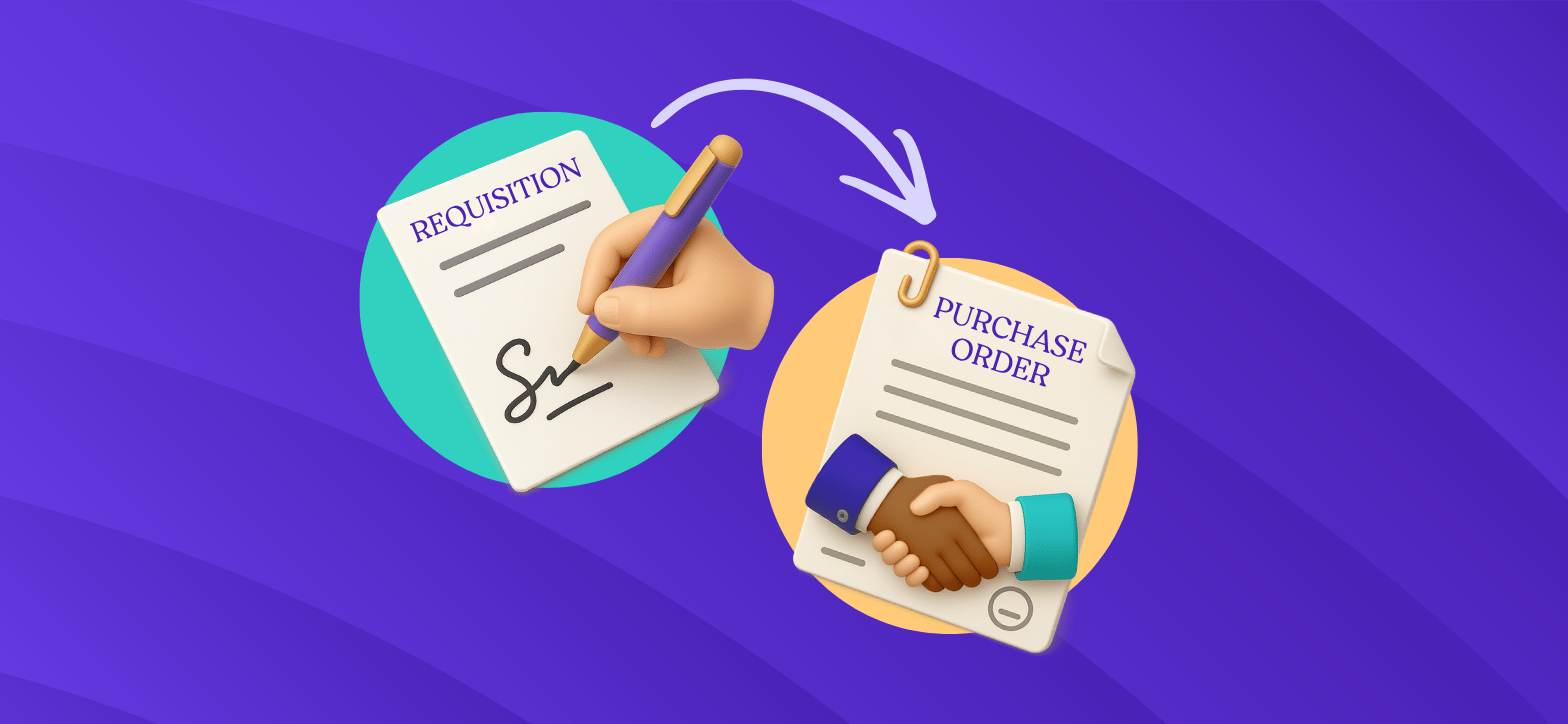
Keeping spend controlled depends on knowing exactly where a purchase moves from an internal request to a commercial commitment. When teams treat purchase requisitions and purchase orders (POs) as distinct processes, they can more easily route approvals correctly, maintain financial visibility, and make sure supplier commitments follow the right checks.
A clear requisition-to-PO process gives procurement and finance a reliable way to approve spend before commitment, preserve an audit trail, and keep the final order tied to the original business need.
This guide breaks down a purchase requisition vs purchase order, including the key differences between them and how the handoff works from request through approval to the final PO.
What Is a Purchase Requisition vs a Purchase Order?
A purchase requisition (PR) is an internal document used to request permission to buy goods or services. An employee or department typically submits it before placing an order with a supplier.
A purchase order is the buyer's formal order to a supplier after the purchase has cleared the required approvals. It records the products or services being purchased along with the agreed commercial terms.
The easiest way to separate the two is by the decision each supports:
- A requisition asks, “Should we make this purchase?”
- A purchase order records, “Here is what we approved and agreed to buy.”
The requisition stays inside the company. Budget owners, finance, procurement, IT, or other stakeholders may review it depending on the purchase. The PO goes to the supplier and becomes part of the commercial record between buyer and seller.
Both sit within the larger buying process, although they serve different functions. The distinction follows the broader difference between procurement and purchasing: procurement covers the decisions and controls around a purchase, while purchasing handles the transaction itself.
That difference also explains why an approved budget alone is not enough. A company can afford a purchase and still accept poor pricing or unfavorable terms. Strong buying controls create room to evaluate both before the PO commits the business.
Purchase Requisition vs Purchase Order: Key Differences
The biggest purchase requisition vs purchase order differences come down to purpose, timing, audience, and commercial commitment.
Purpose and audience
A requisition exists to support an internal decision. The requester explains what they need, why they need it, and what the purchase is expected to cost.
The PO communicates the outcome of that decision to the supplier. It gives the vendor the details needed to fulfill the order and invoice the buyer correctly.
Timing and approval
The purchase requisition process comes first.
Once the requisition reaches the appropriate approvers, they can confirm budget availability, policy requirements, supplier status, and any additional reviews. A rejected request stops or changes the purchase before an order is issued.
The purchase order process begins after those approvals are complete.
Pricing and commercial terms
A requisition may include estimated pricing from a quote, previous purchase, budget, or requester estimate.
The PO should contain the final commercial terms the buyer has accepted, including the approved quantity, pricing, and payment conditions.
This distinction matters when negotiation happens between request and purchase. The amount originally requested may differ from the final commitment.
Information each document contains
A purchase requisition commonly includes:
- Requester and department
- Product or service description
- Quantity
- Estimated cost
- Suggested supplier
- Budget or account code
- Required date
- Business justification
A purchase order carries relevant approved information forward and commonly adds:
- PO number
- Final price and total commitment
- Payment terms
- Billing and delivery information
- Supplier details
- Agreed terms and conditions
The documents overlap because they describe the same purchase. The PO reflects the commercial decision after the internal review is complete.
How the Requisition-to-Purchase-Order Handoff Works
A typical handoff follows this sequence: Need identified → requisition submitted → approval → PO created → supplier receives order.
The exact workflow varies by company and system, but these steps fit within the broader procurement process.
Step 1: Submit the purchase requisition
The requester starts by documenting what the business needs.
A useful requisition gives approvers enough information to make a decision without chasing the requester for missing context. That usually includes the expected cost, supplier, budget details, requested timing, and business reason for the purchase.
Complete intake keeps approvals moving and budgets accurate, while a clear scope gives procurement the context it needs before entering the supplier conversation.
Step 2: Review and approve the request
Next, the requisition goes to the people responsible for approving the purchase. The workflow may check:
- Whether the budget is available
- Whether the purchase follows company policy
- Whether an existing supplier or contract already meets the need
- Whether sourcing or negotiation is required
Technology purchases may also require security, legal, privacy, or IT review.
The approval stage should confirm both budget fit and commercial fit. For material purchases, the buyer also needs to understand whether the supplier, scope, price, and contract structure make commercial sense.
Budget approval confirms that the purchase is affordable. However, commercial validation is what determines whether the quote is competitive.
Step 3: Convert the approved requisition into a PO
Once the request is approved and the commercial details are settled, an authorized buyer can create the purchase order.
This is where preliminary information becomes a formal commitment. Estimated quantities become approved quantities. Quoted prices may become negotiated prices. Payment terms and other commercial conditions are added to the final order.
That makes the requisition-to-PO handoff an important control point.
Before issuing a material PO, buyers should have enough context to understand what they are agreeing to. For technology spend, that can include comparing the supplier's proposal to current market pricing and your own historical price before committing.
Conversion methods vary by company and system, and PR and PO numbers may differ. The important part is preserving the connection between the approved request and the final commitment.
Step 4: Issue the PO and preserve the transaction record
The buyer sends the PO to the supplier.
From there, the PO becomes a reference point for fulfillment, invoicing, and payment. When applicable, AP can later compare the PO with receipt and invoice information before releasing payment.
Keeping the requisition, approval record, and PO connected gives finance a clearer record of how the purchase moved from request to commitment.
Why the Requisition-to-PO Handoff Matters
The handoff gives finance and procurement a control point before money leaves the business.
Control spend before commitment
The requisition creates time to review the need before the supplier receives an order.
For larger purchases, that review should also test the commercial decision. The business may have approved $100,000 for a product, but procurement still needs to determine whether $100,000 is a reasonable price for the scope and terms.
That is the difference between spend control and spend intelligence. Approval controls who can buy and how the purchase proceeds. Better market and supplier context helps the buyer make a stronger decision inside that process.
Maintain one audit trail
A connected process gives teams a record of who requested the purchase, who approved it, what was ordered, and what was ultimately invoiced. Finance can use that record to reconcile committed spend and trace the reasoning behind each transaction.
Reduce off-policy purchases and invoice problems
A connected procure-to-pay process keeps purchases inside the approved workflow and ensures AP has the documentation it needs when invoices arrive. Each purchase remains traceable through payment, with the full decision history available to finance.
How SaaS and AI Purchases Change the PR-to-PO Process
Traditional requisition and PO controls work well for the initial purchase. SaaS and AI contracts keep changing after that first commitment.
A subscription may renew automatically. Seat counts can rise or fall. AI consumption may run above or below the original commitment. Vendors can introduce new packages, unit rates, or AI features before the next renewal.
The buying process therefore needs to keep track of:
- Renewal and opt-out dates
- Seats, credits, or consumption levels
- Duplicate and overlapping tools
- Pricing and packaging changes
- Purchases that bypass the approved process
Shadow IT creates an obvious gap because the purchase may never enter the requisition workflow in the first place.
The same commercial discipline should continue after the PO is issued.
Before the initial purchase, buyers need context on what they should pay. Before renewal, they need to know what has changed across usage, scope, pricing, and the supplier's offer.
That context is most useful when it stays aligned with the buyer. Supplier incentives or marketplace relationships can influence recommendations, which makes independence an important part of evaluating pricing guidance.
Tropic gives modern software buyers that buyer-side context through a model with no supplier kickbacks or marketplace conflicts. Its pricing intelligence gives teams a stronger basis for evaluating an offer before commitment, while contract, usage, and renewal intelligence informs whether to renew, resize, consolidate, or renegotiate later.
The principle is straightforward: approval tells you whether you can buy. Commercial intelligence helps you decide what you should agree to.
Purchase Requisitions and Purchase Orders Work Best as One Control
A purchase requisition and purchase order solve different parts of the same buying problem.
The requisition determines whether the company should move forward. The PO records the commercial commitment after the purchase has been approved. Keeping the two connected gives finance and procurement a clearer path from request to spend.
For SaaS and AI, that context needs to continue through renewal. Pricing, contracts, usage, and supplier changes can all affect whether the original buying decision still makes sense.
Tropic brings that context together for software buyers, with pricing intelligence informed by more than $23B in spend data. That approach is one way AI can support procurement decisions, surfacing pricing and renewal context before the next commitment.
Request a demo to see how Tropic helps software buyers validate pricing before commitment and prepare earlier for renewal.
Purchase Requisition vs Purchase Order FAQs
Is a purchase requisition the same as a purchase request?
Many organizations use the terms interchangeably. Some use "purchase requisition" for the formal request entered into an approval workflow, while "purchase request" may refer more broadly to the initial request to buy.
Can a company use purchase orders without purchase requisitions?
Yes. A company's purchasing policy determines whether a formal requisition is required before issuing a PO. Some organizations use requisitions only above certain thresholds or for specific purchase categories.
What is the difference between a purchase order and an invoice?
The buyer sends a purchase order to place an approved order. The supplier sends an invoice to request payment for the goods or services provided.
What is a blanket purchase order?
A blanket purchase order covers repeat purchases from the same supplier over a defined period or spending limit. It can reduce the need to create a new PO for every individual transaction.
What is the difference between a purchase order and a sales order?
The buyer creates the purchase order to request goods or services. The supplier may create a sales order in its own system to confirm, process, and fulfill that order.

Related blogs






Drive savings and efficiency at any stage
Discover why hundreds of companies choose Tropic to gain visibility and control of their spend.