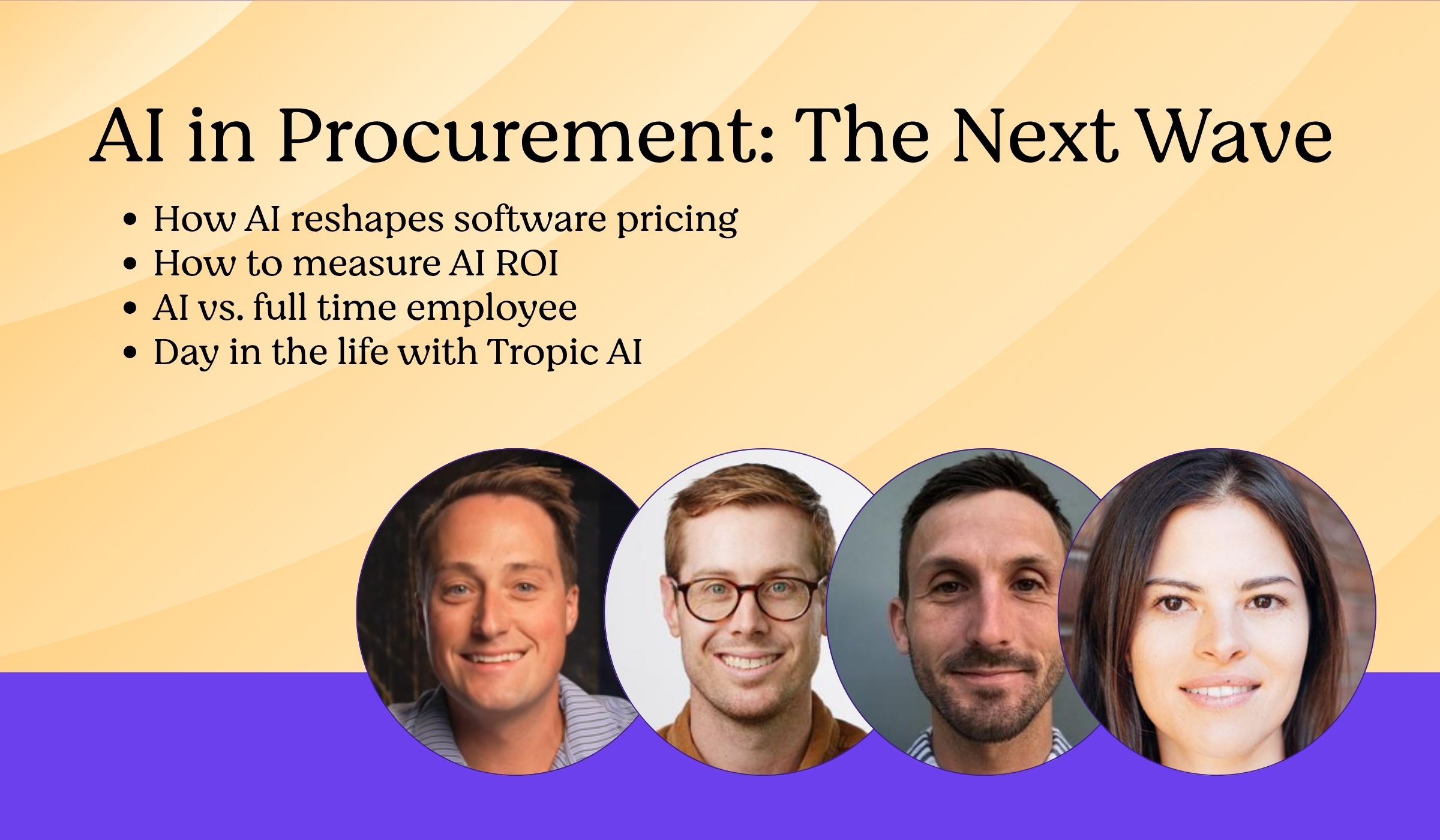
Alright, Russell. Glad to have you here today. I'm with, you know, Russ Russell Lester. He's the CFO of of Tropic. And, you know, Russell, I've had the opportunity to work with a lot of CFOs, over the years. In fact, I've reported them at a couple different companies now. And in my current role, I get to consult with finance leaders and other CFOs.
And budget season seems to be one of those painful times of year where it requires a lot of input, a lot of, work. It seems like all all hand on deck, and it almost feels like sometimes people are kind of not looking forward to it, if I can put it that way. Whereas, I'm just wondering, like, does is that the case or is that a perception or does it need to be that way? Talk to me a little bit about your thoughts around, you know, budget season, which I'm assuming you're kicking off right about now.
Tis the season. We are.
If you're on a fiscal year that is calendar based, this is the time. And if if you haven't kicked off, you soon will be. And you're right. People approach the process with a lot of consternation and stress. And I think it's a byproduct of if if you're not approaching planning and budgeting with an always planning mindset, then it is this seasonal heavy lift.
And for many people, they may feel like they put far more into it than they get out of it. And I think all of those things come from if you approach it with the wrong filter or lens because good planning that's done properly is beneficial to the company. It it acts as a form of alignment.
It brings together resourcing conversations that you may not have during the year. It allows you an opportunity to look under the hood of your business and ask questions of your business that you may or may not be asking. And so I think it's a fantastic opportunity for reflection, but it can also be a really heavy lift as you try to track down data that maybe you're not tracking regularly or align people in ways that maybe you're not aligning them around regularly. So it really runs the gamut depending upon how what your operating cadence looks like day to day. So there are companies where the planning process is not this huge heavy lift and companies where it is absolutely something that can bring the whole company to its knees.
Can I can I ask a question? Has the budgeting maybe the importance of budgeting changed over the past couple years? Recognizing it's always been important, but is and I'm not trying to ask a leading question. Is it more important in this market than it was three years ago?
Yeah. Well, I mean, three years ago, you have basically, you know, zero interest rate, happening.
And in in that environment, liquidity was was free and flowing, and people were throwing money at growth.
And it's not that the planning practitioners and the financial resources, we were still running the same cadence, but the scrutiny was different and the flexibility was different. The runways were longer.
The capital was flowing more freely, and so there wasn't the same level of rigor and scrutiny in in on the investment side of the p and l.
And so fast forward to And and I'm not a finance expert, but what I hear you saying and and to tell me if this is right or wrong, but Mhmm.
The importance of being accurate is probably higher today than it was before. Because if we weren't accurate from a budget perspective three years ago, but money was to your point free or zero interest rate, then not that big of a deal. Or am I am I oversimplifying there?
No. You're not. I mean, think about the consequence of missing, if if if cash and runway are paramount importance and there's any variance any variance, how does that variance get funded? I mean, if it's an upside variance, okay. But most of the time, you're worried about a downside variance of softer revenue or higher expense.
And so all that does is it it creates more pressure on the business to go and find how you're going to fund that variance. So accuracy is more important than ever.
Okay. And would you say you know, I'm a procurement guy as you know. So, that's all I've ever kinda done.
I love you anyway in spite of that.
K. Alright. We're gonna we're gonna move on from that. I I'm glad, so, great great comment there.
But do you find that the relationship between finance and procurement has changed from a budgeting perspective? Like, are you relying more heavily on your procurement, counterparts than you have historically?
I think the visibility of that reliance is becoming more clear and the specificity of the reliance is is clear. I do think finance and procurement have long had a very strong symbiotic relationship.
I think the formalization of that relationship and the the clear swim lanes and handoffs between them has matured over the past several years. And so I think what you see today is often cases where either procurement is reporting up through finance formally Yeah.
I see that. Or Yeah.
Or certainly partner heavily with finance. And because they're solving at the root, we're solving for the same things. We're we're trying to achieve the same outcomes.
Okay. So put grab your magic wand and if you, you know, could ask anything of your procurement team, say, you know, data, insights, etcetera. Like, what in an ideal world, what do you want from them to help you have a successful budget season?
Yeah. I mean, the budget inevitably begins with that extract of what where am I spending my money today? And and what what I would ask my procurement partner is where is the spend inefficient?
Where are their leakages? Where where is there what I call spoilage?
So overlap, leakage, spoilage can look like lots of different things, but it could be a combination of oh, and, it could be unexpected expenditures. So it's basically, I'm looking for visibility.
I'm looking for input on where do we think we're spending more than we should be, you know, to to which understanding price benchmarking would be important.
Where are we spending money where we don't believe the utilization is where we thought it would be or the original use case for why we invested has shifted.
You know, where are we spending money where there's overlapping of capabilities? And so it can look like lots of different things, but that's why I call it spoilage or leakage, which we're we're spending money and we're not getting a commensurate amount of return based on on that investment, and the procurement practitioner will have their hand on the pulse of that because they're they're looking at at those contracts every single day.
Yeah. So so you're looking for, hey. I wanna know if make sure I I'm getting a good deal that there's not inefficiencies from a benchmarking perspective. You wanna know if there's opportunities to consolidate, rationalize.
You wanna probably look at utilization data to make sure we don't have a bunch of shelf where out there.
What about what about trends? What about, you know, where pricing is is going? Like, how how do you what kind of information are you looking for to kind of forecast out, and and also how far are you looking to forecast out?
What a very timely question. There are articles out recently that per user, per seat pricing may be undergoing a transformation where companies that were locked into that model, but we're seeing restructuring and headcount reductions across the board, that would naturally mean that every company across SaaS is downsizing what they're spending. So what's happening?
Those vendors are smart. They're transforming their pricing model to transactional based models or hybrid models where they have both per seat per user and transactional based. And so we need the procurement team or capabilities to stay on top of those trends because if you're not modeling for that in the budget process and you just assume the pricing will stay per user or per seat, and you know you're going to reduce your headcount and you assume you're gonna save money, but meanwhile, the vendor comes in with a pricing change that you weren't on top of, guess what? Now you've got a budget variance that you've gotta go find, and no one wants that.
Yeah. And and by the way, as a procurement person, for a long time, I thought, gosh, that's an incredible burden because I'm covering a very broad swath of spend for, you know, maybe a small team, big company, broad suppliers, etcetera.
You can't do this alone as a procurement person. Like, you need a tool. You need that benchmarking. You need something to help you move from this idea of, be being a procurement generalist to a a procurement specialist.
And so a tool is gonna help supplement that information so that way I have that information that I can share with you. I I think that's really, really important key call out. Okay. So so now let's we we've given you that information.
Are you looking to do this on a supplier basis? Are you looking to, you know, forecast your costs? I've I've heard the term peanut butter spread. Talk talking to me, like, how granular are you getting?
Well, this is where it does it it does vary by company stage.
It varies by CFO style.
But if you're asking me what I like to do is I do like vendor level spend estimates. And let me explain why.
Yes. I could empower my budget owners with one lump sum amount that they could, as you say, peanut butter spread throughout the year, and they just manage to that amount.
And I don't feel like the alternative is that dichotomous or opposite, but it is different, which is if we dig into vendor level targets, then our variance analysis is a lot easier to do when you're operating in year and you're looking and saying, why why did our expenses come in different than we anticipated?
It also fast forwards the rigor that we're already going to get to anyway. Yeah. And so, inevitably, CFOs today are now more on top of because of data, we're more on top of utilization rates, the expense rates. And we'll we're familiar with these brands and these tool names when we're doing our budget versus actual in the in the current year. So we know the tools that are the leading drivers of that. So we're going to ask that anyway. So why not ask that in the budget process?
Why not get to that level of rigor and specificity when you're doing the budget?
The reason you don't is if you don't have the data or administering the data and handing out the targets is just too complicated to to manage to and therefore, then you go with a a peanut butter spread.
So it sounds like you're maybe reverting to a peanut butter spread model if you don't have sufficient data, if you don't have the right, data points. Is that correct?
I think that's a fair characterization.
Again, with the caveat being it's just some CFOs, their style or preference might be trust and empower the budget owners. Let them manage to it. All I need to know is that you're managing to the total. I just feel like if you do that as CFO, you're lacking the connectedness to the business of what we're spending and why we're spending it, and you're missing out on the opportunities to have a bit of the checks check and balance conversation. Because I think when finance and procurement are asking those tough questions at the vendor level, it creates a nice check and balance and a reminder that we're not just spending freely. We're not like we were three years ago where spend control didn't matter.
Well and and that's a good point. Spend control does matter. And having talked to a lot of finance leaders over the past year or so, I think the ones that are having the most success are the ones that can get the company bought in on this concept rather than viewing it as a procurement task or rather the viewing it as a responsibility of finances. So maybe do you have some ideas around how you can get the company bought into this idea of not only spend management, but also, you know, hey, we have this budget. We need to operate to this budget. So how do we, you know, do that successfully?
I do. I'm so glad you asked this question.
And the reason is that in my career, I've seen a lot of enthusiasm and momentum and celebration around what we would call the the top line of the p and l. Right? Top line being revenue.
Totally.
And so as you know, there are contests and and presidents club and rewards, and we celebrate in company meetings when we book new business and when we retain large customers.
And my experience has been, we do not typically reward, celebrate, or create visibility around the bottom of the P and L, the expense side where, we're driving efficiencies.
And the irony there is when where cash is so important and liquidity is so important, managing your expenses wisely drives the same or more scalable benefit as does driving revenue opportunities. So what if?
What if we were able to create an environment where we celebrated, rewarded, and made very visible those wins that we have on the expense side of the p and l? I think there's a huge opportunity to do that. It would be transformative, and it would begin to connect people. Because the problem is we tell people, spend like it's your own money. Have you ever heard that in the budget cycle?
For sure. Yeah. Hundred percent.
And what happens? People, they hear that, but it's like, but it's not my money. It's company money, out of sight, out of mind.
But if we created this culture of celebration, well, we know people are motivated towards recognition and visibility.
And suddenly, we can reward other parts of the business. And and it's not at the expense, we should still greatly celebrate all the wins on the sales and renewal side. But let's also celebrate reward and make visible those those wins that we're driving on the expense side.
Yeah. It's really interesting you say that because I've certainly been in this scenario where, you know, we we go find some savings. Right? Maybe we're able to reduce some licenses.
Maybe we're able to, you know, go without a tool. And then there's this expectation a lot of times where the stakeholders, like, hey. Great. Now I want to reinvest that money in a tool on their team.
And then but then finance comes to me. I said, hey. Good news, Russell. I I I I saved, you know, or we saved, you know, a hundred thousand dollars on this one tool.
Like, great. Where is it? Like, well, we we we spent it on another tool. And is that really savings?
What how does that resonate with you?
Yeah. So I have two other concepts. So the first one, I broadly call levers and leakages.
And when I talk about levers and leakages, I'm talking about the repeatable, scalable process of the company identifying ways to make the p and l engine run more efficiently.
Obviously, a lever is something that you can accelerate.
A leakage is something you want to stop, you know, which is draining your P and L. But as you drive that flywheel and you generate opportunity and benefit, there's a second concept I have called center of table. And it is, maybe not common and it is not always popular, but once leadership teams understand it, they're in favor of it. Center of table says, as a budget owner, when I identify and unlock a hundred thousand dollars of efficiency or expense savings, I don't just go and spend that on something else and then come back to finance and say, well, I met my budget, but I spent money on something I didn't even tell you I was gonna spend money on.
Rather, we put it to the center of table for the leadership team to talk through and say, we've now found some efficiencies. What is the best way we can use that money together as a team to hit our company goals and targets? And again, it's not about removing autonomy or empowerment from the budget owner. It could feel that way.
It could look that that way. It is about making sure the company is advancing against his priorities in the best way possible. Because very often if the case is solid, that leader will be able to reinvest some of that money. But it shouldn't just be a blank check automatic because if you do that, it it reverts back to what I would call lazy spending or back to the days where, liquidity was just freely flowing.
So so we wanna reinforce that rigor even when you unlock and find opportunities.
And it feels like the budgeting seasons are a really powerful tool to to, you know, accomplish this task because you can maybe set budgets a little bit lower than what's being requested with the concept of, hey, everyone go out and and we find ways to reduce budget, but then you can keep some in reserve to say, okay. Now that we've accomplished that, here now that there's extra budget that we can take request and and then prioritize them, not at the individual department level, but at the company level. Is that in line with this center of table methodology?
Yeah.
Top of funnel, we will have what we call need to find or gap closers or you know, there's always this concept where the quota is higher than the company revenue target. You create stretch. There's these different terms that are very familiar top of funnel and on the revenue side of the p and l. But the same is true on the expense side. There's no reason in your planning process that you couldn't look at your tech stack spend relative to benchmark and say, it's clear we've got room here to reduce. We don't know exactly where we're going to cut or what opportunities will come up, but we're going to goal ourself on, whatever, ten percent reduction in overall tech stack spend.
And then Just to be clear, if you have a good procurement, as you said at the very beginning, who can give you these insights on where they can cut, that can be a little more surgical.
Right?
Far far easier when when you have that because then you have a road map. You you you ideally even have your top ten vendors or contracts that you're going to look into first. Yeah. And some rationalization as to whether that ten percent is achievable.
Got it. Awesome.
I I I'm thinking back to other companies I've worked for. And, you know, as a leader, you know, a lot of times there'll be some sort of, like, company, you know, bonus structure. Right? And and I think back to where sometimes that bonus structure was based off of, like, you know, formulaic approach of, hey.
Revenues, did we hit a certain revenue target? Retention, did we hit our certain retention number? Maybe, you know, I don't know, expansion. But to your point, they were all they were all, you know, kinda top of, top of the top of the line kinda metrics.
It'd be interesting to maybe incorporate some sort of, hey. We also have a goal to find five million dollars as a company inefficiencies in savings, and then, you know, bake that into a part of your, you know, part of a, you know, leader bonus or does is have you seen that done effectively before or is that not a good idea?
Yeah. I mean, companies that are operating profitably do often goal on EBITDA. Okay.
And or or some measure of some derivative of profitability. So you see that.
And then you've got companies that are in high growth mode that are are close to breakeven or barely breakeven or aren't breakeven. And it becomes less relevant that they goal the company on that because what they the tension is always we don't want to distract people from driving growth.
And so there is this balance, but I think there is a way to to create formal goals that are that are held company wide and that everyone benefits from by unlocking those efficiencies.
And it could even be things.
Think about an environment where you set various hurdle rates of efficiency gains and maybe the grand prize that the whole company wins is a trip for the entire company to some tropical location. Wouldn't that be cool?
That would be cool.
Okay. I think people would they would work for that. Right? They would work together and and work to find opportunities to to hit that efficiency target.
And and it's funded by in part by the save or actually, the the savings, a part of that is then taken to fund this trip. Right?
So it's That's right.
Self funding.
You redeploy it. It's self funding in that way.
Yeah. Interesting.
Alright. Let's last topic before we close, AI.
How are you seeing AI impact, you know, the budget process?
I don't know if you if there's, you know, best practices or if you're starting to play around with it.
You know, maybe it's a way to gain more accurate data drive efficiencies. Any any thoughts about, you know, incorporating artificial intelligence, generative AI?
Everybody's thinking about AI. Everybody's trying to figure out the right way to use it.
CFOs are trying to balance the risk of using AI with the rewards.
We don't want spurious results.
We don't want, a misuse or an abuse of AI. But I say all that to say, AI is very positioned to help analyze and jest and automate a lot of mundane, you know, tasks that would could be repetitive, whether it's matching of information, whether it's finding overlaps that we spoke about earlier, whether it's rec creating recommendations based on previous patterns, you know, because AI can do the pattern analysis type of work very efficiently and effectively. And what does that do? It frees up those those resources in the business that are having to do that matching and overlap and efficiency gain work manually. It frees them up to do higher value work that they may find more interesting and more enjoyable anyway. And so I think AI is an accelerator to the budget process.
I think if you're not looking into it, you're you're already behind.
And I think that we just want to balance that we don't do AI for AI's sake and and, actually, that we don't call something AI that is not even AI. And and that's what you've gotta be wary of. A lot of people out there are claiming to be AI enabled, AI powered.
And I would argue they're doing they're doing little more than an index match or a v lookup that one would do or a sum if then embedded nested if statements in Excel, and they're calling that AI. And so we want it to we want it to truly be machine learning and and truly be AI. Huge opportunity.
And we're kind of in the in the steep curve of figuring out how to use that properly and well in the office of the CFO. But I think over the next year, you're gonna see lots of tools light up, lots of opportunity there, lots of momentum. And and we're we're definitely looking into it ourselves.
Yeah. I mean, it feels like in my experience working and supporting the budgeting process, it feels like a lot of times there's assumptions being made and I don't think that that'll ever completely change to where it's a complete science and you you can forecast a hundred percent but I would expect, you know, AI but also just even a lot of the acts better access to data and benchmarks and supplier trends and supplier intelligence, all of those things will make it so the assumptions are are fewer or at least more accurate.
Would you say that's fair?
Yeah. I mean, imagine a world where you supplement a a procurement practitioner's knowledge and expertise with an AI model that's being trained on these pricing structure changes and notices that there are vendors that follow a leading vendor's pricing adjustments.
And if it's able to detect that anomaly and the leading vendor adjusts their price and then they can flag that another price adjustment is likely to occur with these vendors, that's when you begin to get to the predictive side of AI that could be really compelling and and interesting.
K. Awesome. Well, Russ, thank you for taking, you know, some some time today. I I'll let you get back to budgeting season. I'm sure that's the top Thank you. Top of mind for you, but, really appreciate your thoughts there. And and good luck in the next few months as you budget for next year.
Thanks so much. Really enjoyed the conversation. Happy to chat about this type of stuff anytime.